
Death and the Civil War, Chapter 1
Clip: Season 28 Episode 9 | 11m 22sVideo has Closed Captions
How the US dealt with the huge number of dead in the Civil War.
How the young United States dealt with the unprecedented and overwhelming number of dead in the Civil War. The Ric Burns film is based on the book "This Republic of Suffering" by Harvard President Drew Gilpin Faust.
Problems playing video? | Closed Captioning Feedback
Problems playing video? | Closed Captioning Feedback
Corporate sponsorship for American Experience is provided by Liberty Mutual Insurance and Carlisle Companies. Major funding by the Alfred P. Sloan Foundation.
Support provided by:


Death and the Civil War, Chapter 1
Clip: Season 28 Episode 9 | 11m 22sVideo has Closed Captions
How the young United States dealt with the unprecedented and overwhelming number of dead in the Civil War. The Ric Burns film is based on the book "This Republic of Suffering" by Harvard President Drew Gilpin Faust.
Problems playing video? | Closed Captioning Feedback
Where to Watch American Experience
American Experience is available to stream on pbs.org and the PBS app.
Buy Now
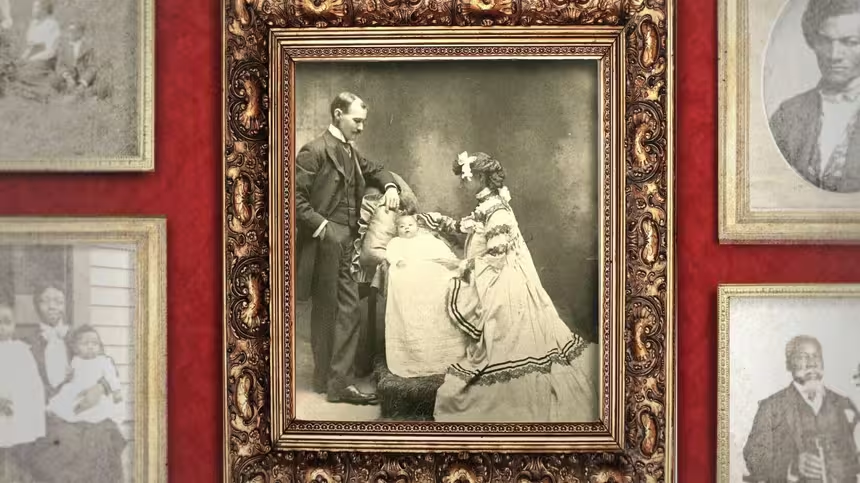
When is a photo an act of resistance?
For families that just decades earlier were torn apart by chattel slavery, being photographed together was proof of their resilience.Providing Support for PBS.org
Learn Moreabout PBS online sponsorshipOn the evening of May 10th, 1864, as the Civil War gro its fourth straight year -- 26-y Robert Montgomery, a private in Signal Corps in Virginia, wrote his father back home in Camden, -- dripping blood on the paper a from the horrific arm wound he h a few hours earlier.
Dear Father.
This is my last letter t been struck by a piece of shell shoulder is horribly mangled and is inevitable.
I am very weak bu to you because I know you would to read a word from your dying s death is near, that I will die f and friends of my early youth bu here too who are kind to me.
My will write you at my request and the particulars of my death.
My be marked so that you may visit desire to do so.
It is optionary whether you let my remains rest Mississippi.
I would like to res with my dear mother and brothers a matter of minor importance.
Gi to all my friends.
My strength f horse and my equipments will be Again, a long farewell to you.
M in heaven.
Your dying son, J. R. Again, a long farewell to you.
M in heaven.
Your dying son, J. R. James Montgomery's friend, Fairfax, did write soon thereaft some of his effects -- and assur that he had been conscious to th that he had died at peace with h his maker.
But it was little consolation.
T grave had been marked, the famil able to find it, and was thus ne realize their fond hope of bring dead son home.
The dead, the dead, the dead -- our dead - or North, ours all -- our young handsome and so joyous, taken fr son from the mother, the husband wife, the dear friend from the d everywhere among these countless see, and ages yet may see, on mo gravestones, singly or in masses or tens of thousands, the signif Unknown.
Walt Whitman, 1865 Nothing in the experience of the 31 million people living on the eve of the Civil War coul Americans for what was about to them over the next four years.
It was only in part the shocking secession itself -- as the long debate over freedom and slavery states rights -- burst into the Abraham Lincoln's election in No and tore the country in two.</p> Something else would challenge A the next four years -- something fundamental -- something differe task of saving or dividing a nat or maintaining slavery, or winni conflict.
With the coming of the Civil War modern war, the first mass war o age -- death would enter the exp the American people, and the bod of the American nation, as it ne -- on a scale and in a manner no imagined possible, and under cir for which the nation would prove unprepared.
History is full of brutal surprises that don't see coming.
Nobody predict Nobody predicted Gettysburg.
Wha War brought was this terrible mo of a set of old 18th and 19th Ce with modern warfare -- and the r is mass slaughter that is harder for anyone to explain even to th The unimaginable scale of the slaughter, the sheer numbers would be all but impossible to c Nearly two and a half percent of would die in the conflict -- an 750,000 people in all -- more th other American wars combined.
Ne and never since, have so many Am in any war, by any measure or re Transpose the percentage of dead that mid-19th-century Am into our own time -- seven milli we had the same percentage.
What as a nation today, be like if we loss of seven million individual it invaded just about everyone's one way or another.
The enormous tide of death unleashed by the war posed chall which there were no ready answer war began -- challenges so large overwhelmed the abilities of ind institutions to respond to them that called forth -- slowly at f and starts -- immense and eventu efforts -- by individuals, group government -- as Americans worke new solutions, new institutions, of coping with death on an unima Before the Civil War, there were cemeteries in America.
No provisions for identifying th for notifying next of kin, or fo aid to the suffering families of No federal relief organizations, ambulance corps, no adequate fed no federal provisions for buryin No Arlington Cemetery.
No Memori The United States embarked on a new relationship with death Civil War in a whole series of w nation, it embarked on a new rel with death because its survival and defined by the deaths of so thousands of people.
So it would become inseparable f in that sense.
In a second way, States would develop a new relat death in a national sense, becau pension system, the reburial sys of death -- that would transform of the federal government.
So it a different nation -- a stronger nation with more responsibilitie because of taking on these oblig would grow out of Civil War deat there are all the changes for in who were living in a world of mo loss in the North, and in the So ultimately twenty percent of the of military age were going to di everyone had lost a loved one.
And so lives were shattered, in ways, often because so many of t unknown.
And ideas about what de be changed by the intensity and nature of this experience.
Certainly, as we think about the obligation to the state, and what the state citizens -- particularly with re thing that we, in some sense, is thing we really own, which is ou and our own mortality.
The Civil us rethink that definition as a as a people.
What do governments bodies -- to the bodies that mak And that becomes a central quest war.... in the Civil War, I thin as a nation to the insistence th is predicated on the willingness to lay down their lives for the the absolute bottom line.
So I think the war casts not jus but a long sense of reality over -- and how we deal with, really, questions.
You know everybody di mortality is assured.
But the wa with that reality changes over t Civil War shows us that they did how they changed.
And to be aliv change is something that the Civ think, asks us to do.
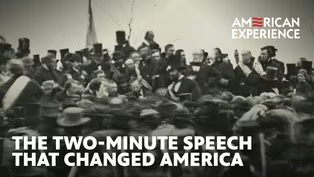
Video has Closed Captions
Clip: S28 Ep9 | 3m 18s | On November 19, 1863, President Abraham Lincoln gave The Gettysburg Address. (3m 18s)
Providing Support for PBS.org
Learn Moreabout PBS online sponsorship












Support for PBS provided by:
Corporate sponsorship for American Experience is provided by Liberty Mutual Insurance and Carlisle Companies. Major funding by the Alfred P. Sloan Foundation.