
April 21, 2026 - PBS News Hour full episode
4/21/2026 | 57m 46sVideo has Closed Captions
April 21, 2026 - PBS News Hour full episode
April 21, 2026 - PBS News Hour full episode
Problems playing video? | Closed Captioning Feedback
Problems playing video? | Closed Captioning Feedback
Major corporate funding for the PBS News Hour is provided by BDO, BNSF, Consumer Cellular, American Cruise Lines, and Raymond James. Funding for the PBS NewsHour Weekend is provided by...
April 21, 2026 - PBS News Hour full episode
4/21/2026 | 57m 46sVideo has Closed Captions
April 21, 2026 - PBS News Hour full episode
Problems playing video? | Closed Captioning Feedback
How to Watch PBS News Hour
PBS News Hour is available to stream on pbs.org and the free PBS App, available on iPhone, Apple TV, Android TV, Android smartphones, Amazon Fire TV, Amazon Fire Tablet, Roku, Samsung Smart TV, LG TV, and Vizio.
Providing Support for PBS.org
Learn Moreabout PBS online sponsorshipAMNA NAWAZ: Good evening.
I'm Amna Nawaz.
Geoff Bennett is away.
On the "NewsHour" tonight: President Trump extends the cease-fire with Iran and keeps the naval blockade in place, while the two sides remain far apart on terms for ending the war.
President Trump's pick to head the Federal Reserve faces a roadblock to Senate confirmation, a standoff over a multibillion-dollar building renovation.
And we examine the growing divide on reproductive rights between men and women, especially among younger generations.
LEAH, Auburn University Student: It's really easy to get caught up in seeing all these horrible things, the attack on access to contraceptives, abortion.
However, it's important that we stay empowered and we stay loud and we voice these issues.
(BREAK) AMNA NAWAZ: Welcome to the "News Hour."
President Trump said late today he would extend the cease-fire cease-fire with Iran as negotiations over a next round of talks seems to be at an impasse.
Mr.
Trump said Pakistani mediators asked him to extend the truce.
Vice President Vance was supposed to lead a delegation back to Islamabad to meet the Iranians and discuss ending the war that the U.S.
and Israel launched nearly two months ago.
Our White House correspondent, Liz Landers, begins our coverage.
LIZ LANDERS: In Pakistan's capital, the stage was set for a second round of peace talks, clear skies, but a cloud of uncertainty loomed.
Today, Vice President J.D.
Vance unexpectedly put his trip on hold and remained in Washington through the afternoon.
Pakistani officials said they had expected top negotiators from Iran too, though they never confirmed.
MAN (through translator): So far, no delegation from Iran has gone to Islamabad.
LIZ LANDERS: On Iranian state TV today, news anchors reiterated messaging that Iran won't show up to the table.
It's been just over a week since the previous round of talks in Islamabad ended without a deal.
These latest talks appear to have unraveled ahead of a fast-approaching deadline for the cease-fire to expire.
But, this afternoon, President Trump announced the U.S.
is giving Iran more time to come up with a - - quote -- "unified proposal," and until then will -- quote -- "extend the cease-fire until such time as their proposal is submitted."
The last-minute extension came at Pakistan's request.
On Monday, the man leading Tehran's delegation, Mohammad Bagher Ghalibaf, accused Trump of turning the negotiating table into a -- quote -- "table of surrender" and that Iran has -- quote -- "new cards on the battlefield" it's prepared to reveal.
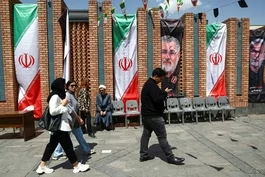
But on the ground in Iran's capital, people remain divided on whether Iran should negotiate an end to the war.
MIRZAEI, Tehran, Iran, Resident (through translator): The talks will bear fruit.
There may be some back-and-forth for a few days, but they will ultimately yield results.
LIZ LANDERS: While others are more skeptical.
ZEINAB EGHBALI, Tehran, Iran, Resident (through translator): Why should we negotiate when the other side is lying?
Why?
When Trump says that whatever he says must be done, why should we accept it?
LIZ LANDERS: And on the Indian Ocean today, the U.S.
military intercepted and boarded what the Pentagon says is another sanctioned oil tanker.
Now nearly 10 days into the U.S.
naval blockade of Iranian ports, it's the 28th such ship to be stabbed by the blockade and the first outside the Middle East.
In turn, Iran's foreign minister this afternoon called the U.S.
blockade -- quote -- "an act of war and a violation of the cease-fire."
That came after President Trump said Iran has -- quote - -"violated the cease-fire numerous times."
Meantime, in Israel, the country came to a standstill for two minutes marking its Memorial Day.
Prime Minister Benjamin Netanyahu lauded Israel's military campaign against Iran and its proxy groups.
BENJAMIN NETANYAHU, Israeli Prime Minister (through translator): Together with our great friend the United States, we crushed in advance the machine of destruction of the Iranian regime.
We pushed away from us an immediate existential threat.
LIZ LANDERS: But he also denounced an incident in Southern Lebanon where an Israeli soldier photographed another smashing a statue of Jesus with a sledgehammer.
The image went viral over the weekend, and, today, the IDF said both soldiers had been removed from combat duty and are being held in detention for 30 days.
All that as the IDF today claimed that Hezbollah had violated their cease-fire with Israel after firing upon soldiers in Southern Lebanon and launching a drone toward Israel.
Back in Islamabad, mediators awaited us and Iranian delegations that may never arrive, one more roadblock on the path to peace.
For the "PBS News Hour," I'm Liz Landers.
AMNA NAWAZ: And Liz joins us now with the latest.
So, Liz, the mediators in this situation, the Pakistanis, and the Iranians are reacting to the president's declaration of a cease-fire.
What are they saying this evening?
LIZ LANDERS: Within just the last few minutes, we heard from the prime minister of Pakistan.
He posted on X saying thank you to President Trump.
And he also said that he sincerely hopes that both sides will continue to observe this cease-fire.
He added too that Pakistan will continue earnest efforts towards these negotiations, so leaving that open for the future, Iran, though, far less optimistic.
An adviser to Iran's parliamentary speaker says that Trump's cease-fire extension doesn't mean anything, that the losing side cannot dictate terms, and that the cease-fire extension is certainly a ploy to buy time for a surprise strike, Amna.
AMNA NAWAZ: So, Liz, what does your reporting tell you that the sticking point to these talks is right now?
LIZ LANDERS: Well, we spoke with a source close to the administration just a few moments ago, who said that the real sticking point is this blockade right now in the Strait of Hormuz, and, in particular, the United States attacking and firing on that Iranian ship just a few days ago.
That ship was waiting in the Gulf of Oman to go into the strait.
The U.S.
military boarded that ship.
Allegedly, that boat had dual-use goods on board, so potentially chemicals to make Iranian missile production, which is why the U.S.
Navy intervened there.
Iran wants the issue of this blockade to be fixed before they meet with the Americans again.
But the source was telling us that the Trump administration has no desire to change anything about the blockade right now.
President Trump made that pretty clear in his TRUTH Social post that we saw earlier today.
A reality check here though, Amna.
President Trump said just last Friday that Iran had agreed to virtually all of his demands to end their nuclear program.
He thought that they were going to get a pretty quick deal was how he described it going into these weekend negotiations.
Iran immediately said that they didn't.
One diplomat that I spoke to this afternoon said that basically right now there is no trust between the Iranians and the Americans, so that also is a sticking point here.
AMNA NAWAZ: Our White House correspondent, Liz Landers, beginning our coverage tonight.
Liz, thank you.
LIZ LANDERS: Of course.
AMNA NAWAZ: In the day's other headlines: The Justice Department announced criminal charges today against the Southern Poverty Law Center over its past use of paid informants to infiltrate extremist groups.
Acting U.S.
Attorney General Todd Blanche told reporters late this afternoon that the charges include wire fraud, bank fraud and conspiracy to commit money laundering.
Earlier in the day, the head of the organization says that, while it no longer works with paid informants, their contributions had been invaluable.
BRYAN FAIR, CEO, Southern Poverty Law Center: When we began working with informants, we were living in the shadow of the height of the civil rights movement, which had seen bombings at churches, state-sponsored violence against demonstrators, and the murders of activists that went unanswered by the justice system.
There is no question that what we learned from informants saved lives.
AMNA NAWAZ: The Southern Poverty Law Center was founded in 1971 and has long been criticized Republicans, who say it unfairly targets conservative groups and individuals.
Last year, FBI Director Kash Patel said the agency was severing its ties with the center, which for years had provided law enforcement with research on domestic extremism.
In Virginia, voters are deciding on a redistricting plan that could help Democrats pick up as many as four U.S.
House seats in the midterm elections.
If approved, today's referendum would amend Virginia's Constitution to give Democrats the power to redraw the state's congressional districts.
Supporters say it's needed to offset Republican redistricting efforts in places like Texas, while opponents say they prefer the status quo.
TANGERINE GOST, Virginia Voter: Well, I just want it even, with Democrats -- the Democrats in Virginia.
I just want to be even, like Democrats and Republicans.
JO ANN LUCY, Virginia Voter: The boundaries were set a long time ago, I guess, I'm assuming, and I just didn't - - I just didn't like the idea of changing.
AMNA NAWAZ: Democrats hold six of Virginia's 11 congressional seats.
Even if voters approved today's measure, it could still face legal challenges before taking effect.
The Pentagon unveiled details today about its $1.5 trillion budget request for the coming fiscal year.
About $750 billion would go to what officials are calling presidential priorities, including a Golden Dome missile defense system, A.I.
infrastructure and drones.
Service members would also get a pay raise, with junior enlisted troops getting a 7 percent bump.
The Pentagon also hopes to grow its force by around 44,000 troops.
If approved by Congress, the budget would be the largest in U.S.
history when adjusted for inflation.
Also today, Defense Secretary Pete Hegseth announced that U.S.
military personnel will no longer be required to get their annual flu shot.
In a video posted to social media, Hegseth described the mandate as -- quote - - "overly broad and not rational."
Instead, the vaccine will be voluntary for all active-duty and reserve troops effective immediately.
The annual flu vaccine has been standard for service members since the 1950s.
Some public health experts warn that today's decision could weaken troop readiness.
Authorities in Mexico say the gunmen who opened fire at the famous Teotihuacan Pyramids acted alone and that he planned the attack beforehand.
Eyewitness video shows the 27-year-old Mexican national firing a weapon yesterday.
A Canadian woman was killed and at least 13 others were injured.
The suspect later died from a self-inflicted gunshot wound.
Authorities say he was carrying a tactical-style backpack with a cell phone, bus tickets and materials that appeared to reference the 1999 Columbine High School shooting.
Mexico's President Claudia Sheinbaum says security will be stepped up at such sites following the attack.
CLAUDIA SHEINBAUM, Mexican President (through translator): We had not witnessed anything like this in Mexico.
It is the first time this has happened.
Based on everything indicated by prosecutorial authorities, this person showed signs of psychological problems and was influenced by incidents that occurred abroad.
AMNA NAWAZ: Also today, multiple media outlets are reporting that the two Americans killed in a car accident in Mexico on Sunday were CIA officers.
They were reportedly returning from a counter-cartel operation in Northern Mexico.
President Sheinbaum said in a separate appearance yesterday that her administration had no prior knowledge of their activities and that Mexico would investigate whether any national security laws were broken.
And, on Wall Street today, stocks ended lower amid that uncertainty over the Iran cease-fire talks.
The Dow Jones industrial average slipped nearly 300 points.
The Nasdaq fell more than half-a-percent on the day.
The S&P 500 also ended the session in the red.
Still to come on the "News Hour": another member of Congress resigns for ethics reasons; a senior Hezbollah leader in his first interview on American television; and Apple enters a new phase, with Tim Cook stepping down as CEO.
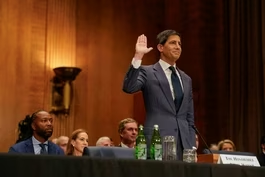
President Trump's pick to lead the Federal Reserve, Kevin Warsh, was on Capitol Hill today facing a slew of lawmakers questions on his monetary policy and independence from Trump, all that as the president's pressure campaign against current Fed Chair Jerome Powell threatens to freeze Warsh's nomination indefinitely.
SEN.
TIM SCOTT (R-SC): I will now swear in the nominee.
AMNA NAWAZ: At his confirmation hearing for the Fed's top job, Kevin Warsh promised to protect the Central Bank's independence while pledging what he called regime change.
KEVIN WARSH, Federal Reserve Chair Nominee: The sooner that we can reform the institution with my colleagues, if confirmed, the sooner we can ensure price stability, and we can have a new set of leaders atop the institution with high, credible ethical standards to return the Fed to what it should be.
AMNA NAWAZ: The former Fed governor criticized monetary policy errors he argued allowed inflation to soar.
KEVIN WARSH: We are still dealing with the legacy of the policy errors in 2021 and 2022.
Once you let inflation take hold in the economy, it's more expensive and harder to bring it down.
AMNA NAWAZ: But among his biggest challenges today, addressing senators' concerns he could withstand presidential pressure.
Democratic Senator Ruben Gallego: SEN.
RUBEN GALLEGO (D-AZ): Mr.
Warsh, I think you're incredibly qualified.
Well, a lot of us are actually worried about the integrity of the Federal Reserve.
We're worried about what this means for the economic markets and we're worried about what this means for inflation.
We're worried about your independence.
KEVIN WARSH: I take my responsibility to be an independent leader of the Federal Reserve very seriously, if confirmed by this body.
I take the integrity of the office and my personal integrity very seriously.
AMNA NAWAZ: Warsh's nomination follows a relentless campaign of criticism and threats of firing from President Trump aimed at current Fed Chair Jerome Powell, all while pushing for him to lower interest rates.
Republican Senator John Kennedy: SEN.
JOHN KENNEDY (R-LA): The problem is that President Trump has said he's not going to appoint anybody who wouldn't agree to lower interest rates.
Have you agreed with the president that you're going to lower interest rates?
KEVIN WARSH: Senator, I'm glad you framed it that way.
The president never asked me to predetermine, commit, fix, decide on any interest rate decision in any of our discussions, nor would I ever agree to do so.
AMNA NAWAZ: Warsh found support among some Republicans on the panel, like Senator Tim Scott, who argued his previous Fed service during the Great Recession left him battle-tested.
SEN.
TIM SCOTT: He helped our economy through the crisis and restored faith in the economy.
He has seen the economy in its darkest days and understands how economic decisions affect job growth, our economy, and the opportunities that we have come to love as Americans.
AMNA NAWAZ: But the president's pick, a former banker and investor whose wife, Jane Lauder, is heir to the Estee Lauder cosmetics fortune, also faced questions about his own personal wealth, reportedly well over $100 million, according to financial disclosure forms, likely making him the wealthiest nominee in Fed history.
SEN.
ELIZABETH WARREN (D-MA): It's critical that the next chair have no financial conflicts, none.
AMNA NAWAZ: Democratic Senator Elizabeth Warren pushed Warsh for more disclosure and an asset divestiture plan.
SEN.
ELIZABETH WARREN: You have $100 million in undisclosed assets.
And what I'm asking is, are any of those with this outfit that invests in companies affiliated with President Trump or his family, companies that have facilitated money laundering, Chinese-controlled companies, or financing vehicles set up by Jeffrey Epstein?
It's a yes-or-no question.
KEVIN WARSH: Senator, I have worked tirelessly with the ethics officials at the Office of Government Ethics.
SEN.
ELIZABETH WARREN: Yes, and you have not revealed $100 million in assets.
KEVIN WARSH: I'm doing an ethics with them and have agreed, Senator, to sell all of my financial assets.
SEN.
ELIZABETH WARREN: That's my not my question.
AMNA NAWAZ: Complicating Warsh's path, a Department of Justice criminal probe opened under Trump's second term into Jerome Powell's handling of renovations at Fed headquarters.
Republican Senator Thom Tillis has said he will block Warsh's confirmation until that investigation is dropped.
SEN.
THOM TILLIS (R-NC): We have got to end this investigation.
Big DOJ didn't know about it.
The president didn't know about it.
Let's get rid of this investigation so I can support your confirmation.
AMNA NAWAZ: For now, a standoff over Warsh's full Senate confirmation and an uncertain future for the nation's Central Bank.
For more perspective on the Fed and Warsh, I'm joined now by David Wessel.
He's director at the Hutchins Center on Fiscal and Monetary Policy at the Brookings Institution.
David, always great to see you.
DAVID WESSEL, Brookings Institution: Good to be here.
AMNA NAWAZ: So you watched the hearings.
What stood out to you today?
DAVID WESSEL, Brookings Institution: A couple things.
One is, Kevin Warsh did not, despite the president's demands, seem like the guy who's really ready to cut interest rates any time soon.
He came off very much as an inflation hawk.
He didn't even mention the Fed's mandate to maximum employment in his opening statement.
And the second thing was, he seemed to be performing for an audience of one, Donald Trump.
He would not agree that tariffs raised inflation.
He would not agree that the president's flippant demand that we cut interest rates to 1 percent would lead to higher prices.
He wouldn't comment on the president's persecution of Jay Powell.
He just was determined not to put any space between him and the president.
AMNA NAWAZ: I mean, he also said that he'd never heard from the president about pressure to lower interest rates, never committed to doing that.
We know that's a big issue for the president, though.
If he's confirmed, how do you see him navigating that?
DAVID WESSEL: I think you're right.
I think there are two -- he has two challenges.
One is, he has to figure out what's the right thing to do with interest rates.
It's a pretty tricky time.
If you tell me what's going to happen in the Middle East, it might be clearer.
But I think his real challenge is going to come when the president realizes that Kevin Warsh cannot get the Fed to cut interest rates any time soon, and certainly not to the degree that the president would like.
And then, when the president goes after him, as I expect he will, Kevin Warsh will be judged by the Powell standard.
Will he be as resolute and firm in defending the Fed from presidential pressure as Jay Powell was?
And that's going to be a very tough test for him to meet.
AMNA NAWAZ: He delivered some very blunt messages about regime change, criticizing the policy at the past and decisions made by his potential predecessors.
What did you take away from the way he was talking about that?
DAVID WESSEL: Well, this is echoing what he's been saying as he campaigned for the job.
It's almost like he's been saying everything's gone to hell at the Fed since I stepped down 15 years ago.
I think he's going to... AMNA NAWAZ: As Fed governor, we should say.
DAVID WESSEL: As Fed governor, yes.
He's going to have to find a way to explain to the staff and the other members of the Fed Policy Committee, like, I think you did a lot of wrong things, but I want you to work with me.
So I think it's all part of the same pattern.
Some of it, I don't quite understand the logic of, but he's going to be -- I think he's going to have a hard time demonstrating regime change or a radical shift on an institution which has a lot of inertia and where he's one vote of 12 on the committee.
AMNA NAWAZ: We often see these confirmation hearings devolved into clear partisan lines, but there was bipartisan concern and questions about the Fed's independence, how he would maintain that.
Did that surprise you?
DAVID WESSEL: No, I think that members of Congress understand that an independent Fed that makes monetary policy decisions based on its own judgments is better for the economy than one that bends to what the White House wants, which is almost always lower interest rates.
I think it was still a pretty partisan hearing.
The Democrats said you're a terrible choice and the Republican says you're a great choice.
And even Thom Tillis says, as long as the president would drop his investigation of Jay Powell, I would vote for your confirmation.
AMNA NAWAZ: On that point, if that DOJ probe is not dropped against Jay Powell, how do you see this process playing out?
DAVID WESSEL: I think that Jay Powell's made clear that he's not leaving until they drop the investigation with finality.
So I expect that he's going to be there for a while.
It's going to be really interesting to see what happens on May 15, when his term is chairman up.
Jay Powell and the Fed say, Jay Powell becomes the temporary chairman, but the White House has been suggesting that maybe there's some legal opinions that say that they could designate another governor.
So I worry that there will be some kind of fight over that, more litigation.
And I think that would be unsettling to the public and to the markets.
AMNA NAWAZ: We will wait and see what happens next, have you back then to talk about it some more.
DAVID WESSEL: OK.
AMNA NAWAZ: David Wessel of the Brookings Institution, thank you so much.
DAVID WESSEL: You're welcome.
AMNA NAWAZ: Another member of Congress has resigned, yet again under allegations of misconduct.
Florida Democrat Sheila Cherfilus-McCormick was due to face the House Ethics Committee today to determine her punishment after it concluded she committed large-scale financial fraud, money laundering and other violations.
This comes just a week after representatives Eric Swalwell and Tony Gonzales resigned amid accusations of sexual misconduct.
Lisa Desjardins been following it all and joins us now.
So, Lisa, let's start with Congresswoman Cherfilus-McCormick.
Why did she step down now?
LISA DESJARDINS: As you said, we know the timing.
This was just minutes she announced her resignation before that hearing from the House Ethics panel was to recommend a possible punishment for her, possibly expulsion.
Now, that same panel had found she violated 25 House rules.
And they range, as you say, from money laundering to campaign finance issues to financial fraud.
So, talking about those even more specifically, the most serious of those violations had to do with $5 million in COVID funding that was sent to her nonprofit organization, but which she kept, and the organization kept some of it, allegedly being funneled to her campaign and to herself personally.
Now, she's also facing a criminal case.
And this is what she says is the reason she did not cooperate with the Ethics Committee, that she was holding back because of the criminal case.
So let's look at her statement of resignation today.
She said specifically: "This was not a fair process," meaning the Ethics process.
"The Ethics Committee refused my new attorney's reasonable request for time to prepare my defense.
By going forward with this process while a criminal indictment is pending, the committee prevented me from defending myself."
Now, members on the Ethics panel who have been investigating her for some two years defended their process.
They say she had ample opportunity to defend herself.
REP.
SUHAS SUBRAMANYAM (D-VA): The process worked in some ways, in that she decided to resign, instead of face any consequences that may be coming her way.
And certainly the process over the past two years was able to uncover a lot of evidence in some ways.
But, in other ways, it was two years.
It was a long time.
And so I'd like to see us move faster in the future, and I have a couple of ideas on how we can do that.
LISA DESJARDINS: The committee also said the House has a right to have Ethics investigations even if criminal cases are pending separately.
AMNA NAWAZ: Meanwhile, I know you're tracking another effort.
There's a call for the expulsion of another House member.
Remind us who we're talking about and where that effort stands.
LISA DESJARDINS: We have mentioned him before, but now there will be more spotlight on this Florida Republican.
His name is Cory Mills.
Now, Mills is facing several accusations.
Police investigated a domestic assault call against him last year in Washington.
The woman involved did not press charges, but bodycam video obtained by The Washington Post recorded Mills telling officers that he was going to call the attorney general.
Separately, a protective order against him was filed by a different woman in Florida.
And he also faces campaign finance violation charges as well.
I managed to speak with Mills at length today, and he's defiant.
He says he's eager to defend himself.
He says he has not been charged with anything and he's happy to go through the Ethics process.
However, at least one Republican so far is talking about expulsion for him.
That's Nancy Mace of South Carolina.
She's introduced a bill to expel Cory Mills.
She hasn't put it on the fast track yet.
I spoke to another key figure who may help determine where this goes.
That's Lauren Boebert of Colorado.
She said she would consider expulsion perhaps.
She's not impressed with his denials.
REP.
LAUREN BOEBERT (R-CO): I mean, who hasn't denied allegations?
Everybody does.
So, I mean, you have temporary restraining orders.
You have bodycam footage, stories changing.
I don't know.
So, we will see if the vote comes up.
I'm not going to answer on hypotheticals right now.
LISA DESJARDINS: So we will see.
The Ethics process continues.
We don't know when it will end.
Sometimes, it takes years.
AMNA NAWAZ: Meanwhile, we know there's some new data on the state of misconduct on the Hill.
What did we learn?
LISA DESJARDINS: I want to draw attention to this report from a nonpartisan group that focuses on sexual harassment, especially in the workplace.
Now, the National Women's Defense League found 30 different members of Congress have been accused of sexual harassment since 2006.
They found 77 percent of those cases involved staffers.
Now, this is public reporting only, and that's an important factor, because, of course, this group and anyone who's covered this area believes and it finds data to support there is massive underreporting.
So this is only what we know in public, and it's just a tip-of-the-iceberg situation.
There's a lot of conversation on the Hill.
I hope it continues, but we will have to see what else is uncovered or if the climate changes there.
AMNA NAWAZ: Lisa Desjardins, thank you so much.
LISA DESJARDINS: You're welcome.
AMNA NAWAZ: The Lebanese militant group Hezbollah attacked an Israeli army position in Northern Israel today, saying it was in response to several Israeli cease-fire violations.
It's the first time the Iran-backed group has claimed responsibility for an attack during the tenuous truce that started last week.
Representatives from the government of Lebanon and Israel will meet again this Thursday in Washington for peace talks.
Hezbollah is not involved.
The full disarmament of the group is a central part of the discussions.
But, in a rare interview, a top Hezbollah official tells special correspondent Simona Foltyn they will never give up all of their weapons.
SIMONA FOLTYN: We're about to meet a high-ranking Hezbollah official to understand the group's position on the cease-fire.
He is one of the few senior leaders to have survived Israel's relentless assassination campaign, and he's still considered a high-value target.
Wafiq Safa is a senior official in Hezbollah's political wing.
He narrowly escaped a targeted Israeli strike in 2024.
This is his first interview on American television.
There have already been several violations in the first days of the cease-fire.
Is Hezbollah committed to abiding by it?
WAFIQ SAFA, Senior Member, Hezbollah Political Council (through translator): Hezbollah is committed to the cease-fire, but we have seen during the last two days that the Israelis have continuously violated it, be it the destruction and bulldozing of houses or the bombardment of villages or even the killing of civilians.
There can't be a one-sided cease-fire from Hezbollah only.
So Hezbollah will respond to these attacks, but in a way that we deem appropriate.
SIMONA FOLTYN: We are at an undisclosed location in Beirut's southern suburbs, a residential area where Hezbollah enjoys widespread support.
Israeli bombardment has left a trail of destruction here.
Despite the cease-fire, the buzz of Israeli drones is constant.
Safa has little confidence in the Trump administration's ability to restrain Israel.
WAFIQ SAFA (through translator): We don't believe that there are any guarantees with the Israelis, but for the weapons that we possess.
SIMONA FOLTYN: It's a lesson learned from the previous U.S.-backed cease-fire that was supposed to end the 2024 war.
Israel had reserved a right to strike what it said were Hezbollah targets, violating the agreement more than 10,000 times in 15 months.
Hezbollah held back until the U.S.
and Israel attacked Iran.
It reentered the war to avenge the killing of Iran's Supreme Leader Ali Khamenei.
Many Lebanese blamed Hezbollah for this decision to drag Lebanon back into a war, and it looked as though you were defending Iran's interests and not Lebanon's interests.
WAFIQ SAFA (through translator): In reality, there's a delusion.
And this delusion stems from the fact that Israel never stopped the war.
Diplomacy was tried, and it failed.
Therefore, it was necessary to take the right decision under the right circumstances and at the right time to defend Lebanon and to defend the Lebanese people, to deter Israel and to force it to stop the attacks.
SIMONA FOLTYN: The decision to reenter this war, was that an Iranian decision or a Lebanese decision?
WAFIQ SAFA (through translator): We chose the right time, when the Israeli enemy was busy with its war on Iran.
We benefited from the ongoing war.
And we don't deny that Iran also benefited from this war that we took to the Israeli enemy.
We are in a permanent alliance with the Islamic Republic, and it's natural that we support each other.
Israel was preparing for another war on us, and Hezbollah made the first move.
SIMONA FOLTYN: On March 2, Hezbollah fired six rockets into Northern Israel.
In response, Israel sharply escalated its attacks, killing more than 2,000 Lebanese.
But if Israel was preparing for another war, why attack first and give them the justification on a silver platter for what you knew would be a disproportionate response that would claim a many civilian lives?
WAFIQ SAFA (through translator): The Israelis don't need a pretext.
The six rockets that we fired, why didn't they speak to the cease-fire monitoring mechanism?
They bypassed the mechanism and they went straight to the war they had been threatening us.
SIMONA FOLTYN: But Safa admits that Hezbollah too was preparing for another war, even as it appeared to collaborate with the Lebanese state to hand over some of its weapons.
WAFIQ SAFA (through translator): During these 15 months, Hezbollah was trying to rehabilitate its military, organizational, political, and social capabilities.
And Hezbollah succeeded in that.
SIMONA FOLTYN: As part of a U.S.
and Israel-backed Lebanese government decree, Hezbollah was supposed to have disarmed south of the Litani River, which runs up to 18 miles north of Israel's borders.
The process was declared completed at the end of December 2025.
We saw with our own eyes how the Lebanese army confiscated some of your weapons.
But in the past weeks, we have seen Hezbollah fighters once again battling Israeli troops in Southern Lebanon.
So it seems that you were not disarmed.
WAFIQ SAFA (through translator): The Lebanese army did seize a number of weapons, but the Lebanese army didn't know how many weapons Hezbollah had to begin with.
We helped the Lebanese army so that the south of the Litani is free of weapons.
When this war started, we fired from the north of the Litani to the north of the river, and it's our right to do so.
SIMONA FOLTYN: Israel says it now wants to take care of Hezbollah itself.
Its troops have pushed several miles into Southern Lebanon, establishing a yellow line similar to Gaza in what looks like an annexation of land.
Hezbollah has vowed to resist the occupation.
WAFIQ SAFA (through translator): We don't accept any Israeli presence, not on our land, not in our skies, not even in our waters.
SIMONA FOLTYN: Israel says its so-called buffer zone is necessary to protect residents in the north.
At least 35 Israelis have been killed by Iranian and Hezbollah missiles, though Safa denies that the group is deliberately targeting civilians.
WAFIQ SAFA (through translator): Let us be clear and honest.
Hezbollah's ethics and religion prohibits it from killing civilians.
But what happens when we fire at soldiers, there may be what is called collateral damage.
If Hezbollah wanted to target civilians, you would have seen large numbers of civilians killed and injured.
SIMONA FOLTYN: Following this latest war, Hezbollah appears to have hardened its position, boosted by Iran's insistence that Israel must cease attacks on Lebanon if the Strait of Hormuz is to remain open.
WAFIQ SAFA (through translator): As far as Hezbollah's weapons are concerned, it's out of discussion.
SIMONA FOLTYN: Hezbollah's demands are clear.
WAFIQ SAFA (through translator): We want complete and permanent adherence to the cease-fire, withdrawal from all occupied Lebanese territory, the release of the prisoners, and the return of the displaced.
SIMONA FOLTYN: Israeli and Lebanese officials will meet again on Thursday in Washington.
For now, this tenuous truth is barely holding.
And, this time, Hezbollah says it will fight back if it fails.
For the "PBS News Hour," I'm Simona Foltyn in Beirut.
AMNA NAWAZ: The "News Hour" has requested an interview with an Israeli official to discuss the war with Hezbollah and the current cease-fire, and we hope to bring that to you soon.
Apple is entering a major transition after CEO Tim Cook announced he's stepping down following 15 years at the helm of one of the world's most influential tech companies.
Cook will hand over leadership to John Ternus, the company's head of hardware engineering.
But the handoff comes at a challenging moment for the iPhone and computer giant, as it confronts a series of big questions about its future.
William Brangham has more.
WILLIAM BRANGHAM: During Cook's time at Apple, the company's market value surged by more than 3.6 trillion -- that's trillion with a T -- dollars, thanks in large part to the dominance of the now ubiquitous iPhone.
But starting September 1, John Ternus will step into the top job.
He has spent 25 years leading Apple's engineering team.
That's the one that built products like the iPhone, the iPad and Mac computers.
So, for more on what we can expect from Apple in the coming years, I'm joined by Rolfe Winkler.
He's a technology reporter at The Wall Street Journal who has covered Apple closely.
Rolfe, thank you so much for being here.
Before we get to the new boss, let's talk a little bit about Tim Cook's legacy.
I mean, he took this job arguably handling what was probably the worst -- the hardest succession gig in the tech industry following in the footsteps of the revered visionary Steve Jobs.
How did Tim Cook do?
ROLFE WINKLER, Technology Reporter, The Wall Street Journal: He -- well, it depends on who you ask.
If you ask shareholders, he did pretty well.
You guys mentioned the number, $3.6 trillion of value added during his tenure.
That's pretty impressive.
If you ask others who are looking for innovation, really, truly new products from Apple, they haven't shown us anything certainly as game-changing as the iPhone in certainly ever.
It's, of course, hard to top that.
WILLIAM BRANGHAM: And do we have a sense as to why he's stepping down now?
And he's, I know, staying on as executive chairman.
I take it that's to sort of smooth this transition.
ROLFE WINKLER: Yes, he's going to -- well, first off, why is he stepping down?
He's 65 years old, so it's natural for them to be thinking about succession.
And I think they have been thinking about it for a long time.
Tim Cook, relative to some other CEOs, probably doesn't have as large an ego as some others.
And he cares that Apple is handed off well and smoothly.
And now's a good time.
They're coming off an upgrade cycle.
The iPhone 17 is very popular.
So iPhone sales are good.
Geopolitical issues for the moment have receded, the ones that impact Apple, tariffs, problems with China.
So that's not a big problem.
They have got what they say is a decent product road map.
They're probably referring to things like the foldable iPhone that's coming up, smart glasses that will compete with what Meta's selling.
There's a tabletop robot that is -- they're going to work on that will be powered by a new Siri.
So you put all that together and now's a decent time to be handing the reins to the next guy.
WILLIAM BRANGHAM: And the next guy, John Ternus, is the longtime engineering chief at Apple.
Was he the obvious heir apparent?
And does -- do you have a sense as to how he might steer the company?
ROLFE WINKLER: He led hardware engineering.
He's -- yes, he's -- he makes a lot of sense as a candidate.
There were some others that were interested.
He -- think about what hardware engineering is for this company.
Basically, it's sort of the people who build what the product designers envision.
The hardware engineering team is the one that makes it happen, right?
They're the ones that are responsible for sort of keeping that high-quality bar as high as it is for Apple.
And Ternus has been responsible for doing that for all of its products since 2021.
So he's -- if the future of this company is great devices, and that's the past for this company, it makes sense it's also going to be its future, then Ternus is a natural choice.
WILLIAM BRANGHAM: As you have been describing, we know Apple for the products they make, but so many tech companies are now moving into A.I.
Apple has been slow to do that.
Why is that?
And do you think that that will change under new leadership?
ROLFE WINKLER: I think it has to change under new leadership, because Apple has always led when it comes to the next computing paradigm, whether it was phones or computers before that.
A.I.
is the next shift.
And they're not there.
One reason is because they don't want to spend the money to be there.
These companies are spending hundreds of billions of dollars building large language models.
Apple's not going to spend that.
It prefers buybacks and protecting the bottom line for shareholders.
The other reason that they're struggling there is because they care about privacy, which means they're not using that huge advantage they have, which is all the data on your phone, to build useful A.I.
models.
Now, I think they have got religion on this now, and they're going to try to turn the page and figure out a way to turn their devices into great A.I.
But they really got to move quickly.
WILLIAM BRANGHAM: All right, that is Rolfe Winkler of The Wall Street Journal.
Thank you so much.
ROLFE WINKLER: Thanks for having me.
AMNA NAWAZ: A majority of Americans think abortion should be legal in all or most cases, but there's a growing gap between men and women on the issue.
And that divide is perhaps clearest among Generation Z, those born between 1997 and 2012.
But, as special correspondent Sarah Varney reports, this split is part of a bigger picture about how Gen Z thinks and what they want for their lives.
SARAH VARNEY: It's a sunny fall day at Auburn University, and that means students from lots of campus organizations are outside trying to get fellow Gen Z'ers to stop by their tables.
ELIZABETH, Auburn University Student: You pick one, you put it into the baggie.
SARAH VARNEY: Among them is Elizabeth, a 21-year-old from LaGrange, Georgia.
Like many of her peers at this largely conservative Alabama school, Elizabeth considers herself mostly against abortion.
ELIZABETH: I don't necessarily think abortion is the answer.
SARAH VARNEY: But after Roe v. Wade was overturned and Alabama's near-total abortion ban went into effect, she was unsure of what would happen next.
ELIZABETH: You shouldn't feel like you don't have access if it's your life or a child's life.
And my biggest thing was, OK, what does that mean for contraception?
And what does that mean for birth control and all of these other things?
It was kind of one of those things, I was like, where does that leave us?
LEAH, Auburn University Student: With that one door closed, it made me realize the severity of like, oh, like, this kind of clicked for me how important this issue is.
SARAH VARNEY: Twenty-one-year-old Leah is a junior from Huntsville.
She believes women should make their own decisions about pregnancy and was stunned by the Supreme Court's ruling.
LEAH: I was like, oh, wow.
Like, I do have peers where access to abortion would make a world's difference in the trajectory of their life outcome or the child's outcome.
SARAH VARNEY: Both women grew up in Christian churches and say their perspectives are not always shared by men in their generation.
ANAKIN, Auburn University Student: It is unique DNA, it is a life, and to kill it would be murder.
SARAH VARNEY: Anakin is a senior from rural Alabama.
I sat down with him and three other Gen Z men who attend Auburn.
The Bible, they told me, informs their views on abortion.
PARKER, Auburn University Student: I wish I knew the verse, but I know that the lord tells this.
The lord tells us that life begins at conception.
SARAH VARNEY: Montgomery native Parker is a junior.
PARKER: It doesn't say those specific words, but when you analyze it, you know what the truth is.
SARAH VARNEY: An overwhelming number of Gen Z women, 76 percent of them, believe abortion should be legal.
For young men, that number is 59 percent.
2022, when Roe v. Wade was overturned, obviously, it's a seismic event.
Was that something that registered for you?
BEN, Auburn University Student: I did not pay any attention to that.
SARAH VARNEY: Was it something that your friends talked about or did you talk about it all in your family, or no?
BEN: No, I didn't think about it at all.
SARAH VARNEY: Ben is a senior at Auburn and grew up in Huntsville.
We met him at a Turning Point USA event on campus.
What are your views, though, on the fact that abortion is now illegal in Alabama in particular, I guess?
BEN: I like babies.
I want to have a lot of babies.
I think if you get someone pregnant, then you got to have the kid.
I don't see a need for killing babies.
But I'm not -- like, I don't really look into abortion stuff.
I don't really care, to be honest.
TRICIA BRUCE, Sociologist: Everyday Americans have not sat down for even an hour, let alone days or years, thinking about all the intricacies of this issue of abortion.
SARAH VARNEY: Tricia Bruce is a sociologist and author.
She conducted two nationwide studies, interviewing hundreds of Americans on their attitudes about abortion.
She shared some of the responses from Gen Z men.
TRICIA BRUCE: He says; "Well, I can't really speak on abortion because, like, I'm not super Christian, but I'm also -- like, I'm not, like, a woman.
So, like, that's really none of my business."
SARAH VARNEY: Bruce says religion, age and politics are the biggest influences.
But gender also matters.
TRICIA BRUCE: Women are more likely to talk about how this issue is more important to them.
And they're also more likely to hear those stories.
So, three-quarters of our interviewees overall have heard a personal story, know someone personally who has had an abortion.
That's especially true of women.
RYAN BURGE, Washington University in St.
Louis: I think Dobbs was such a psychic shock for a lot of women because it took a right away that they'd had for a long time.
And that's not something we have hardly ever seen in the history of America.
And I think, for a lot of women, that changed them.
SARAH VARNEY: That gendered gap on abortion rights is indicative of a bigger split today, says Ryan Burge.
He teaches religion and politics at Washington University in St.
Louis.
RYAN BURGE: I think, for a lot of men, they didn't feel that.
They didn't intuit that like women did.
And I think that might be one of the reasons we're seeing this divide happen, is because women keep yelling like, no, they took our rights away.
And men go, I don't care, or I don't think of it that way.
SARAH VARNEY: Burge is a demographer who analyzes religious trends in the U.S.
He says Gen Z women are more socially progressive than any prior generation of American women.
RYAN BURGE: And, meanwhile, Gen Z men, I wouldn't call them conservative, but definitely more toward the middle of the spectrum.
SARAH VARNEY: We showed Burge our interviews from Alabama and asked if they tracked with what he sees in the data nationwide.
RYAN BURGE: I think men want to keep it the way it was because that benefited men.
And women obviously want things to change and they are changing in ways that are benefiting women more and more.
And I think that's what's happening a lot right now with young men is, they feel like they're the last generation of men who sort of to run the show, and they're sort of digging their heels in and trying to get as much as they can.
SARAH VARNEY: Burge says a part of what's happening is that young women are leaving churches at a faster rate than Gen Z men.
RYAN BURGE: So, I think a lot of women, a lot of young women, they think about religion, they go, why would I want to go to an institution on a regular basis that tells me I don't have the same rights, that my vote is wrong, that my views on these social issues are incorrect?
And I'm also surrounded by guys who I really don't want to marry because they agree with the teachings of the church, which I don't agree with.
NICK FUENTES, Influencer: In terms of where the pendulum is at, I feel like the women are very unloving to the men.
That's why they don't cook.
SARAH VARNEY: Today, young men are also flooded with messages on social media, far right influencers that peddle male supremacy and push back on evolving gender roles.
ANDREW TATE, Influencer: If I have responsibility over her, then I must have a degree of authority.
You can't be responsible for a dog if it doesn't obey you.
RYAN BURGE: I think it's very interesting that Joe Rogan's podcast is three hours' long.
Theo Von a two-hour podcast.
These guys are filling their heads with content in a way that was not possible -- think about even 20 or 30 years ago.
How would you be able to pump 15 hours of content into one person's brain per week, every week for years, was impossible.
SARAH VARNEY: One survey found that 60 percent of young men in the U.S.
regularly engage with content from online masculinity influencers.
Burge says their messages are helping to shape what Gen Z men want for their future.
BEN: Ideally, I will make enough money to have a lot of kids.
My wife will -- this is ideally -- stay at home, because, if I have a lot of kids, someone has to take care of them.
SARAH VARNEY: And what kind of relationship do you want to have with your partner?
BEN: Probably the traditional route.
I will probably get to make the final decision.
BEN: Obviously, we will talk, come up with decisions, the big decisions, but I think I'd like to have the final say.
TRUTH, Atlanta Resident: A lot of women saw the marriages that our mothers had with our fathers, and we're saying no.
SARAH VARNEY: Truth was born and raised in Atlanta.
At 21 years old, she understands why some Gen Z men are being influenced by sexist voices.
TRUTH: I think a lot of boys my age are really - - it's easy for them to slip into that pipeline, when you're able to feel like, well, I'm a man and I'm better and women should just do this and women should be in the kitchen and just having babies.
I think that helps with their feeling of loneliness and they're able to bond on that.
SARAH VARNEY: But she doesn't want to be in a relationship with men who hold those views.
What's your experience like been trying to date over the years?
TRUTH: I think it's just a lot of misogyny and a lot of controlling that not just I see, but also my friends see.
And it makes me not want to date.
I will have to be -- like, I will go on a few dates, but to take it to a serious level.
SARAH VARNEY: Ten years from now, what do you hope your life will look like?
RUSSELL, Auburn University Student: I would say a successful job and hopefully married and, 10 years down the road, kids on the way, and starting a successful family.
ELIZABETH: I mean, I do want a large family.
And that is because I have wanted to be a mother for so long.
I don't think it's something that you have to do, though.
SARAH VARNEY: Ryan Burge worries these divisions within Generation Z may be intractable.
RYAN BURGE: What women want and what men want are in two completely different directions.
And I don't know how you reconcile.
These are not issues where you can compromise.
Like, are we going to have children is a binary choice.
Are we going to get married in our 20s versus our 30s?
That's sort of a binary choice.
SARAH VARNEY: As young Americans move out of their parents' homes later, get married later, and have fewer children, Gen Z women and men are navigating a new reality.
TRICIA BRUCE: In that broader climate, then you have this kind of renegotiation around, what does it mean to be in relationship?
What do gender roles look like, if there is such a thing?
What are the different responsibilities that people carry?
SARAH VARNEY: What does it feel like to be a woman in America?
LEAH: I think it's definitely hard.
I think it's really easy to get caught up in seeing all these horrible things, the attack on access to contraceptives, abortion.
However, it's important that we stay empowered and we stay loud and we voice these issues, and we fight to get ourselves educated and to put ourselves into roles where we can make change.
SARAH VARNEY: For "PBS News Hour," I'm Sarah Varney in Auburn, Alabama.
AMNA NAWAZ: Finally tonight, a story from PBS News Student Reporting Labs.
That's our high school journalism training program.
They take us to meet a photographer from North Bend, Washington, who shares his passion for the natural world and highlights how trees that were logged more than a century ago can be surprising sources of inspiration and hope.
SCOTT RINCKENBERGER, Nature Photographer: To me, this work matters because the entire world is this interconnected web, and everything relies on everything else for the system to work properly.
And it's been humanity's fatal flaw that we have not fundamentally understood that in a lot of ways, and we have taken and we have taken and we have taken and we have undermined the very sort of foundation of how we survive.
I want people, especially younger people, right now to feel empowered.
I want people to feel like there is a future to be created that can be better than the one that's currently being proposed.
I consider my gallery a sanctuary in the same way that being out in the woods or being out in the mountains can be a sanctuary.
It's given me also a place where we can come together and gather around shared values.
For instance, here at the gallery, earlier this year, there was an attempt to sell-off a lot of public lands.
And so we had a big letter-writing event where hundreds of people from the community came and wrote letters.
We provided all the beautiful postcards with images of the places that were being threatened and all the postage.
And it was an amazing opportunity to take a stand.
The show that I currently have in the gallery, The Forest Abides, it features photographs of old growth stumps that were logged around the turn of the last century and then subsequent new growth that's happening on those landscapes.
I like to think of the photographs in The Forest Abides show as a set of portraits, because there's such an individualism to each of these trees, but there's this sort of very individual way in which the forest is regenerating.
Yes, so it's got three different trees growing out of it, and then you can see that still got the springboard notch that shows that loggers were up there climbing around on this cliff to cut that tree down, which is pretty wild to think about.
And so each of them I think of in terms of these really interesting character studies.
And it's really hard for nature to speak for itself, so it takes this sort of collective of people who do study it and who do understand it and who do care about it and who do love it to tell the stories.
And I think that, if they could talk to us, the way that I'm reading it is that they would say, slow down and be patient.
Just watch.
AMNA NAWAZ: And that is the "News Hour" for tonight.
I'm Amna Nawaz.
On behalf of the entire "News Hour" team, thank you for joining us.

Apple prepares for new era after Tim Cook
Video has Closed Captions
Apple prepares for new era after Tim Cook (5m 30s)

Gen Z men and women sharply divided reproductive rights
Video has Closed Captions
Gen Z men and women on why they’re sharply divided over reproductive rights (9m 43s)
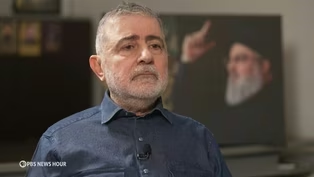
In rare interview, top Hezbollah leader rejects disarmament
Video has Closed Captions
In rare interview, top Hezbollah leader rejects disarmament, calls for Israeli withdrawal (8m 21s)
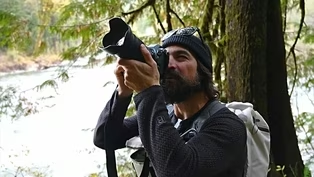
New growth in logged forests inspires photographer’s hope
Video has Closed Captions
New growth in logged forests inspires photographer’s hope (2m 51s)
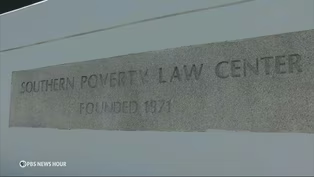
News Wrap: DOJ announces criminal charges against SPLC
Video has Closed Captions
News Wrap: DOJ announces criminal charges against Southern Poverty Law Center (5m 18s)
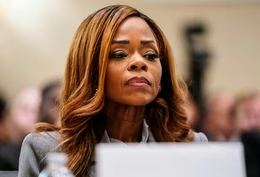
Rep. Cherfilus-McCormick resigns ahead of House ethics probe
Video has Closed Captions
Rep. Cherfilus-McCormick resigns ahead of ethics probe into use of campaign funds (4m 53s)
Trump extends Iran ceasefire as talks to end war stall
Video has Closed Captions
Trump extends Iran ceasefire as talks to end war stall (6m 13s)
Warsh faces questions on Fed independence, personal wealth
Video has Closed Captions
Fed nominee Warsh questioned on independence from Trump and personal wealth (8m 58s)
Providing Support for PBS.org
Learn Moreabout PBS online sponsorship
- News and Public Affairs

Today's top journalists discuss Washington's current political events and public affairs.

- News and Public Affairs

FRONTLINE is investigative journalism that questions, explains and changes our world.












Support for PBS provided by:
Major corporate funding for the PBS News Hour is provided by BDO, BNSF, Consumer Cellular, American Cruise Lines, and Raymond James. Funding for the PBS NewsHour Weekend is provided by...