
Food, Gas Prices Still on the Rise Ahead of Memorial Day Weekend
Clip: 5/18/2026 | 8m 53sVideo has Closed Captions
What's behind rising prices and what does it say about the economy?
High fuel prices have spilled over into other parts of the economy, contributing to rising food costs and an uptick in inflation.
Problems playing video? | Closed Captioning Feedback
Problems playing video? | Closed Captioning Feedback
Chicago Tonight is a local public television program presented by WTTW
WTTW video streaming support provided by members and sponsors.
Food, Gas Prices Still on the Rise Ahead of Memorial Day Weekend
Clip: 5/18/2026 | 8m 53sVideo has Closed Captions
High fuel prices have spilled over into other parts of the economy, contributing to rising food costs and an uptick in inflation.
Problems playing video? | Closed Captioning Feedback
How to Watch Chicago Tonight
Chicago Tonight is available to stream on pbs.org and the free PBS App, available on iPhone, Apple TV, Android TV, Android smartphones, Amazon Fire TV, Amazon Fire Tablet, Roku, Samsung Smart TV, LG TV, and Vizio.

WTTW News Explains
In this Emmy Award-winning series, WTTW News tackles your questions — big and small — about life in the Chicago area. Our video animations guide you through local government, city history, public utilities and everything in between.Providing Support for PBS.org
Learn Moreabout PBS online sponsorship>> Travelers are preparing to hit the road for the upcoming Memorial Day weekend and their wallets may take a hit, too.
Gas prices in Chicago are up $0.70 from a month ago and nearly a dollar and $0.70 compared to last year.
Meanwhile, inflation is up and disruptions to fertilizer shipments are leading to uncertainty in the agriculture business.
Joining us, our can foster professor of agricultural economics at Purdue University and Sam Henri executive director of the Energy Policy Institute at the University of Chicago.
Thanks to both for joining us.
Maury.
How has the war in Iran affected oil and gas prices?
>> Well, this is the biggest disruption in the industrial market.
So it's pretty significant.
The global oil market is about 100 million barrel a day will market.
You have about 20 million barrels a day or so going through the Strait of Hormuz so there's really nothing that compares to the market is down something on the order of 1.2 billion barrels over the over the course of the crisis.
And so this has led to a massive increase in oil prices already from about $60 a barrel before the crisis that out today around $110 a barrel.
So it's been it's been a pretty significant impact.
>> On that, Sam, can you explain how oil more markets settle on a global price?
>> Supply demand.
It's a global market the sum total of all of the supplies to go into the market on any day and demand the cost of drilling the next well to meet demand.
And so it's really one of the most fluid, one of the most liquid markets in the world.
No pun intended you I think question that a lot of Americans have, I can imagine I and probably many Chicagoans is, you know, given that the U.S.
is such a massive producer and a massive export are, why are prices?
So I hear and it really just speaks to the global nature of the of the oil market.
Essentially a disruption like this that happens anywhere in the world affects prices everywhere, United States, although it is a massive producer to massive export or is also an importer.
Well, and these are just fundamentally global markets.
And so the price that could in the world market is the price that short of or adjusted for location for shipping costs is the price that we pay here in the U.S.
>> Can foster how is the Strait of Hormuz closure affecting farmers?
>> Well, I think a it's broadly separate depending on where you are in the United States.
If you're Midwestern farm, most Midwestern farmers secured their fertilizer prior to the conflict and in some cases, even applied at my school.
And so these fertilizer prices aren't the prices that they're paying.
If you go to the south, it's a little different.
The culture, there's some of Southern farmers would not have purchased fertilizer for this year's crop.
>> And course, are facing higher prices for fertilizer.
At the same time, the Rouge right at the beginning of planting season.
So most of the plans were in place and it's been very little disruption to farmers plans for the 26 Think, you know, the thing to watch is the duration of this conflict.
And if it goes on into the fall and starts to affect the 27 crop planting season, then think we're going to see some changes >> How crops are grown, where the room?
And which crops are focused on by farmers as they make adjustments in trying to avoid.
>> High for prices than it sounds like you're saying the oil price shocks that we're seeing right now might not be directly impacting food prices.
>> You know, I mean, they are or they will be, but not through that channel.
So they're more likely to affect food prices through the energy portion of the retail food dollar, which is mostly around transportation processing.
And the and the cold chain keeping things cold or frozen, not directly through farm prices who are farm fertilizer prices.
>> Sam, with the street closure of the Strait of Hormuz, of course, if that closure continues on for another month or 2, what then might we see happening to oil prices?
>> Well, I think you're going to see prices continue to go up.
You're really starting to see in this the the kind of the buffers, the brakes on the on the market really start to erode.
You know, one reason that prices have gone up as much as many people suspected or expecting that they would at the beginning of the crisis, is that the oil market was in a state of surplus.
There was lots of inventory and see their workers, a sanctioned Iranian barrels.
It's essential Russian barrels and that bought the world several, you know, several days of supply.
There's lots of commercial inventories in the U.S.
and other parts of the world that bought the world extra days of supply that those inventories are starting to come down.
And I think it's a real question of how quickly we get to a resolution of the crisis.
You know, the most important thing to bring the prices down is going to be opening up the Strait of Hormuz again, you know, even wants to straight opens.
I think something that's important to understand is that it is going to take some time for the oil markets are really, really cool.
Great for barrels to start flowing back through the Strait of Hormuz.
Again, I think, you know, estimates range from 3 to 6 months.
I'm hearing more and more that it will take up to 6 months for the low market to stabilize and normalize.
And so, you know, you're starting to see the forecast come out from from places like Goldman Sachs and other market forecasting a experts who are saying prices, even if the prices result tomorrow, you're looking at prices, you know, close $200 a barrel through air.
>> Can you know if and when the street does reopen, how would you expect fertilizer prices to respond?
>> You know, fertilizers, markets are very much like they will market.
It's a global market is very fluid and there will be some delays matters of weeks as new inputs surface to the United States into Western.
You're where I think it turned into fertilizer, but we would expect a destabilizing, you know, relatively few weeks or months back to normal.
So you know that the timing of resolution, he's super important here because if you resolved in time for for farmers to begin making the 27 crop decisions based on lower fertilizer prices or the prospect.
Florida for the laser prices between now and next spring that takes a lot of really fun that channel in terms of retail food, price, inflation.
>> Sam, you mentioned, you know, prices not, you know, shooting quite as high as some people expected.
They might have when the conflict started.
That said a little over $5 a gallon today, which I think that is enough for for some folks.
I think it's hard to imagine prices going much higher.
>> It is the point where we're starting to see some demand destruction.
It's true prices are up about 55% from before the crisis.
It's costing the typical American household around an extra $100 a month and gasoline spending.
So that's less money that's available for groceries are going baseball game or whatever it might be.
But it is certainly the case the prices can go higher if the crisis is not results soon, if this is dragging out into, you know, into June it's hard to imagine a drag on beyond June into July.
You know, there's not going to be enough football for last.
really are drawing down the inventories at a historic pace.
There's never been a drawdown in inventories like this, which is what you would expect to match this kind of historic prices.
So when we get to the point where there aren't those you know, inventory is available as a buffer and you really get into a shortage situation in the world market prices will have to go higher to bring the market into into equilibrium.
And so you're missing 20 million barrels a day ish.
Well, it will have to, you know, the demand will have to go down to make demand and supply come come into equilibrium.
And that is going to require much higher prices.
So the most important thing that could happen in terms of the oil market.
I mean, he's obviously foreign policy.
This is a national security, a crisis.
There's many other considerations.
But from an oil market perspective, the most important thing that can happen is getting the straight back open in getting barrels flowing through the strait again.
>> Can we've got about 30 seconds.
But what other policy decisions short of reopening the Strait of Hormuz might meaningfully meaningfully impact the cost that farmers are paying.
>> Well, I think more than the cost side, we see relaxation in terms of renewable fuels policy that are going help prices in the future in particular, soybeans because soybean willows primary in put into making biodiesel.
And there's been quite a bit of opportunity to expand that market.
Now based on decisions that were made in Washington.
put it give a little higher revenues to offset the increased costs.
 New
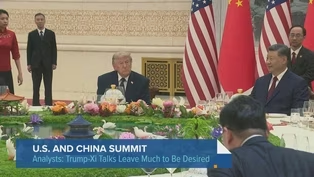
NewTakeaways From Trump's Trip to China
Video has Closed Captions
The president recently returned to the U.S. following a three-day visit to China. (8m 28s)
Providing Support for PBS.org
Learn Moreabout PBS online sponsorship
- News and Public Affairs

Top journalists deliver compelling original analysis of the hour's headlines.

- News and Public Affairs

Today's top journalists discuss Washington's current political events and public affairs.












Support for PBS provided by:
Chicago Tonight is a local public television program presented by WTTW
WTTW video streaming support provided by members and sponsors.