Donnybrook
January 22, 2026
Season 2026 Episode 3 | 27m 55sVideo has Closed Captions
Charlie Brennan debates with Sarah Fenske, Wendy Wiese, Alvin Reid, and Bill McClellan.
Charlie Brennan debates with Sarah Fenske, Wendy Wiese, Alvin Reid, and Bill McClellan.
Problems playing video? | Closed Captioning Feedback
Problems playing video? | Closed Captioning Feedback
Donnybrook is a local public television program presented by Nine PBS
Support for Donnybrook is provided by the Betsy & Thomas O. Patterson Foundation and Design Aire Heating and Cooling.
Donnybrook
January 22, 2026
Season 2026 Episode 3 | 27m 55sVideo has Closed Captions
Charlie Brennan debates with Sarah Fenske, Wendy Wiese, Alvin Reid, and Bill McClellan.
Problems playing video? | Closed Captioning Feedback
How to Watch Donnybrook
Donnybrook is available to stream on pbs.org and the free PBS App, available on iPhone, Apple TV, Android TV, Android smartphones, Amazon Fire TV, Amazon Fire Tablet, Roku, Samsung Smart TV, and Vizio.

Donnybrook Podcast
Donnybrook is now available as a podcast on major podcast networks including iTunes, Spotify, Google Play, and TuneIn. Search for "Donnybrook" using your favorite podcast app!Providing Support for PBS.org
Learn Moreabout PBS online sponsorshipSupport for Donnybrook is provided in part by Design Aire Heating and Cooling.
Well, if you don't know what fair is, >> Donnybrook is made possible by the support of the Betsy and Thomas Patterson Foundation and the members of Nine PBS.
>> Thank you for joining us for another edition.
Great to have you with us.
As always, too many topics to talk about.
So, let's meet the panelists and then jump right in.
There she is, the media veteran herself with the Viz Crescent, Wendy Wiese, Mr.
Bill McClellen from the St.
Louis Post Dispatch, from St.
Louis magazine, the 314 Pod podcast podcast, and also with the daily newsletter, Sarah Fenske.
And there he is, last week's host with the most, but he won't boast >> from the St.
Louis magazine.
Like hot butter on breakfast toast.
>> You on a roll, man.
>> Hey, Alvin Reid.
Hey, by the way, the art this week is from Jan Trager from janger.com.
Thanks, Jan, for sharing your uh talent with us.
And folks can see more of her great work at janger.com.
>> It's weather appropriate.
It is very timely.
It really winter scene.
Yeah, I wouldn't want to drive in it though.
>> Sarah, I want to ask you about uh the peasants with pitchforks this week in Franklin County uh basically showing up in front of the town mothers and fathers there and saying no to a data center.
So, they've decided to put this data center proposal on hold for 6 months.
Meanwhile, in the city of St.
Louis, that proposal for a data center at the Armory, the old Armory on 6440 has been revised.
Now they're thinking about putting a data center in the old famous bar building next door and then turning the armory into mixed use development of some sort.
Do you think either of those projects will actually come to fruition?
>> Boy, it's always hard to make a prediction here, but here's what I think is going to happen.
I don't think this one in Franklin County is going to happen.
I was watching this live stream for this meeting.
There were four hours of vehement testimony.
People in Franklin County are very upset about this.
They do not want it coming to their more rural place and changing their way of life.
They're upset about AI.
They don't want to facilitate this uh intense electricity usage.
Um and I think you're going to increasingly see these rural communities are saying, "Don't bring this here.
We're here because we don't want this."
Now, in the city, it gets a little more complicated.
There were a lot of people who were really wound up when they were talking about putting it in the armory.
This is this historic building.
We haven't given up on the idea of something cool going there.
Well, the the developers behind this project have very smartly sweetened the pot of what they want to do by saying we'll take this vacant warehouse and then we'll give you like a lot of office workers in the armory.
I can see that being attractive to a lot of people.
People would love to make that armory city foundry area work.
Having a lot of office workers there would uh would really help all the restaurants in the area, help those uh residential towers that are there.
And I think you'll see them being able to peel away some of the people who stood against having a data center in the armory to say, "Yeah, maybe we're okay with one next door."
>> I I can't be peeled away.
Okay.
>> Fair.
I I And I will say this, >> right or wrong, I think data center is like touching a nerve across the region and now outward into the state where it's like just say no to data center.
And I think those people were very sincere in Franklin County and I think people here are too.
But I think it's something now it's caused celebrating adjacent to um the armory.
Let's find something better to do with those properties.
And >> yeah, who wants to have an office next to the data center?
And you know, you got Steve Smith just across the highway with the foundry across from a data center.
What we're seeing is that the people in the rural area are much more liberal on this than the people in the city.
>> Well, no, the city has been very against this.
A lot of city residents have been against this.
I just wonder if this could change their mind.
>> I Well, there's a I mean, Go ahead, Bill.
>> Well, I I was going to say that the thing about Franklin County that is uh interesting is the fellow whose property it's on, the man who's pushing the idea will not say who's behind it.
you know, who's going to be developing it.
And I think that if you have any chance at all to sell an idea like this, you have to be very open about it and say, well, it's because such and such companies come in this thing like, well, we're not going to talk about who's behind this.
That's an invitation for people to say, well, there's got to be a reason and it's not a good one.
>> Wasn't that the case in St.
Charles?
And I think even though we had had as a region we had had several um data centers opening up, they had sort of done it under the radar until St.
Charles.
But this I still think if if you believe every all the mail that we received after the last time we talked about it, it's way too close to the Slooh campus.
You said they sweetened the pot.
It seemed like they built an entirely new pot.
You got names like Arco and Lewis Rice involved.
>> It depends the size of it.
I mean, there are already data centers in downtown St.
Louis, and most people don't even know about it.
But to your point, Bill, you know, this is the oldest trick in the world.
There was a guy out of Leoo, his last name is Hoffman.
He's no longer with us.
He went to Carterville, Georgia, and bought up all the property in his name and then sold it to Anheuser Busch for their brewery because if they knew AB wanted to build the brewery, the price of the property would have skyrocketed just like here, you know, if >> Right.
Well, I I think that's even a little different, Charlie.
That's like Disney, you know, buying the property up be be without telling anybody who it was for.
This the the property there's going to be a data center.
It's not like a secret.
The question is, well, who's who's running this?
Who's behind it?
If it's Mark Zuckerberg or Elon Musk, then people aren't going to like it.
>> Yeah.
I don't think it helps for them to get the end user out there.
I kind of get why they're hiding this even though then I understand why, you know, the people are saying, "Hey, we're not going to let this thing next door until we know more about it."
But if they were told, "Oh yeah, this is going to be Elon Musk's project."
It's like, "Hey, we can point to how he had did a terrible job at his project in Memphis."
Like there's examples now everywhere around the country where people hate having these things as neighbors, where they are raising electric rates.
There's reason, you know, the people against these things have some some facts.
>> This is a transformative amount of money.
Again, there's that word.
at work >> like a drinking game, the first person to say transformative amount of money.
But I I I truly do hope that they make the right decision because that is it's the last thing we need right now.
>> They're coming.
This is the question is where I mean there's no doubt we're not going to all give up artificial intelligence and Google.
We're not going back.
>> I get that.
But just at the armory listen, there might be a place where it goes and I might be indifferent about it, but not at the armory.
And by the way, a man named Stan Kronke bought a property in Englewood and some of the greatest thinkers in St.
Louis said like he'll never build a stadium and move the Rams there.
So there is something to you better be looking into who's buying what and why.
>> Hey Alvin, you were at the dedication the rededication of the Martin Luther King statue this past week in uh Fountain >> Fountain Park.
Fountain park and uh the mayor of St.
Louis was there, Cara Spencer.
and she did address the news story that came out that last May, eight months ago, $100 million was appropriated for tornado relief uh from the state of Missouri.
And as thus far, not one penny of that $100 million has been spent yet in Fountain Park and elsewhere in North St.
Louis.
Well, the mayor and I will probably agree that that was the coldest I think I have been in my life and snow flurries turned into a snowstorm and God bless everybody who was out there.
And it was just it was just really bad that day.
But, you know, she basically said, "This is on me.
I own it.
The recovery has been too slow and I know people are still suffering."
And I I acknowledge that she was there and she was very honest.
But we have to spend this money, okay?
We have to get after it.
And I don't know what the log jam is, but somebody needs to take dynamite out there and blow up that log jam and get them going down the river again because it has taken way too long.
And I said right after the tornado that January of 2026 would be a water watershed month.
And I think that's where we're at right now.
Let's get after it.
I I think that uh the problem lies with FEMA and that the this administration is so vindictive that I think the mayor feels that if she says this is all FEMA's fault that the administration said well you're not getting anything then and she has to walk very carefully but I from the story that I read without any inside information it sounds like FEMA has until FEMA does something nothing can happen.
Well, she wasn't I mean, she was making she she rolled it in powdered sugar and, you know, chocolate sprinkles, but she said FEMA.
I mean, there's no doubt about it.
Uh because she t they were several people were were quoted as saying that FEMA has changed the rules, you know, that there's all this stuff.
She was she was very she was very quick to say that the state has been a good faith partner, that the state is doing fantastic things for us and trying to do fantastic things for us.
But yeah, it's not so much the message as the way it's delivered.
She was holding FEMA's feet to the fire and I wish she would stop saying this is on me.
It's not on her.
It is not on her.
>> Well, I think some of it is on her and so I do appreciate her taking responsibility for this.
I think she was pretty critical of Mayor Jones with the ARPA money, but it is very hard to spend money in targeted effective ways and get it to the right people and make sure there's no corruption and make sure you've crossed all your tees.
And I think she's she's realizing that and it has been difficult and they say we're going to see a great escalation soon.
I really hope that's correct.
Well, >> but it's not all FEMA.
>> No, I think a lot is FEMA.
Wall Street Journal had a front page story on this very issue and said that the floods in Texas and the tornado in St.
Louis are hampered by a crippled FEMA which has been crippled by this administration which encouraged the early buyouts and the retirements and so they lost whole departments.
But the real blame belongs to Josh Holly and Eric Schmidt who are our representatives in Washington DC representing this state.
They should be looking out for our best interests and you know instead of worrying about who's going to control Greenland.
They should they should be con concerned about North St.
Louis.
>> Well, I agree, but I Why am I not shocked?
>> Well, you know, why aren't you shocked?
In all honesty, as much as I know it's very popular to bash this administration, FEMA has never been, if you remember with the, you know, with Katrina, we were we were throwing bombs at at at FEMA back then and Asheville.
>> But Charlie's right that it has gotten a lot worse.
This Wall Street Journal story was was eye opening about how much worse it got.
But to my point, the city has also struggled to spend its own Rams money, which is not, you know, the money that was earmarked from the Rams that was dependent on that.
That's not FEMA money.
So, there's a couple complicated things going on here.
I'm not saying it's easy.
>> We have taken our focus, the media, the government leaders, everybody off of the tornado.
I mean, we just didn't keep our eyes on the prize.
We just moved on to other things.
>> I I don't know that that's necessarily true.
I think it's just bogged down and somebody has to, like I say, blast a hole in it.
I will also say that, and I, you know, we joked around with it, but 30 member committees just they just can't get things done.
I mean, that's just a reality.
>> And weren't there two 30 general?
>> I mean, look.
>> Well, hey, Bill, let me ask you about another committee that's being established this time by St.
Louis attorney Jerry Schlickter of Schlickter Bogard, former guest of uh our show here on KETC Nine PBS.
Schlickter is the guy who gave us historic tax credits in the state.
He also started this program to attract immigrants.
He started arch grants.
And now he would like to form a committee that'll rejuvenate, resuscitate downtown St.
Louis.
They're calling this downtown forward.
And among other things, he wants to go after the vape shops and the problem properties.
He says that the Mark Twain Hotel in downtown St.
Louis has had 1700 police calls in 10 years.
He goes, "That's got to change and this group's going to do something about that."
What do you think?
Well, there's so many groups for downtown.
And I think look, there's a a great great guy, but this is like the motorcycle gangs that got infiltrated by the DEA, the FBI, the ATF.
Pretty soon, most of the motorcycle gangs were law enforcement guys.
And I I think that this is the same way.
Pretty soon, everybody who lives downtown will either head a commission or be on a commission.
I mean, we already have three or four commissions on downtown and at at some point it just gets to be, oh, another downtown commission.
>> Well, my my first thought was was another downtown commission and another acronym.
What are they going to what are they going to get done?
But then I thought, you know what, good for Schlickter, Mr.
Schlicker, because you as you said, he's got a great reputation and you know, they're putting their money where their mouths are.
They it sounds like the biggest hurdle they are going to have is changing perception.
You know, when it comes to perception about the downtown, you know, the downtown area within the region, that's where they're going to focus.
That's going to be the >> Well, when when you say they're putting their money where their mouth is, you they're soliciting funds and and Schlickter's a guy, if I had money, I'd give money to Schlickter.
But the problem is all these other organizations are also soliciting funds and it just seems like it's >> too many cooks spoil the broth or whatever like yeah I'm with Bill on this.
I hear from a lot of downtown stakeholders that they're like do we really need an entire new structure?
Like can't we form a committee within one of these existing structures if this is what needs to be targeted?
And when you talk about changing the impression of downtown St.
Louis I agree that needs to happen.
I fought that fight with all of you guys frequently, but there's a lot of different efforts to do that already.
If you look at Greater St.
Louis, Inc., you look at the the made STL made thing, there's a whole what the Missouri History Museum, the effectiveness of all.
>> Yeah, there's there's some really good projects, but the last thing we need is let's hire another PR firm to try to come up with some, you know, messaging.
>> If you identify a problem, Mark Twain Hotel, okay, and and Jerry Slinker does great work.
I you know I I' admirable work as the Buffalo Bills say it instead of admiral but um okay if that's the problem say like all right our first goal is to eliminate this problem we're going to buy it clear it out make it something useful just make that your one specific goal in life >> kill the Mark Twain not literally but you know just like >> give give yourself a sunset in two years it's going to be gone and it's going to be better and one project at a time instead of this is part of a big problem.
So we're going to address this whole big problem just do on that.
>> I I think a lot of the people in this group were part of a committee that was in part of downtown now which kind of was absorbed by Greater St.
Louis Inc.
which put a guy in charge of downtown St.
Louis >> until he left the town for New Orleans.
So you know you got Amy Gil of 705 Olive the hotel there.
You got Alex Oliver, you've interviewed him.
You got Jerry Schlickter.
You got people uh Mr.
Pistister is his first name, Dan.
>> Yeah, Dan Pister.
He's Nick Pers's brother.
Nick, they they they don't live elsewhere.
They all are downtown and they really are just tired.
And it's not perception.
I mean, the vape shops are not perception.
>> Agreed.
They want to change it.
And it's not perception.
Otherwise, all these businesses wouldn't be moving out.
Like this week we heard that Weber Shanwick, and Momentum are taking 130 >> employees out, some of them to St.
Charles.
They're not moving out because of perception.
>> But they have reinvented the blue ribbon panel, which is something that we all laughed about for decades.
You know, the St.
Louis always there always had to be a blue ribbon panel or a special commission.
>> They called it the Manhattan Project or something like that.
You know, it's a group of people working together.
That's what it is.
Yeah.
I mean, these are good people, but it's like, is there do we need a new whole new thing?
>> Yeah.
>> Well, how about a new food pantry in St.
Charles on North First?
I think it's at First Capital Drive, I think.
Uh, anyway, it's a uh food pantry that received some push back from the neighbors, Wendy, but uh St.
Charles City Mothers and Fathers approved it in the end.
What' you think?
>> I think it's going to take a little while for everything to sort of settle into place.
It is appointment only, which I know sounds a little counterintuitive when you're talking about hunger because you don't make an appointment to be hungry.
Uh, but they are only doing it two days a week.
And it's it's reach St.
Charles, I believe, is is the name of of the food pantry.
And food pantries, like everything else in the world, has changed.
You know, they've changed dramatically.
They've had to change uh the way they they do business.
And so I understand that the neighbors are reluctant.
They think that this is going to suddenly become a magnet for all homeless people.
And uh I'm pretty sure that the operators of the food pantry will keep a they'll be very vigilant about keeping an eye on that kind of thing with law enforcement.
But I wish them I wish them the best and I really hope that it works out and is very effective for >> Well, I think only in the St.
Louis area would you have to make a reservation.
>> No, no, that's happening that's happening everywhere.
>> Okay.
Yeah, but I will say this that if you actually go to a food pantry when they're having, you know, they're giving away food, you see middle class people and and literally that that perception is just wrong.
And so thus, I hope this works.
And if if the reservation, the appointment thing is needed, I I really don't think it's necessary, but if you get food to people, then I can't complain.
>> These are these are some wealthy people involved, too.
>> No.
Did she misspeak?
Because the proprietor of this food pantry said that she she's open to the super rich as well.
>> Yes, >> she's open to everyone.
I mean, okay.
>> Well, she said the super rich.
>> She was misspeaking.
And then >> No, there was No, no, no, no, no.
She wasn't.
There was a famous, infamous story in People magazine, like within the last 20 years, about a family that lived in an $800,000 house that was frequenting these food pantries because they had fallen on hard times.
They had sold all their furniture, but they needed help.
Well, then they're not super rich.
>> Yeah, at that point formerly super rich.
I think Wendy's being way too diplomatic.
I the Post Dispatch had a good story about this and it just it just boiled me.
You know, the neighbors are saying, "Oh, you know, we don't want the these this riff raff in our neighborhood is basically the takeaway.
We're going to make them form an appointment first."
Like, these are the people that have a lot of chaos in their lives and are just trying to get by.
And to add that extra layer, it just feels so rich.
I I suspect that a lot of the people are are okay with this and you know it's it's natural for people to be concerned but but I think you know St.
Charles went along with it so this thing has been approved so I I don't think that it's like a St.
Charles no everybody's snobish problem >> almost every food pantry in the St.
area has appointment only and they do that because you know they're staffed by volunteers and they can't have a big onslaught of people and but the people go in there love it because they don't want to stand in line outside right >> they want to go inside have the food ready and then leave >> and they're trying to make it more of a marketplace type of experience >> I don't have to make an appointment at the marketplace I frequently will change what hour I might go to the grocery store >> I I would we call that house rich is what the term used to be like say oh yeah you got big magnificent house and you look inside they have the furniture.
>> House poor.
>> Yeah.
House poor.
I'm sorry.
Not house rich.
Yeah.
House poor.
Uh I I will say that back in the day when they used to give away like the free cheese and the butter like at one of the newspapers I worked at, nobody was starving, but somebody would run and say like, "Do you need some cheese?"
And we'd all like send like a runner down because Right.
And so it isn't like only what you do.
you know that that cheese made like really good macaroni and cheese and stuff and but like so in other words people take advantage of free stuff that aren't exactly like starving.
>> I but food pantries are a little different.
I mean I agree.
I'm just saying that not everybody that goes to a food pantry like is like starving.
>> So you were taking the cheese from the federally subsidized surplus cheese program even though you didn't qualify.
>> Yes.
I mean, it was a thing, right?
>> I hope Hal Goldmith is not watch.
>> Wait, wait.
You can turn over food stamps, too.
People out in front of the grocery store would like say like, "Hey, I'll I'll give you $40 worth of food stamps for $25."
Well, and rich people did that.
We're We're going to edit this portion out of the broadcast.
Good >> idea.
>> It was It was 35 years ago.
Welcome a little >> 45 actually.
Well, let's move on quickly to another topic.
How about MoDOT?
Uh, you had a story this week in St.
Louis magazine in the daily newsletter and in the online edition, Sarah, uh, that MODOT got a lot of push back for the design, the redesign of 6440.
And viewers to this program can go online at the MDOT website and see it's I think it's called uh, Future 64 64 future.
They've been working on this for two years, but among the plans was to stop west uh the westbound exit on Compton on 6440 in addition to repairing parts of that highway largely between Jefferson and I guess Grand.
So that would include Vandeventer and Grand.
But this one proposal would send westbound traffic over Forest Park Parkway over Grand and then back on to 64/40.
And the business owners in Midtown did not like that.
>> Yeah.
And I can see why.
I understand it's always good if we can get rid of more highway infrastructure, but man, that Grand and Forest Park intersection is horrible.
I go out of my way to try to avoid that thing.
It It feels dangerous to me.
You don't know where you're supposed to stop.
Half the people there don't know where they're supposed to stop.
And to put even more traffic on that, there's a reason these businesses are speaking out.
They're saying people are just going to avoid this area if we put people there without fixing that intersection first.
>> Well, Chafitz uh is is also going to be hurt a little bit.
People leave Chafitz and get right on the highway.
>> Well, I mean, >> I haven't seen the plans.
>> I remember like the whole state was going to fall apart when we close 640.
And it's like water.
It people find a way to get home or get here.
Shafus will be fine.
Everybody will be fine.
If it needs to be fixed, fix it.
We'll figure it out.
Somebody tell me why all those speed bumps are on the Compton Bridge, though.
I I just can't figure that out.
But would you be saying this, Alvin, if you owned a business on Olive?
>> I would say this that the percentage of business loss, I think, would be less than what people imagine because that's how it was with 64/40.
Like the whole like from the stadium to Chesterfield was just going to go out of business because 64/40 was closed all that time and it just didn't happen.
But that was >> a couple places did.
Couple places did >> that was temporary and that was two and a half years.
>> That was a long time.
>> Well, I suspect and I I think the folks at MDOT are going to uh take a look a long look at the plans after your story, Sarah, this past week, you and Ryan Crawl.
Right.
>> Ryan Crawl.
Yeah.
>> And uh >> they're they're they're going to urge everyone to be patient because I think their engineers are going to go back and take a look at what's going on and take in the feedback that they heard from the business owners.
>> Yeah.
This is the first most people heard this was even happening.
So there was a large angry reaction and MDOT saying, "Hey, hey, we are listening."
>> I think what what's funny is you're talking about this horrible horrible congestion at Grand and Forest Park Parkway and we had never noticed it.
I mean, we drive every Thursday we're we're here.
And I guess you just get used to it after a while because I am I I I know that I am going to have to almost close my eyes to be sure that I'm not dinged by somebody, you know, that somebody isn't veering into my lane.
It's always a nightmare, but you just get used to it.
That's the sad part.
>> And I will say this that like, you know, Kranzberg Arts Foundation does a tremendous job, you know, along Olive.
They've bought two business business there.
the key and the other one where I will be doing sports trivia on Wednesday nights by the way.
So, I'm really being honest.
I I could take a oppositional view, but that's really what I think.
I think everybody will be all right.
Thank you, Alvin.
By the way, we're going to talk about college sports betting on Last Call tonight.
And since you write that sports column for the American, we're going to go to you first on that one.
But first, let's go to the uh letter writers and see what they had to say about last week's program.
Josh Holly is famous for running away from scary things.
Enough said that from Richard Eganther of St.
Louis.
We also heard from DB Ross of Hillsboro who wrote, "I agree with Wendy that Missouri is not Texas, Florida, or Tennessee.
But if states like New Hampshire, Washington, South Dakota can function without an income tax.
Why can't we?
Still the best show on television for 40 years.
I've been watching since 1992, says Barnett Miller of Ofallen, Illinois.
You can write us care of 9PBS.
The zip code is 63108.
We love those emails.
Donnybrook@ninepbs.org.
On social media, use Donnybrookstl.
Call the Nine line at 314512994.
And wherever you are, listen to us on your favorite podcast source.
Yes, we'll be talking about possible regulations on college sports betting in Missouri and elsewhere.
on our last call show.
It's found on the Nine PBS YouTube channel.
And we'll also be talking about whether the Gateway Arch should expand into Illinois.
Looks like there's progress in that area, if you call it progress.
Thank you very much for joining us on this this edition.
Sure.
Appreciate you joining us, but do join us on YouTube for Last Call.
See you next week.
>> Donnybrook is made possible by the support of the Betsy and Thomas Patterson Foundation and the members of Nine PBS.
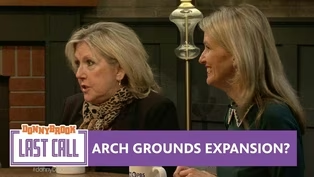
Donnybrook Last Call | January 22, 2026
Video has Closed Captions
Clip: S2026 Ep3 | 10m 59s | The panelists discuss a few additional topics that weren’t included in the show. (10m 59s)
Providing Support for PBS.org
Learn Moreabout PBS online sponsorship
- News and Public Affairs

Top journalists deliver compelling original analysis of the hour's headlines.

- News and Public Affairs

FRONTLINE is investigative journalism that questions, explains and changes our world.












Support for PBS provided by:
Donnybrook is a local public television program presented by Nine PBS
Support for Donnybrook is provided by the Betsy & Thomas O. Patterson Foundation and Design Aire Heating and Cooling.