
January 25, 2024 - PBS NewsHour full episode
1/25/2024 | 57m 46sVideo has Closed Captions
January 25, 2024 - PBS NewsHour full episode
Thursday on the NewsHour, negotiations over funding for Ukraine and the southern border are derailed by Republican infighting, threatening a crucial, emerging deal. Donald Trump takes the stand in the federal defamation case brought by writer E. Jean Carroll. Plus, the governor of Texas defies a Supreme Court ruling to remove razor wire at the border.
Problems playing video? | Closed Captioning Feedback
Problems playing video? | Closed Captioning Feedback
Major corporate funding for the PBS News Hour is provided by BDO, BNSF, Consumer Cellular, American Cruise Lines, and Raymond James. Funding for the PBS NewsHour Weekend is provided by...
Support provided by:

January 25, 2024 - PBS NewsHour full episode
1/25/2024 | 57m 46sVideo has Closed Captions
Thursday on the NewsHour, negotiations over funding for Ukraine and the southern border are derailed by Republican infighting, threatening a crucial, emerging deal. Donald Trump takes the stand in the federal defamation case brought by writer E. Jean Carroll. Plus, the governor of Texas defies a Supreme Court ruling to remove razor wire at the border.
Problems playing video? | Closed Captioning Feedback
How to Watch PBS News Hour
PBS News Hour is available to stream on pbs.org and the free PBS App, available on iPhone, Apple TV, Android TV, Android smartphones, Amazon Fire TV, Amazon Fire Tablet, Roku, Samsung Smart TV, and Vizio.
Providing Support for PBS.org
Learn Moreabout PBS online sponsorshipAMNA NAWAZ: Good evening.
I'm Amna Nawaz.
Geoff Bennett is away.
On the "NewsHour" tonight: Negotiations over funding for Ukraine and the southern border are derailed by Republican infighting, threatening a crucial emerging deal.
Former President Donald Trump takes the stand in the federal defamation case brought by writer E. Jean Carroll.
And the governor of Texas defies a Supreme Court ruling to remove razor wire at the border.
The state's standoff with the federal government and how Mexico's foreign minister views the ongoing immigration crisis.
(BREAK) AMNA NAWAZ: Welcome to the "NewsHour."
We start with two intertwined and looming issues.
High-stakes negotiations over a possible deal to aid Ukraine and reform the U.S. immigration system are at risk of collapsing under their own political weight.
Congressional correspondent Lisa Desjardins spent the day speaking with lawmakers on Capitol Hill.
She's here now to explain.
Lisa, good to see you.
LISA DESJARDINS: Good to see you.
AMNA NAWAZ: So bring us up to speed.
Where do things stand on Capitol Hill?
LISA DESJARDINS: After these weeks of very urgent and serious talks between lawmakers on Capitol Hill and maybe some less serious sound bites from others not involved in negotiations, we are now on the edge of a complete failure by our lawmakers to either address the border security right now or to figure out what they want to do to help or not help our allies in Ukraine.
As you know, we were reporting those two issues have been linked since President Biden linked them in one bill and Republicans asked for policy changes at the border before they would support Ukraine funding.
So let's look at where we are in this moment about that idea of linking these two bills.
Right now, negotiators that have been working on trying to get that deal together actually have agreed on policy, I'm told by familiar sources, but they haven't yet figured out the dollars, how much money goes where.
That's obviously a big problem, but the policy chunk is a huge breakthrough.
However, conservatives have increasingly become skeptical on that policy.
At the same time, Leader Mitch McConnell has made it clear today that he ideally would like a combined deal.
However, he has a different problem.
President -- former President Trump opposes the combined deal, especially opposes the border security portion.
And since New Hampshire, McConnell and other Republicans have started referring to Trump as a potential nominee of their party, and they have said he wants to run on the border issue.
So what we have here is a political problem.
Mitch McConnell said that behind closed doors to his Republicans last night, that no matter what they want, the politics mean that this kind of deal may not be able to go forward for Republicans.
Meanwhile, what is going forward are those negotiations.
The three senators that have been behind closed doors for weeks now, there they are right there, one Democrat, an independent and a Republican.
They say they will work throughout the weekend with Democratic Leader Schumer in the Senate, saying he expects them to come up with a deal.
Senator Sinema of Arizona said she does expect text on the border policy next week.
We will see.
AMNA NAWAZ: Take us back to the presidential politics you mentioned there.
How big a factor is that in blocking any potential action for Ukraine or border funding?
LISA DESJARDINS: Well, I will start by saying this deal always has been precarious, always has been difficult.
It wasn't clear Democrats were going to be all the way on board.
But in this moment, it is presidential politics absolutely that is blocking it and that has really kind of incited more fear, I think, in Senate Republicans, who might have been on the fence over whether to try and help some partial solution at the border, maybe not get all what they want, versus backing off altogether and doing kind of politically more expedient thing.
One of the reasons, of course, former President Trump.
I want to show one of the things that he wrote on social media just in the last day about this deal.
He wrote: "I do not think we should do a border deal at all unless we get everything needed to shut down the invasion."
Now, of course, Amna, this is not an invasion at the border.
These are groups of asylum seekers largely, more than half of them family members.
But you can see in that tone election year rhetoric that former President Trump will be using.
Now, to respond to this, to make it even more clear, the last person before Trump to be the Republican nominee, Mitt Romney, had something to say today.
SEN. MITT ROMNEY (R-UT): The fact that he would communicate to Republican senators and congresspeople that he doesn't want us to solve the border problem because he wants to blame Biden for it is really appalling.
LISA DESJARDINS: As we speak, I'm told by my sources in the Trump campaign that he is now responding to Romney directly.
It's kind of a blast at Romney, as you would expect.
All of this, also another problem, no one was clear that the House was ever going to pass this deal.
But senators wanted to do something.
They still may try.
AMNA NAWAZ: What about this critical aid funding.
We keep calling it critical aid funding.
We know they have been seeking it since last fall.
When does the inaction to pass funding here start to create more problems there?
LISA DESJARDINS: I want to credit Nick Schifrin for a lot of this reporting as well.
Right now, the U.S. is paying not only for some help, critical weaponry, but also the Ukraine government to keep financially viable.
Four billion dollars is needed for them routinely to keep the payroll going.
The U.S. is paying for teachers, those kinds of things.
And, by the way, if there's not air defense for Ukraine, that will be a game-changer soon.
They will probably not be able to make it as they are coming up quickly.
AMNA NAWAZ: That's our congressional correspondent, Lisa Desjardins, covering these critical negotiations.
Lisa, thank you.
LISA DESJARDINS: You're welcome.
AMNA NAWAZ: Well, former President Donald Trump is also dealing with his own legal problems today.
He took the stand in a New York City courtroom as part of the defamation lawsuit filed by writer E. Jean Carroll.
In an earlier trial, Trump was found guilty of sexually abusing Carroll in the 1990s in a department store dressing room and then defaming her by denying the assault and alleging she invented the story to make money.
Our William Brangham was in the courtroom today, and he joins us now.
William, it's good to see you.
We should note the president, despite the conviction, has all along maintained his innocence in all of this, but this testimony from him was long awaited.
So, tell us, what did he have to say on the stand?
WILLIAM BRANGHAM: Well, Amna, he didn't have much to say.
I mean, the former president was on the stand for less than five minutes in total today.
And that's largely because Judge Lewis Kaplan had put a series of constraints on the former president, arguing that he cannot, by law, try to relitigate the previous case, which he was found guilty on.
And the former president was clearly angered and chafed against all of this.
But he got on the stand and answered a few quick questions.
He said that he 100 percent stood by a previous deposition, saying that this all set of accusations was a hoax against him.
He was asked if he had ever intentionally asked someone to harm E. Jean Carroll.
He said no.
And that was largely it.
He got off the stand and, as he was walking out the courtroom, very angrily muttered: "This is not America.
This is not America."
AMNA NAWAZ: So, William, he's already been found guilty of sexually abusing E. Jean Carroll and of defaming her.
So what is it that the jury is deciding in this particular case?
WILLIAM BRANGHAM: The jury has to decide how much money, if any, that E. Jean Carroll deserves to get from Donald Trump for those defamatory comments that he made about her when he was the president.
She alleges that, after he made those comments, she suffered through a torrent of online abuse and death threats and harm to her reputation.
She says this is what happens when a former sitting president, then-sitting president, accuses you publicly of being a liar and making up a story to attack him.
It is worth noting that, even though he has been found guilty of defamation, the former president continues to say this, not in a courtroom, but at every campaign rally, every interview he does on social media, he is continuing to say these defamatory comments about E. Jean Carroll.
AMNA NAWAZ: So this is one case that seems to be coming to a close.
I want to ask you about another case involving former President Trump.
That's being brought in Fulton County, Georgia, related to his alleged attempts to interfere in the 2020 election.
William, there have been some serious accusations brought against the prosecutor in that case.
What's the latest on that?
WILLIAM BRANGHAM: That's right, Amna.
The prosecutor in that case is the Fulton County district attorney, Fani Willis.
She has got this elaborate election interference case.
She's got 19 defendants that she has charged.
A few weeks ago, one of those defendants came forward in a motion and said that the lead prosecutor that Willis appointed, a man named Nathan Wade, was in fact Willis' boyfriend.
And he alleged that Wade was using the over half-a-million dollars in legal fees that he's been charging against this case to take Willis on fancy vacations and that this is clearly a conflict of interest and she should be dismissed from this case.
Now, Willis hasn't said anything publicly about -- directly about these accusations.
She did a week or so ago seem to imply that all the attacks against her and Wade, because both of them are black, that these were rooted in racism.
Now, today, Donald Trump's lawyers seized on that accusation and said, if you're out there claiming that the defendants in this case are racists, you are hopelessly tainting a potential jury pool and that the district attorney should be dismissed and the entire case should be dismissed.
So, this has escalated very, very quickly.
The judge in this case has now set a hearing for February 15, middle of next month, to go through these accusations, and we will see what happens at that point, but, so far, a very serious shadow cast over this quite consequential case.
AMNA NAWAZ: All right, that is William Brangham covering the trials of former President Donald Trump joining us from New York.
William, thank you.
WILLIAM BRANGHAM: Thanks, Amna.
AMNA NAWAZ: In the day's other headlines: Former Trump adviser Peter Navarro was sentenced to four months in federal prison for contempt of Congress.
He had refused to cooperate with the congressional January 6 investigation.
Navarro appeared in court in Washington, where the judge told him he's not the victim of a political prosecution.
Later, Navarro filed an appeal of his conviction and sentence.
The U.S. economy is showing more signs of surprising resilience thanks to robust consumer spending.
The Commerce Department reports overall output expanded at an annual rate of 3.3 percent in the fourth quarter of 2023.
That was down from 4.9 percent in the third quarter, but much stronger than expected.
In Gaza, the Hamas-run Health Ministry reported an Israeli strike killed 20 people waiting for food in Gaza City.
The Israeli military said it's investigating.
Elsewhere, fighting raged near two hospitals in Khan Yunis.
Palestinian medics said the Nasser and al-Amal complexes have been cut off by shelling.
And at an Israeli border crossing, hostage families demanded that humanitarian assistance be sent to the captives held in Gaza.
DANNY ELGARAT, Brother of Israeli Hostage: Hundreds of humanitarian trucks come inside to Gaza Strip, and only for one side, only for the Palestinians.
There is no humanitarian steps for our hostages over there.
There is no Red Cross visiting.
There is no food.
AMNA NAWAZ: Also today, the Israeli military said a misfired Hamas rocket may have struck a U.N. shelter in Khan Yunis on Wednesday, killing 12 people.
It ruled out an Israeli airstrike or artillery as the cause.
In Yemen, the leader of the Houthi rebels vowed today they will go on targeting commercial shipping until food and medicine gets to Palestinians in Gaza.
Abdel-Malek Al-Houthi insisted that the rebels, backed by Iran, will not be stopped by U.S. and British reprisals.
Ukraine is calling for an international investigation into the downing of a Russian plane that killed all 74 people on board.
The Russians claim it was hit by a Ukrainian missile and that 65 Ukrainian prisoners were among the dead.
Today, Moscow said the plane's flight recorders have been recovered from the crash site in Western Russia.
In Kyiv, President Volodymyr Zelenskyy said it will take outside investigators to get at the truth.
VOLODYMYR ZELENSKYY, Ukrainian President (through translator): The 700th day of this war, a very difficult day.
It is obvious that the Russians are messing with the lives of Ukrainian captives.
All clear facts must be established to the extent possible, given that the aircraft crashed on Russian territory.
AMNA NAWAZ: Ukraine has not confirmed shooting down the plane, but it has questioned whether any POWs were actually on board.
A Russian court today sentenced Darya Trepova to 27 years in prison for a bombing that killed a pro-war blogger.
Trepova said she did not know a bomb was hidden in a gift she delivered to the victim in St. Petersburg.
Her lawyers called the sentence cruel.
A separate court gave Russian nationalist Igor Girkin four years in jail for criticizing President Putin's war strategy.
The state of Alabama prepared today to execute convicted killer Kenneth Smith with nitrogen gas, pending his final appeals.
That method has never been used in the U.S. Plans called for Smith to be strapped to a gurney tonight and fed pure nitrogen, causing him to suffocate.
The state says its painless, but opponents call it cruel.
A chapter in spaceflight history has closed tonight on Mars.
NASA says its Ingenuity helicopter has flown its last flight because one of the rotor blades is bent.
Ingenuity made the first powered flights on another planet.
It's original 30-day mission ended up lasting more than three years.
Japan's space agency confirmed today that its first lunar mission made a pinpoint landing last week, but it's upside down.
An image from a smaller probe showed the rover toppled over because an engine lost thrust.
That left its solar panels unable to generate power.
Scientists hope the sun's changing angle will fix the problem.
And on Wall Street, stocks advanced on the upbeat news about economic growth at the end of last year.
The Dow Jones industrial average gained 242 points to close at 38049.
The Nasdaq rose 28 points.
And the S&P 500 added 25.
Still to come on the "NewsHour": new abortion restrictions affect an estimated tens of thousands of rape victims; why the demand for lithium batteries could drain water resources; Ohio becomes the latest state to restrict minors' access to gender-affirming care; plus much more.
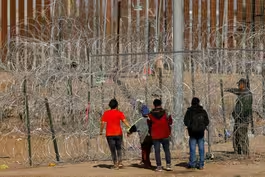
A standoff between federal Border Patrol and Texas state officials is intensifying following a Supreme Court ruling in favor of the Biden administration.
Laura Barron-Lopez has more.
LAURA BARRON-LOPEZ: Earlier this week, the Supreme Court said U.S. Border Patrol agents could remove razor wire that the state put in place along the Rio Grande River.
The Homeland Security Department is demanding immediate access to a section of the border and being blocked with razor wire and fencing.
But Texas Governor Greg Abbott is doubling down, blocking the agents from entering the area and saying Texas constitutional authority is -- quote -- "the supreme law of the land and supersedes any federal statutes to the contrary."
Joining me to discuss this further is Stephen Vladeck, a professor at the University of Texas School of Law.
Professor Vladeck, thanks so much for joining.
Republican Governor Abbott is saying Texas is going to hold the line.
And it's unclear when or if this razor wire is going to be removed.
Who ultimately has the authority over the border here?
STEPHEN VLADECK, University of Texas School of Law: Yes, I mean, I think it's pretty clear, under the Constitution, under our precedents, that immigration policy, control of the border really is ultimately in the federal government's purview.
But, Laura, I think it's just as clear that Governor Abbott wants this confrontation and that he's willing to take this battle all the way back to the Supreme Court before he's going to stand down.
LAURA BARRON-LOPEZ: And Governor Abbott is claiming that he has this authority under the U.S. Constitution because the federal government isn't protecting Texas against a -- quote -- "invasion."
That's the way he's been describing it.
Is this a reasonable interpretation of the Constitution?
STEVE VLADECK: No, and in two different respects.
I mean, the first is that, obviously, an influx of asylum seekers, however many we're talking about, is not what the founders had in mind when they used the word invasion.
But, Laura, second, even if you're not persuaded by that, the clause Governor Abbott's relying on in Article 1, Section 10 of the Constitution was dealing with the specific scenario of the ability of states to respond to invasions until federal authorities were able to respond.
This is the time in American history when the federal military was small.
It was very spread out.
It took weeks to travel.
Congress was usually out of session.
There's no support in our history, there's no support in founding or other materials for the idea that states can decide for themselves that they're under invasion, and, even if the federal government disagrees, that somehow it's the state's determination that would control.
LAURA BARRON-LOPEZ: Recently, three migrants drowned in the Rio Grande in this section that Border Patrol agents have been trying to access.
And all this comes as a number of Republican governors still say that they support Texas, that they stand by Texas.
What are the larger implications of this standoff between Texas and the federal government?
STEVE VLADECK: I mean, the larger implications are pretty staggering.
It's not just the specter of a physical confrontation between federal and Texas officials along the border in Eagle Pass.
It's also basically a relegation of a debate that we had in American law for the first 70 years of this country about the ability of states to effectively nullify those federal laws that they disagreed with, that they thought were unconstitutional.
For better or for worse in our constitutional system, federal law supersedes state law, even when we don't like how the federal government is or is not enforcing those federal laws.
The remedies for those disagreements are not to allow every state to go out on their own and to have their own policies.
The remedies, if you really have a problem with the policies, is to change the people who are making them.
Otherwise, it's a federal system, Laura, in name only.
LAURA BARRON-LOPEZ: And Governor Abbott also claims that the federal government has -- quote - - "broken the compact with states."
Where have -- what do you think he means by that?
And have states in the past used that language to justify defying the federal government?
STEVE VLADECK: Yes, I mean, the compact theory of the Constitution is a pretty outlier view, especially these days, about the way the Constitution was formed.
The basic premise is that the federal government, the constitutional system we have was formed by the states, and, therefore, the states can control its terms.
That was the argument on which the Southern states predicated secession and helped to precipitate the Civil War.
There's a reason why we tend not to hear that much of it these days.
Again, I mean, I think there's a lot of folks who are going to have strong views about whether the Biden administration is or isn't doing what's best for the country at the border.
But the way to air those disagreements is through the federal electoral process.
In a world in which states can follow this version of the compact theory as a justification for interfering with federal authority, what's to stop California from doing that to the next Republican president?
What's to stop Vermont from doing that to the next Republican president?
And then we're talking about a system in which the states have all the power, and the federal government is basically impotent to do anything.
LAURA BARRON-LOPEZ: Professor Stephen Vladeck of the University of Texas, thank you for your time.
STEVE VLADECK: Thank you.
AMNA NAWAZ: Now to a view of this crisis from the top levels of the Mexican government.
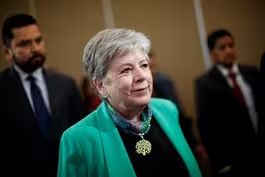
A short time ago, I spoke with Mexico's secretary of foreign affairs, Alicia Barcena.
Just last week, she met with Secretary of State Antony Blinken here in Washington on this complex political, but fundamentally human matter.
Since the holidays, there's been a drop in migrant encounters at the U.S. border, which the Biden administration credits to more aggressive enforcement by Mexico.
I began by asking Secretary Barcena what Mexico has done differently.
ALICIA BARCENA, Mexican Foreign Affairs Secretary: In the case of U.S. and Mexico, it's no longer Mexicans going to the U.S. that much.
We are having much more people coming from Guatemala, Venezuela, and we agreed that we were going to, in a certain way, do some repatriation back to the countries of origin.
So that's number one measure we have been doing, and that has worked quite well.
Secondly is that we have done much more law enforcement to bring down the pressure in the border in the north, and we are bringing people from the north to the southern part of Mexico.
And, from there, we are looking for, in some cases -- some people cannot be -- some migrants cannot be repatriated, such as the Haitians, for example.
So we help them to find some jobs in our own country.
Then the third one is we are focusing on the structural causes of migration, which means that we are going to these countries and we are providing some development packages to the people to -- in a certain way, to incentivize them to stay back in their countries of origin.
AMNA NAWAZ: As part of your enforcement efforts, I know in the past Mexico has relied heavily on your armed forces and on the National Guard, and there's been some studies that have shown that that reliance has led to a number of abuses, sexual abuse and extortion along the way, particularly for women and migrants of African descent.
I have to tell you, from the migrants I have met recently arriving in the U.S., most of them have said the most difficult part of the journey is coming through Mexico, because of that abuse.
How is your government planning to stop that?
ALICIA BARCENA: You see, the thing is that this is something that we are very worried about, because, precisely, we are trying to seek the possibility of people staying in the southern part of Mexico, because the travel is dangerous.
I think the smugglers is a big problem, a big issue, not only from Mexico.
This starts from the Darien in Panama.
So, one of the things we are aiming at is to go together to the Darien, together with the U.S., Colombia, Panama and other countries, to see if we can stop the human trafficking, because this is a real serious problem.
AMNA NAWAZ: Madam Secretary, if I may, what I have heard from these migrants, though, is not that the Darien Gap was difficult.
It is that Mexican officials, Mexican authorities are the ones abusing and extorting them.
ALICIA BARCENA: Well, sometimes, we have to stop them from getting to the border.
That is true.
And so they want -- one of the things we have to realize is, these people are looking to go to the U.S. That's what they want.
And if we are going to try -- and these people are basically illegal immigrants.
So we are trying to -- we are -- in a certain way, we are doing a lot of efforts to accompany the guards, the military and the -- as you say, the law enforcement officials, to be accompanied by human rights officials.
We are working on that, and also to provide them with social services on their way and humanitarian.
We have 52 shelters, and we have 100 shelters for children and -- that are unaccompanied or children on their own.
So what we are working on is, whenever a migrant comes in and transits in our country, if they are children, and unaccompanied children, we send them to these shelters immediately, to the shelters for children and mothers, for example, or families.
And then, of course, yes, many of them get very aggressive, because we want them to go back.
Of course, that becomes a problem.
Or when we want to repatriate them, that's another issue as well.
AMNA NAWAZ: Secretary Barcena, let me ask you how you're viewing the current immigration debate in the U.S., because, right now, the man who could become the nominee for the Republican Party, former President Donald Trump, has talked about cracking down on immigration and on deporting more people.
And the conversation right now is around tightening access and asylum restrictions.
How do you view that conversation?
How do Mexicans view that conversation?
ALICIA BARCENA: Well, I have to tell you that I think we have to change the narrative, because, at the end of the day, Mexico and the U.S. are neighbors.
We are -- our proximity is there.
We have -- we are the first trading partner of the U.S. today, $163 billion a year, which is $2 million per minute.
This is the trading between U.S. and Mexico.
The major part of these exports to the U.S. are also U.S. components, by the way.
We're talking about 40 percent of the exports of Mexico are U.S. components that come in and out.
So,if the borders are closed, as it happened in December, the damage is not only for Mexico.
It's going to be also for the U.S.
So this is why we believe that we have to partner, U.S. and Mexico, agree on how do we want to deal with migration, which is not coming from Mexico that much.
It's coming from the region, from the southern part of Mexico.
So, of course, I understand the narrative that is -- I mean, it's a narrative that is very negative, because also it's like the Mexicans are the bad guys that are bringing and contaminating the blood of the America.
Come on, give me a break.
The Mexican migrants in the U.S. are contributing to the economy big time.
They are providing $9 billion a year of taxes.
And the salaries, only 20 percent of the salaries of the Mexicans in the U.S. are coming to our country.
We're talking about $65 billion.
That's 20 percent of the salaries.
So that means that 80 percent is staying in the economy of the U.S.
So, and also... AMNA NAWAZ: Madam Secretary, if I may, let me ask you about the other aspects of this relationship, though, because a senior official I spoke with today stressed exactly that, that it is a multifaceted partnership between U.S. and Mexico.
He said, in part, that it's based on security and the economic and migration cooperation, also to combat trafficking and organized crime, and also what he called the scourge of fentanyl.
And, on that point, I need to ask you, because we know most of the precursors in fentanyl are produced in China, but Mexico has become a major transit and production hub, and that is fueling the opioid crisis here in the United States, where tens of thousands of people have died in the last year.
What more can your government do to address that?
ALICIA BARCENA: What we're doing is, we are controlling the coming in of the precursors of fentanyl from China.
And we have a system that we are controlling the entrance of these precursors, because many of these precursors of fentanyl are legal, by the way, because they are used for anesthetics.
And the other thing is, we have to work on the addiction.
We don't have that much consumption of fentanyl in Mexico.
The fentanyl that goes into the U.S. is basically brought in by the Americans, in themselves.
We have closed down laboratories.
We're doing a lot of work in enforcing the - - and supervision of the borders.
AMNA NAWAZ: That is the Mexican secretary of foreign affairs, Alicia Barcena, joining us tonight.
Madam Secretary, thank you for your time.
Really appreciate it.
ALICIA BARCENA: Thank you so much for the opportunity.
Great pleasure.
AMNA NAWAZ: New research is showing just how much of an impact the overturning of Roe v. Wade has had on rape-related pregnancies.
John Yang has more.
JOHN YANG: Amna, polls show that about seven in 10 Americans say abortion should be allowed in cases of rape or incest.
But since the Supreme Court overturned Roe v. Wade in 2022, nine states have banned abortion even in those cases.
Five others have exceptions for rape, but only in the very early stages of pregnancy or after the assault is reported to law enforcement.
In a new study published this week in "The Journal of the American Medical Association," researchers used government data on sexual violence to calculate that, since the Supreme Court said states could regulate abortion however they want, there have been more than 64,000 rape-related pregnancies in jurisdictions with bans.
They estimate that 26,000 of those were in Texas alone.
Dr. Samuel Dickman is one of the study's co-authors.
He's an abortion provider and the chief medical officer for Planned Parenthood of Montana.
Dr. Dickman, is there anything in what you found in your study that surprised you?
DR. SAMUEL DICKMAN, Chief Medical Officer, Planned Parenthood of Montana: Well, thank you, John.
The numbers are just shocking.
We know that sexual assault is common, or at least people who work in the reproductive health world know that it's common.
But seeing the scale of this problem, I mean, it was honestly horrifying when we conducted this study.
JOHN YANG: And you say in your report -- or at least I take it you're saying that this could actually be an undercount.
DR. SAMUEL DICKMAN: Well, studying sexual assault and rape is notoriously challenging, because it's such a stigmatized life event.
So, some people will never report that they were sexually assaulted even on an anonymous survey.
So that would cause our estimates to be too low.
On the other hand, there are other assumptions that we have to make in a modeling study that might bias the estimates to be too high.
So we think we use the best available data using published peer-reviewed research.
But, of course, these are just estimates.
JOHN YANG: Why did you undertake this study?
DR. SAMUEL DICKMAN: Well, I have been an abortion provider for years.
And I have taken care of far too many patients who have come to me and told me that their pregnancy was a result of rape.
And when I talked to my friends and colleagues around the country who work in abortion care and reproductive health, they told me the same thing.
And our study was an attempt to try to figure out, how common is that, that case where someone becomes pregnant as a result of rape?
JOHN YANG: As we mentioned, there are five states that do have exceptions for rape, but under very tight restrictions.
Given those restrictions, how meaningful are those exceptions?
DR. SAMUEL DICKMAN: Those exceptions provide no meaningful abortion care for survivors of rape and sexual assault, full stop.
There are no abortions happening for survivors of rape in states like Idaho that supposedly have exceptions for rape.
But we know that, because of the extremely burdensome criteria for obtaining an abortion, not just on the survivor, but on the medical provider, that providers are essentially telling those survivors of rape that they need to travel out of state or find somewhere else to go or continue a pregnancy that was a result of sexual violence.
JOHN YANG: I was going to ask that.
There's no way of telling, because these are estimates.
But, from your experience, what are these women doing who are pregnant because of rape and unable to get an abortion where they live?
DR. SAMUEL DICKMAN: Well, I have taken care of patients who've driven hours with their family members from Idaho, who've flown from Texas because they weren't able to obtain abortions in those states.
So I think some are able to make that incredibly challenging trip to travel out of state.
But when I think about the patients I took care of in San Antonio when I worked there for years in South Texas, in order for them to get out of state, there are -- they would have to drive 10 hours each way.
They would have to find childcare.
They would have -- I mean, that's difficult for anybody, but imagine the patient who's in an unsafe, abusive relationship, where she doesn't have control over anything in her life, even her own body.
I mean, it's just -- it's so hard to imagine her getting out of state to obtain an abortion.
And that means that many survivors will end up having to continue a pregnancy.
JOHN YANG: You mentioned that you used to practice in Southern Texas.
You moved to Montana just before the court overturned Roe v. Wade.
Why did you move?
DR. SAMUEL DICKMAN: You know, I trained for many years to become a physician and an abortion provider.
And it's an absolute privilege to be able to provide those services to patients.
And my family and I knew that I wouldn't be able to do that after the Dobbs decision was made.
It was very clear that Texas was going to ban all abortions.
And so it was a very difficult decision.
JOHN YANG: Dr. Samuel Dickman, the chief medical officer for Planned Parenthood of Montana.
Thank you very much, Doctor.
DR. SAMUEL DICKMAN: Thank you, John.
AMNA NAWAZ: The push towards a green, battery-powered future comes with a major tradeoff.
More mining for lithium in the U.S. will stress a vital resource, water.
This story comes to us from the Howard Center for Investigative journalism at Arizona State University.
Caitlin Thompson has more.
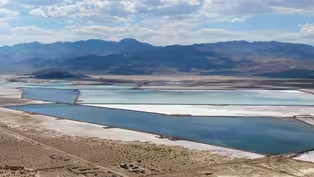
CAITLIN THOMPSON: In the dry, desert landscape of Central Nevada, Nyle Pennington is checking groundwater levels outside America's only active lithium mine.
NYLE PENNINGTON, Hydrologist: The water goes in through the hole in the bottom, and when it just kisses that, then you read the tape.
That's how it's done.
CAITLIN THOMPSON: Pennington is a longtime water scientist who works for a Nevada water authority.
NYLE PENNINGTON: And since were here, I'm going to give it the old Nyle Pennington test.
CAITLIN THOMPSON: He drops a rock into a water monitoring station.
NYLE PENNINGTON: Bone-dry.
If that would have had water in it, you would have heard a pronounced, loud splash.
CAITLIN THOMPSON: This well typically held 30 feet of water.
For Pennington, the hollow sound is a warning bell about the impact from lithium mining.
The mine here needs billions of gallons of water every year, taking it from underground aquifers.
The mine's owner denies it is impacting freshwater aquifers, but Pennington says the evidence he found shows otherwise.
NYLE PENNINGTON: They're overdrafting down there, and it dried this well out.
CAITLIN THOMPSON: Not far away, Esmeralda County Commissioner De Winsor is also seeing a disturbing pattern.
DE WINSOR, Esmeralda County, Nevada, Commissioner: Yes, these out here have opened up a lot more since I have been around in just the last few years.
CAITLIN THOMPSON: Fissures and sinkholes have formed across the valley.
DE WINSOR: This one here has been opened up for quite a few years.
It's getting wider all the time.
CAITLIN THOMPSON: Winsor suspects lithium mining's thirst for water is altering the landscape.
DE WINSOR: A lady fell in there one year, her and her dogs.
CAITLIN THOMPSON: Pennington and Winsor are front-line observers of a new mining rush for lithium.
The mineral is critical for batteries that power everything from electric vehicles to power tools.
For now, China controls much of America's supply.
JOE BIDEN, President of the United States: And for some battery components, critical materials, China controls nearly half the global production.
But China's battery technology is not more innovative than anyone else's.
CAITLIN THOMPSON: The Biden administration is pushing for homegrown lithium production, for national security and green energy.
JOE BIDEN: Anyone want to jump in the back?
CAITLIN THOMPSON: Research by the Howard Center found opening new domestic mines will require billions of gallons of water.
The majority of new mines are proposed for the arid American West in areas prone to chronic droughts.
We found large-scale lithium production could soon stress water supplies in many states.
It's already happening in Nevada at Silver Peak, the country's only active lithium mine, operating since 1966.
And it's where Nyle Pennington has documented falling groundwater levels, like at this well that he says provided water for cattle.
NYLE PENNINGTON: My static water level was at 70 feet.
And it didn't take any time at all.
I mean, they have dried this well out in the course of a year.
CAITLIN THOMPSON: The Silver Peak mine is owned by Albemarle.
The American company is the world's largest producer of lithium, mainly from mines overseas.
Silver Peak is Albemarle's first U.S. mine.
We told Albemarle we wanted to ask about how the water authority identified groundwater wells running dry and how it believes the Silver Peak mine is playing a part.
The company provided the mine's operations manager, Scott Thibodeaux, who spoke to Howard Center reporter Jordan Gerard.
JORDAN GERARD, Howard Center for Investigative Journalism, Arizona State University: Those reports that their hydrologist submits to them blames lithium mining for -- quote -- "de-watering throughout Clayton Valley."
SCOTT THIBODEAUX, Operations Manager, Silver Peak Lithium Mine: I'm not familiar with the particulars.
I don't know that I can comment on that.
CAITLIN THOMPSON: Albemarle is permitted by the state for its water use.
And government records show, in 2020, Silver Peak pumped more than four billion gallons of salty, lithium-rich groundwater, plus hundreds of millions of gallons of freshwater to extract lithium.
And, since then, it's water usage has only grown.
The Central Nevada Regional Water Authority says all the pumping is making the groundwater dry up.
Its 2022 annual report says the drying of one monitoring well is due exclusively to de-watering throughout Clayton Valley for lithium mining purposes.
JEFF FONTAINE, Executive Director, Central Nevada Regional Water Authority: I think that the alarm bells have been rung.
CAITLIN THOMPSON: Jeff Fontaine is the executive director for the Central Nevada Regional Water Authority.
JEFF FONTAINE: I think there are a lot of people concerned about what's happening in Clayton Valley, but I don't know that there's agreement on what needs to be done.
CAITLIN THOMPSON: More lithium mines are coming.
Across the nation, we found more than 70 proposals already in the exploration or permitting phase.
The projects span nine states from California to North Carolina.
Just in Nevada, 28 lithium mines are trying to come online within 50 miles of the Silver Peak Mine, a potential economic boon for Nevada.
GOV.
JOE LOMBARDO (R-NV): Whether it's closing the lithium loop, unlocking innovation and investments in logistics, the message is that Nevada is ready to partner.
(APPLAUSE) CAITLIN THOMPSON: The Howard Center found, most of Nevada's proposed projects will rely on groundwater from basins that are already stressed.
GOV.
GAVIN NEWSOM (D-CA): We see this as one of the greatest economic opportunities of our lifetime.
And we want California to dominate in this space.
CAITLIN THOMPSON: California Governor Gavin Newsom is one of lithium's biggest cheerleaders.
GOV.
GAVIN NEWSOM: And that's the opportunity here anew.
This is it.
This is the Holy Grail.
CAITLIN THOMPSON: Here in the Salton Sea, carbon dioxide bubbles announce chemical reactions deep below ground.
The superheated liquid contains lithium from one of the biggest deposits in the world.
Planned extraction will require access to large amounts of freshwater from the Colorado River.
Its water supply is already stressed and suffering the impact of chronic drought, leaving states, Native American tribes, and industry fighting to access what's left.
JIM TURNER, President, Controlled Thermal Resources: There probably will be a lot of tension.
There already is.
CAITLIN THOMPSON: In January 2023, Jim Turner, president of Controlled Thermal Resources, spoke to the "NewsHour" about his lithium mining project.
JIM TURNER: We will take that lithium hydroxide and we will crystallize it with a certain type of equipment.
And we will get little crystals.
CAITLIN THOMPSON: Months later, the company disclosed just how much Colorado River water the project plans to take when it opens next year, almost two billion gallons of freshwater a year, or nearly 100 billion gallons over the mine'S life.
In a recent interview with the Howard Center, Turner broke the numbers down.
JIM TURNER: When you put it in terms of gallons, it does sound like a lot of water, and it is a lot of water.
CAITLIN THOMPSON: Turner says his company is considering alternative water sources.
He wants to use water left over from farming and ranching, which take the lion'S share of water from the Colorado River.
JIM TURNER: We're doing a lot of work on, can we take drain water, for example, after its gone through the agricultural world out here, can we use that water with some cleanup effort in our process?
CAITLIN THOMPSON: The Howard Center found the combined water needs of lithium mining in California could force neighboring states upriver like Nevada and Arizona to reduce water consumption in a future drought.
Arizona Congressman Raul Grijalva supports lithium mining, but says the 19th century law governing mining was written in an era when lawmakers didn't think about the impact on water supplies.
REP. RAUL GRIJALVA (D-AZ): And we're working with a regulatory framework based on 1872, a 150-year-old federal law, that basically is permissive, to the point of giving the mining industry almost unfettered right to utilize whatever water resources needed to extract.
CAITLIN THOMPSON: There are no federal laws governing how much water a mine can consume.
Grijalva is sponsoring new legislation to modernize the law.
So far, it has support only from fellow Democrats.
REP. RAUL GRIJALVA: I think it's critical to create a balance in order for us to be able to do this correctly.
Dealing with the crisis of climate does not mean that we create another environmental crisis by using water now that is becoming more and more precious every day.
CAITLIN THOMPSON: Back in Silver Peak, Albemarle says it's sticking to plans first announced in 2021 to increase pumping to 6.5 billion gallons of salty, lithium-rich water a year, right as more mines continue the push to come online.
For the "PBS NewsHour," I'm Caitlin Thompson at the Howard Center for Investigative Journalism at Arizona State university in Phoenix.
AMNA NAWAZ: Ohio is the latest state to ban gender-affirming care for transgender youth and to limit trans athletes' participation in school sports.
A total of 23 states have passed trans health care bans, with 20 approved just in the past year.
Stephanie Sy has more.
STEPHANIE SY: Amna, Ohio Governor Mike DeWine had blocked this bill late last month, saying parents and doctors should make decisions around gender-affirming care, not the state.
But, yesterday, the Ohio Senate overrode the governor's veto.
The new law bans gender-affirming surgeries, new prescriptions for puberty blockers and hormone therapy, and restricts mental health care for trans minors without a parent's or guardian's consent.
Doctors who provide care in violation of the law can lose their medical license.
It also bans trans women and girls from playing on women's sports teams in high schools and colleges.
Orion Rummler covers all this for The 19th News and joins us now.
Orion, what kind of impact will this law have on transgender youth and transgender athletes?
ORION RUMMLER, The 19th News: Thank you so much, Stephanie.
So, this law, which, important to remember, will not go into effect until late April, like you said, would prevent trans youth from accessing medications, such as puberty blockers and hormone therapy, as part of their gender-forming care.
And there are also other restrictions at play in Ohio right now that Governor DeWine put into place whenever he vetoed this ban.
He made a couple administrative proposals.
And those restrictions that DeWine brought would affect adults, as well as minors.
STEPHANIE SY: We spoke to someone from TransOhio earlier.
Here's what they said about the effect the law is already having on Ohio families.
DARA ADKISON, Board Secretary, TransOhio: We're in the process of essentially starting refugee enclaves in half-a-dozen states of people who used to want to be in Ohio.
I mean, many of them still do.
These are people who have lived here their whole lives.
They have extended family connections, businesses, jobs, everything that you would expect for people who live somewhere, and they're in the process of deciding to uproot themselves or what they do.
STEPHANIE SY: So, Orion, they're saying people may just leave Ohio.
But with nearly two dozen states enacting similar bans on gender-affirming care for minors, where do these families with transgender kids go?
ORION RUMMLER: That's the question, is, as more states, like you said, ban this care, there aren't many options for them to go, because it's a -- if you look at a map of which of the 22, now 23 states have put in place a gender-affirming care ban, it's basically the entire South.
And then, in Ohio, we're seeing more into the Midwest.
So, families -- not many families have the ability to just pick up and leave.
And the ones I have spoken to in other states, when they are able to move and decide to do so, it's usually like quite a distance, like cross-country, like, just as far as they can get.
STEPHANIE SY: I want to play what a Republican senator who supported the Ohio bill said.
STATE REP. STEVE HUFFMAN (R-OH): We're not outlawing all trans in the state of Ohio.
We're just asking you to say, wait until you're 18.
Wait until you're -- you have the ability to make the decision with your unmature mind, to give that a break.
STEPHANIE SY: So, the backers of the ban say they're trying to keep children safe from medical experimentation.
That's what they call it, citing risks, for example, with puberty blockers.
Orion, where does the evidence stand right now?
What is best for these children, mentally and physically?
ORION RUMMLER: So, whenever a child is going through with gender-affirming care, it already involves elements such as a mental health screening.
It already involves being told of what the consequences are, with the child and the parents involved in going through a process of, these are all the irreversible changes.
These are the reversible changes.
Here's what you can expect down the line.
So, all of that is already part of the process.
And gender-affirming care has been approved by several major medical organizations, who say this care is safe.
And it's -- the way that Republicans frame this care, it's framed in a way that they're just given this care without any context of what they can expect and what the side effects are.
And that's just not true.
That's always a part of the discussion when you're receiving this kind of care.
STEPHANIE SY: You have covered other ways states are targeting trans people in new proposed laws.
What are you watching for in the year ahead?
ORION RUMMLER: In the year ahead, I'm watching for more states to be focused on restrictions on trans adults beyond gender-affirming care.
Right now, at least 10 states are trying to change how they define sex in their state law based on reproductive ability in ways that would prevent trans people from being able to access identity documents, which is their driver's license, from being able to access public restrooms, even in Florida from holding office.
And these definitions, based on reproductive capacity, would also exclude cisgender women who have certain health conditions.
And advocates are really concerned about these bills.
So that's one thing I'm watching in the next - - in the new year.
STEPHANIE SY: Orion Rummler with The 19th News, thank you.
ORION RUMMLER: Thank you so much, Stephanie.
AMNA NAWAZ: After serving prison time for forgery, credit card abuse and burglary, turned to music to change the direction of his life and help young people avoid his path.
The three-time Grammy nominated performer calls himself the musician with a message.
Our Student Reporting Labs team caught up with them during their winter academy in Austin, Texas, for arts and culture series, Canvas.
SAULPAUL, Founder, The SaulPaul Foundation: If young me saw me now, young me would be very, very proud.
He would have his mind blown.
I grew up in the ghetto.
As a young adult of 20 years old, I was sent to prison.
But, as I sat in prison, I realized that it was not because my mom died when I was 3.
I wasn't in prison because my dad left.
I wasn't in prison because I was Black.
I wasn't in prison because of poverty.
I was in prison because of my choices.
But then that is what empowered me.
I was like, wait, if I'm in prison because of my choices, through my choices, I could also dictate my success.
Prison is terrible, definitely punishment, not rehabilitation.
So prison to me was rock bottom, and it inspired me to become who I am now.
My name comes from this guy in the Bible, Apostle Paul.
Before his name was Paul, his name was Saul.
When his name was Saul, he wasn't the best person, and then he had a life transformation, and I could relate to that, because it represented my entire experience.
I choose to be the change, because someone chose to be the change in my life, and that was my grandmother, this amazing woman named Pearly (ph).
She adopted me, and she raised me as her own.
She's no longer here, but I'm her legacy, and she's my why.
When I create music, I like to create movement.
My first movement was called Tower to Tower, and it was how I transitioned and went from prison incarceration to college graduation.
I was like, hey, this isn't working.
Everybody just says, I'm great.
But I need people to recognize that they're great.
I came up with another project, and that was Be the Change.
And I was like, OK, I think this is big enough that everybody can be part of it, yet it's unique to every individual.
Melissa, what's one way you can give back, be kind or be the change?
Last fall, when I went on the Be the Change Tour, I visited 100 schools in 100 cities in 32 states, and saw 125,000 students.
They have done sports clinics.
We have had seniors, mentors, and tutor elementary school students.
This is another group of young people.
They basically wrote notes of encouragement to victims of the wildfire in Hawaii.
I think one reason I'm able to connect with young people is because I speak to young people the way that I wish someone would have spoke to me.
When you give back, not only do you get the benefit of helping others.
It's like, it just works.
I'm SaulPaul, the musician with the message.
I entertain, I inspire, I empower, I equip others to recognize they're born on purpose, with a purpose, and to be the change in their neighborhoods, their communities, in their cities, and on this planet.
(SINGING) AMNA NAWAZ: Choosing to be the change, what a great message.
And that is the "NewsHour" for tonight.
I'm Amna Nawaz.
On behalf of the entire "NewsHour" team, thank you for joining us.
Border standoff intensifies as Texas governor defies ruling
Video has Closed Captions
Border standoff between Texas, feds intensifies as governor defies Supreme Court ruling (5m)
Demand for lithium batteries could harm U.S. water resources
Video has Closed Captions
How demand for lithium batteries could drain America's water resources (9m 38s)
How abortion restrictions affect thousands of rape victims
Video has Closed Captions
Study estimates 64,000 pregnancies from rape in states that enacted abortion bans post-Roe (5m 49s)
Mexico's foreign secretary on steps to ease border crisis
Video has Closed Captions
Mexico's foreign secretary discusses what her country is doing to ease border crisis (7m 44s)
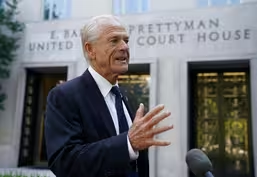
News Wrap: Peter Navarro sentenced for contempt of Congress
Video has Closed Captions
News Wrap: Former Trump adviser Peter Navarro sentenced to prison for contempt of Congress (5m 13s)
Ohio becomes latest state to restrict gender-affirming care
Video has Closed Captions
Ohio becomes latest state to restrict gender-affirming care for minors (5m 53s)
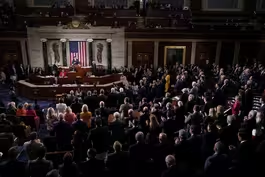
Possible deal on Ukraine, immigration at risk of collapsing
Video has Closed Captions
Possible deal on Ukraine aid, immigration reform at risk of collapsing (4m 38s)
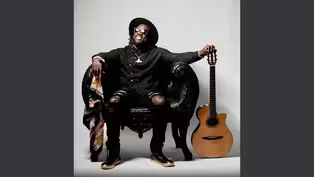
SaulPaul uses his music to inspire and empower young people
Video has Closed Captions
How SaulPaul is using his music to inspire and empower young people (3m 39s)

Trump takes the stand in federal defamation case
Video has Closed Captions
What happened in court when Trump took the stand in federal defamation case (4m 43s)
Providing Support for PBS.org
Learn Moreabout PBS online sponsorship
- News and Public Affairs

FRONTLINE is investigative journalism that questions, explains and changes our world.

- News and Public Affairs

Amanpour and Company features conversations with leaders and decision makers.












Support for PBS provided by:
Major corporate funding for the PBS News Hour is provided by BDO, BNSF, Consumer Cellular, American Cruise Lines, and Raymond James. Funding for the PBS NewsHour Weekend is provided by...