
March 19, 2024 - PBS NewsHour full episode
3/19/2024 | 57m 46sVideo has Closed Captions
March 19, 2024 - PBS NewsHour full episode
March 19, 2024 - PBS NewsHour full episode
Problems playing video? | Closed Captioning Feedback
Problems playing video? | Closed Captioning Feedback
Major corporate funding for the PBS News Hour is provided by BDO, BNSF, Consumer Cellular, American Cruise Lines, and Raymond James. Funding for the PBS NewsHour Weekend is provided by...
Support provided by:

March 19, 2024 - PBS NewsHour full episode
3/19/2024 | 57m 46sVideo has Closed Captions
March 19, 2024 - PBS NewsHour full episode
Problems playing video? | Closed Captioning Feedback
How to Watch PBS News Hour
PBS News Hour is available to stream on pbs.org and the free PBS App, available on iPhone, Apple TV, Android TV, Android smartphones, Amazon Fire TV, Amazon Fire Tablet, Roku, Samsung Smart TV, and Vizio.
Providing Support for PBS.org
Learn Moreabout PBS online sponsorshipGEOFF BENNETT: Good evening.
I'm Geoff Bennett.
AMNA NAWAZ: And I'm Amna Nawaz.
On the "NewsHour" tonight: An immigration ruling from the Supreme Court means Texas police can now arrest and deport migrants.
GEOFF BENNETT: Experts warn of famine in Gaza, as a rift opens between Israeli Prime Minister Benjamin Netanyahu and the Biden White House.
AMNA NAWAZ: And how influencers on social media are playing an outsized role in this presidential election.
HARRY SISSON, Digital Content Creator: A lot of people are persuaded daily by stuff on TikTok.
They will see a clip of Biden or Trump saying something, and that will change their minds.
(BREAK) AMNA NAWAZ: Welcome to the "NewsHour."
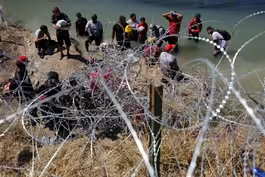
The U.S. Supreme Court has cleared the way for Texas to enforce a controversial immigration law for now.
The law allows state officials to arrest and deport migrants suspected of crossing the border illegally.
GEOFF BENNETT: The three liberal justices dissented, with Justice Sonia Sotomayor warning - - quote -- "The court gives a green light to a law that will upend the longstanding federal state-balance of power and sow chaos."
Challenges to the law are not over, as the justices sent the case back to a lower court.
"NewsHour" Supreme Court analyst Marcia Coyle has been following the decision and joins us now.
Marcia, it's great to see you.
So, the Supreme Court will allow Texas to enforce for now this contentious new law that gives local police the authority to arrest migrants.
How did the justices arrive at this ruling?
MARCIA COYLE: Well, first of all, Geoff, it appears to be a 6-3 decision not to grant the Biden administration a temporary pause on the law taking effect.
The only one who wrote in the majority was Justice Barrett, and she was joined by Justice Kavanaugh.
And her bottom line seems to be that it is premature for the Supreme Court to act on the administration's request at this time while the lower federal appellate court, the Fifth Circuit, still had before it the question of whether to pause the law while the -- an appeal goes forward in that Fifth Circuit.
GEOFF BENNETT: So, this law now goes into effect as the litigation continues in the lower courts.
What happens next?
What are the implications?
MARCIA COYLE: OK, well, first of all, the lower federal appellate court, I believe, has scheduled arguments for the first week in April on whether it should pause the law while an appeal goes forward.
But with the law, the law would immediately take effect now, and Texas will begin to implement it.
It, as you said, allows law enforcement officials to arrest undocumented immigrants who cross the border illegally, allows them to deport them to Mexico.
State judges can make the deportations.
It is quite a departure from what federal law has historically given the responsibility to the federal government.
Texas, on the other hand, claims that its law mirrors the federal law and that many states cooperate.
GEOFF BENNETT: That is "NewsHour" Supreme Court analyst Marcia Coyle.
Marcia, thanks, as always.
MARCIA COYLE: My pleasure, Geoff.
AMNA NAWAZ: In the day's other headlines: President Biden kicked off a three-day swing across the West with a focus on winning Latino voters.
He stopped first in Reno, Nevada, to meet with volunteers, before heading to Las Vegas, then to Phoenix, Arizona, and finally to Dallas and Houston in Texas.
In the meantime, former President Trump stirred new outrage for saying Jewish voters who support Democrats hate Israel and Judaism.
The nation's top Jewish elected official, Senate Majority Leader Chuck Schumer, called it -- quote -- "unadulterated antisemitism."
Both candidates have clinched their presidential nominations, but other races are getting attention tonight in the latest primaries.
Republicans in Ohio are picking a candidate to try to pick up a U.S. Senate seat.
And in heavily Democratic Chicago, voters are choosing a nominee for the nation's second largest prosecutor's office.
The winner is all but assured of election in November.
Congressional negotiators worked today to flesh out spending bills needed to avert a partial government shutdown this weekend.
They agreed overnight on the overall package, covering the Pentagon, Homeland Security and other departments.
Senate leaders welcomed the deal, but said time is running out.
SEN. CHUCK SCHUMER (D-NY): There's a lot of work to do in the coming days.
If both parties proceed in the same manner we did two weeks ago, quickly, constructively, and without unnecessary partisan dithering, then I'm hopeful we can finish the appropriations process without causing a lapse in government services.
AMNA NAWAZ: The spending bills are the final ones needed to fund the government for the rest of the fiscal year.
Former Trump trade adviser Peter Navarro reported to federal prison today in Miami.
He's to serve four months for refusing to cooperate with the congressional January 6 investigation.
Navarro condemned the justice system today at a news conference.
Then he was driven into the prison complex, and officials confirmed he's now in custody.
In Mississippi, two former sheriff's deputies were sentenced in the racist torture of two Black men.
One defendant got 20 years in federal prison.
The other got more than 17 years.
In all, six former officers admitted to their roles in sexually and physically abusing the victims.
Several belong to a group known as the Goon Squad.
The sentencings continue tomorrow and Thursday.
Defense Secretary Lloyd Austin insisted today that Washington remained committed to Ukraine's war effort, despite a funding stalemate in Congress.
Austin joined counterparts from Europe and other nations at a meeting in Germany.
Later, he said -- quote -- "The United States will not let Ukraine fail."
LLOYD AUSTIN, U.S. Secretary of Defense: I leave here today fully determined to keep U.S. security assistance and ammunition flowing.
And that's a matter of survival and sovereignty for Ukraine.
And it's a matter of honor and security for America.
And make no mistake, Putin is watching, the world is watching, and history is watching.
AMNA NAWAZ: Last week, the Pentagon sent its first military aid to Ukraine since December after finding cost savings in other accounts.
In Hong Kong today, lawmakers unanimously approved a national security law that grants the government even more power to crack down on dissent.
The legislature, stacked with pro-China loyalists, had fast-tracked the measure.
It expands on a similar law that's been used to prosecute pro-democracy activists since 2020.
Former Brazilian President Jair Bolsonaro is facing the first of what may be multiple indictments, this one for falsifying his COVID vaccination status.
The far right leader had openly flouted health restrictions during the pandemic.
Under Brazil's legal system, today's indictment allows actual charges to be filed.
The United Nations International Labor Organization reports that illegal profits from forced labor have skyrocketed to $236 billion per year.
The agency finds there was a 37 percent increase in 2021 from a decade earlier.
It also found sexual exploitation accounts for three-quarters of the illicit profits.
Back in this country, the Biden administration is easing its drive for more electric vehicles.
The Energy Department granted higher mileage ratings for E.V.s today.
That makes it easier for automakers to meet higher fuel economy mandates.
And reports said the EPA will relax its timetable for tailpipe emission cuts.
The plan relies heavily on E.V.
sales, but demand for the vehicles has slowed.
And on Wall Street, stocks advanced again today ahead of tomorrow's Federal Reserve announcement on interest rates.
The Dow Jones industrial average gained 320 points to close at 39,110.
The Nasdaq rose 63 points.
The S&P 500 added 29.
Still to come on the "NewsHour": President Biden's plans to counter the spiking cost of housing; what's causing the record-breaking rise in ocean temperatures; why many Americans from white evangelical backgrounds are choosing to leave the church; and a new exhibit celebrates the impact and legacy of the Harlem Renaissance.
Israeli Prime Minister Benjamin Netanyahu reiterated today his determination to send troops into Rafah in Southern Gaza to rout remaining Hamas units.
The drive by Netanyahu has led to a rift with the Biden White House as it warns against an Israeli operation before more than 1.3 million Palestinians can move to safety.
And, as Nick Schifrin explains, many of those people are now starving.
NICK SCHIFRIN: In Gaza City, this is what imminent famine looks like.
Thousands of Palestinians crowd a U.N. warehouse.
The women up front, they wait for an 11-pound bag of flour like their lives depend on it, because they do.
WOMAN (through translator): People are hungry.
People will die.
They are killing people over five kilograms of flour.
My son is a martyr, and his wife died over five kilograms of flour.
YASMEEN TOTAH, Displaced Palestinian (through translator): Our suffering in Gaza is indescribable, hunger, sadness, destruction.
A bag of flour costs up to $1,000 in Gaza, $1,000.
NICK SCHIFRIN: More than half of North Gaza's population is at risk of famine; 6-year-old Fadi Alzant (ph) suffers from cystic fibrosis.
Before the war, his mother says he weighed 66 pounds.
Today, he weighs 26.
His medicine is not available, so he can't walk.
Rafah in Southern Gaza is projected to face famine by July.
Five-month-old twins Meera and Sameera are both malnourished.
WAFAA TABASI, Mother of Meera and Sameera (through translator): They should weigh 13 pounds.
They weigh 6.5 pounds.
They should be making noises, playing and laughing.
They do not make any noises or play or laugh.
NICK SCHIFRIN: In Rafah, where more than a million Gazans are now displaced, they line up with empty buckets and stomachs for the most basic of all needs, water.
The U.N. says half of Gaza's water and sanitation facilities have been damaged or destroyed.
MAHMOUD SALMAN, Displaced Palestinian (through translator): If we go back to even before the war and the catastrophe, there was a water shortage.
But, today, there's barely enough for the necessary things.
JAMES ELDER, UNICEF Spokesperson: Such severe levels of hunger, such a lack of aid coming through.
The children are starting to die of dehydration, starting to die of malnutrition.
NICK SCHIFRIN: James Elder of UNICEF is visiting Gaza this week.
We spoke to him from Rafah.
JAMES ELDER: Record number of children being killed, record number of homes destroyed, record number of civilians, of children or families falling into catastrophic food insecurity.
NICK SCHIFRIN: Today, Israeli spokesman Shimon Freedman blamed the levels of hunger in Gaza on Hamas.
SHIMON FREEDMAN, Coordination of Government Activities in the Territories: We think it's a shame that international organizations are choosing to buy into Hamas' narrative.
Hamas is trying to force a humanitarian crisis in the Gaza Strip because that's part of its strategy.
NICK SCHIFRIN: Israel says it places no restrictions on aid and that, in the past two weeks, an average of more than 200 trucks per day have entered Gaza.
Israel also coordinates with the U.S. on airdrops and facilitated the arrival and distribution of food from the first aid ship.
SHIMON FREEDMAN: While Israel went to great lengths to improve our inspection capabilities, the international organizations responsible for distributing the aid have not done the same.
Israel is inspecting the aid faster than the international organizations can distribute it.
JAMES ELDER: Outrageous how many lifesaving supplies are so desperately close to those who need them.
NICK SCHIFRIN: But Elder and the U.N. say Israel has blocked aid and the U.N.'s struggle to secure convoys is a product of Israeli constraints.
JAMES ELDER: Because of so many restrictions on aid coming in, then so many people, families, moms, children, when they see a single delivery, think, I might not see another one literally for weeks.
So, if we are able to consistently get aid in, then that sense of desperation, which can lead to insecurity, will pass.
NICK SCHIFRIN: Today, in Jerusalem, Prime Minister Benjamin Netanyahu once again said there was no way to defeat Hamas without defeating Hamas' final battalions hiding among the displaced in Rafah.
BENJAMIN NETANYAHU, Israeli Prime Minister (through translator): We are determined to complete the elimination of these battalions in Rafah, and there is no way to do it except by going in on the ground.
NICK SCHIFRIN: But, yesterday, National Security Adviser Jake Sullivan said there was another way.
JAKE SULLIVAN, U.S. National Security Adviser: Now, the president has rejected and did again today the straw man that raising questions about Rafah is the same as raising questions about defeating Hamas.
That's just nonsense.
Our position is that Hamas should not be allowed a safe haven in Rafah or anywhere else.
But a major ground operation there would be a mistake.
NICK SCHIFRIN: And so U.S. and Israeli officials will meet next week to debate the fate of a city filled with the famished.
For the "PBS NewsHour," I'm Nick Schifrin.
AMNA NAWAZ: For perspective now on the rising tensions between the Biden administration and Prime Minister Netanyahu, we again turn to David Makovsky of the Washington Institute for Near East Policy.
He joins us tonight from Tel Aviv.
David, always good to see you.
You Saw nick's reporting there, continues to lay bare just the horrific conditions on the ground for Palestinians in Gaza.
That's what people here in the United States are seeing, that suffering, that humanitarian crisis.
Tell me a little bit about the perspective in Israel.
What's the news coverage there like?
DAVID MAKOVSKY, Senior Fellow, Washington Institute for Near East Policy: I usually try, and certainly since the start of the war on October 7, but really even before, I try to watch the Israeli network news, which is in prime time in Hebrew, every day, try to even watch multiple channels.
Sometimes, you do feel like, Amna, that you're watching different wars in different countries.
It could be for purposes of morale that you don't always see suffering of individuals.
For the most part, they don't see these reports of people's -- an imminent sense of starvation in the north, which is about 10 to 15 percent.
They see the food distributed in the south, where the 85 to 90 percent are.
So they don't see the size of the humanitarian crisis in the same way that we see it often in the United States.
AMNA NAWAZ: David, I want to ask you about these recent headlines about sort of a public now rift between President Biden and Prime Minister Netanyahu, that on top of Senator Chuck Schumer, the highest-ranking Jewish official in the States, essentially calling for Netanyahu to step down.
How is all that resonating on the ground?
Are people concerned?
DAVID MAKOVSKY: Look, I think there clearly is concerned, because the president is someone who is venerated here because of his trip right after October 7, a long sense of backing for Israel for decades in the Congress.
And he's someone -- with ordering the aircraft carriers to the Eastern Mediterranean, sending weapons and supporting Israel's right to overthrow Hamas.
So, when the president speaks to the contrary, that's something that does concern people.
There will be some who want to minimize it, saying it's all a result of American domestic politics, of progressive pressure on the White House.
But, still, when the president speaks, it's definitely of concern because they -- there is a sense of adulation, I would say, here for the president.
Schumer is not as known as the president is, but newscasters have made the point that he's like the number one supporter in the Senate.
But, frankly, Netanyahu is not doing well in the polls in Israel.
Out of 120 seats in the Knesset.
He polls about 18, 1-8.
And, by the way, his numbers have been poorer since early January of 2023, before October 7, due to a very controversial judicial overhaul program that he advanced.
So, what Schumer said, frankly, resonates with a lot of Israelis who are upset with Netanyahu, partly because they think, it was your watch.
You were -- Israel was ill-prepared on October 7.
And some think he has not handled the war well.
He's not been able to articulate a day-after strategy.
And he has not been as good as the president has been in making the distinction between driving out Hamas from power and innocent Palestinians.
AMNA NAWAZ: David, support for the war is still very high in Israel.
DAVID MAKOVSKY: Very.
AMNA NAWAZ: In a sense, right now, is Netanyahu's political survival sort of dependent on the war continuing?
DAVID MAKOVSKY: Yes.
But Israel has got very strong military and other security institutions.
I mean, this is too small of a country, where everybody knows someone, that he cannot keep a war going if the security establishment does not think it's a very viable objective.
The country believes in the goal of driving Hamas from power.
If he was seen as somehow artificially extending a war that the security services thought should have been stopped, I think your question would resonate.
But it's clear he doesn't want an election because his numbers are low.
But I think the war itself is seen by Israelis as just, as wanting to drive Hamas from power.
But you can't beat something with nothing.
You will have to provide a more compelling vision.
What comes after Hamas?
And, there, I feel that the public feels he's not been adequate to the task.
AMNA NAWAZ: David, does a conflict for Netanyahu, does a conflict with Biden in any way benefit him?
Does it allow him to say, look, I have stood up to the U.S. calls for a cease-fire, for a two-state solution, I am working to keep you safe?
Does that help him?
DAVID MAKOVSKY: Yes, it does.
If the president is seen as pushing kind of two states down Israel's throat in a way that is not what I call performance-based, security criteria, clear benchmarks, if he is seen as just saying, I'm going to unilaterally somehow impose this, that's Netanyahu's ticket back to power.
It's clear.
Right now, the president has not gone that far.
He's also aware of the backlash that would only help Netanyahu's political fortunes.
I don't think the president wants to do that.
And he's also -- the president is aware that this is difficult.
I think I have said in your show.
If the Palestinian state looked like Costa Rica, every Israeli would sign-up.
But their view is, if they withdraw, they're more vulnerable; they're not more secure.
AMNA NAWAZ: There has been some analysis in the Israeli press that Netanyahu is hoping that former President Trump and Republicans could step in and offer him a sort of political lifeline.
Do you see that happening?
DAVID MAKOVSKY: Trump is seen as totally unpredictable in Israel.
As far as I know, Trump has not even spoken a word to Netanyahu since Netanyahu called and congratulated Biden on his electoral victory in 2020, which Trump said he won, not Biden.
And he's blasted him.
He's used curse words against Netanyahu.
There's a certain image in America somehow that Bibi is waiting for Trump.
I think that's just not true.
I just think that Netanyahu knows, a second-term Trump who's untethered, even in the best case, and even more untethered in the second term, is a total wild card.
And I don't think he feels comfortable believing that is -- that's going to be better for him.
AMNA NAWAZ: David Makovsky of the Washington Institute for Near East Policy joining us tonight from Tel Aviv.
David, thank you so much for your time and insight.
DAVID MAKOVSKY: Always delighted to be with you, Amna.
GEOFF BENNETT: Social media influencers are playing a key role in President Biden's reelection campaign.
It's a way of connecting to younger voters who are harder to reach through traditional advertising.
Here's Laura Barron-Lopez.
HARRY SISSON, Digital Content Creator: All right, everybody.
Joe Biden's about to pull up in the motorcade, so I'm going to get a clip for you guys.
LAURA BARRON-LOPEZ: Twenty-one-year-old Harry Sisson had a special view of President Biden on the night of the State of the Union address, up close and personal from the White House.
HARRY SISSON: President Biden needs four more years in that house.
LAURA BARRON-LOPEZ: And his videos capturing behind-the-scenes moments were broadcast to more than 830,000 followers.
Harry is just one of dozens of social media personalities and influencers that the Biden administration and, more importantly, the Biden campaign is courting, from special invites to White House briefings to State of the Union watch parties, all to get out their message and the vote on platforms like TikTok and Instagram.
HARRY SISSON: I know, in my circle, even just friends, a lot of people are persuaded daily by stuff on TikTok.
They will see a clip of Biden or Trump saying something, and that will change their minds.
LAURA BARRON-LOPEZ: The Biden campaign told "NewsHour" that they aren't currently paying influencers for their content.
HARRY SISSON: I don't think that young people are picking up the phone when a campaign person is making a call.
I don't think the young persons are really going to political rallies unless they're really interested in politics.
Hearing from the candidate in a digital space, not a physical space -- and the reach on TikTok is just remarkable.
It is the best way for candidates to get in touch with young people.
LAURA BARRON-LOPEZ: TikTok and YouTube are the two most popular digital platforms among young people.
Almost a third of young people under the age of 30 get their news regularly from TikTok.
Recent polling shows Biden is struggling with young voters, a key part of the Democratic base, his approval with voters under 30 sitting at 30 percent.
Now they're trying to meet young voters where they are, on the grid.
MAN: But you know who's having a bad day?
Mike Johnson and his House Republican Caucus.
I will tell you why.
LAURA BARRON-LOPEZ: They're hoping that, by partnering with beloved online personalities, the algorithm might work in their favor.
HANNAH MURPHY, Financial Times: They are on social media.
LAURA BARRON-LOPEZ: Hannah Murphy is a reporter at Financial Times covering technology and social media.
HANNAH MURPHY: There's a general wariness, a distrust of traditional media, of politicians themselves.
And this is a way of really reaching out to the people that young people relate to, who look like them, who they trust above all, so finding sort of trusted messengers to speak on your behalf.
REP. NANCY PELOSI (D-CA): Mr. Speaker, I think... LAURA BARRON-LOPEZ: Despite the ongoing scrutiny around TikTok, including legislation that could ban the app if it fails to separate from its Chinese parent company, the Biden campaign is cranking out viral content.
MAN: Trump or Biden?
JOE BIDEN, President of the United States: Are you kidding?
(LAUGHTER) JOE BIDEN: Biden.
LAURA BARRON-LOPEZ: Since their TikTok launch on Super Bowl Sunday, the campaign has been leaning in.
(CHEERING AND APPLAUSE) MAN: Look over here.
WOMAN: Joe.
LAURA BARRON-LOPEZ: Capitalizing on pop culture moments and filming with regular people are all part of the strategy, unvarnished, relatable and genuine.
MAN: The president came to my House to have dinner.
LAURA BARRON-LOPEZ: In 2024, celebrities with millions of followers have arguably less sway than the micro-influencer who has earned the trust of their smaller base.
HANNAH MURPHY: Working with micro- and nano-influencers - - these are folks with thousands of followers, tens of thousands, rather than the millions.
You can really target a particular demographic.
You can geotarget in the battleground state whether the race is really tight.
You could say, I want to find farmers in Wisconsin to put out a particular message.
LAURA BARRON-LOPEZ: Former President Obama revolutionized how once-nascent social media platforms could turn out the vote.
Now there are communications agencies dedicated to partnering campaigns and politicians with influencers as an integral part of their digital strategy.
Veteran Democratic operatives like Teddy Goff see this move as a natural next step.
TEDDY GOFF, Former Obama Campaign Digital Director: You know, I think, especially for young people, but for an increasing number of old people, their perception of the war in Gaza, their perception of LGBTQ rights and all these other issues are being shaped by the experience that they're having on having on TikTok.
And I think it behooves politicians to be there if they want to have a voice in that conversation.
WOMAN: President Joe Biden!
LAURA BARRON-LOPEZ: As long as campaigns remain on social media, there is a lurking threat of disinformation.
But it's a threat that Goff says is best confronted head on.
TEDDY GOFF: I think there's even more danger in not being on it.
I mean, if you're President Biden, disinformation about you can be spreading on TikTok whether you're on it or not.
And so you're going to stand a better chance of combating that disinformation if you're on it.
LAURA BARRON-LOPEZ: I mean, how do you know that what you are putting out there on social media is actually persuading voters or is influencing any voters at all?
TEDDY GOFF: It's really tough to know that.
I think, for that matter, it's really tough to know that with television ads too and with speeches.
You can measure whether people are getting to the end of your video, let's say, or dropping off halfway through your video.
So there are all these proxy metrics for efficacy.
But I think, ultimately, what you -- you can't know that each individual post is effective.
LAURA BARRON-LOPEZ: Former President Trump isn't on some mainstream platforms like TikTok, instead using his own social media platform, TRUTH Social, which he founded after getting kicked off X, formerly known as Twitter, in the aftermath of January 6.
And his campaign points to what they call an organic ecosystem of social media loyalists like Joe Rogan, Libs of TikTok, and Diamond and Silk that have grown over the years, especially on YouTube.
WOMAN: These people are so scared of President Trump.
First off, they know they can't beat him.
LAURA BARRON-LOPEZ: Only the November result will reveal whether the investment in influencers translates to votes.
For the "PBS NewsHour," I'm Laura Barron-Lopez.
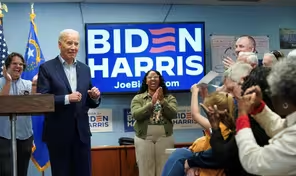
GEOFF BENNETT: For his part, President Biden was on the campaign trail today in the key swing state of Nevada, where he touted a plan to address skyrocketing housing costs and a severe shortage of affordable homes.
I spoke earlier today with Tom Perez, a senior adviser to the president, about the administration's latest effort.
Tom Perez, welcome back to the "NewsHour."
TOM PEREZ, Senior Adviser to President Biden: It's a pleasure to be with you.
GEOFF BENNETT: Most of the problems with the housing market stem from a shortage of homes.
Homeowners are in many cases unable or unwilling to move because they don't want to give up the record low mortgage rate they locked in during the pandemic.
So how would President Biden's plan help free up existing homes and incentivize sellers?
TOM PEREZ: Sure.
No, your point is a fair point.
When you have a 3 percent interest rate on your loan and you're trying to buy a new house, and, right now, you're a 6 percent, 6.5 percent interest rate environment, that's a problem.
The one -- one part of the president's proposal will help a person who's been in their house who didn't have kids when they bought the house, but now they have two children, to get a $10,000 tax credit for two years if they go into a bigger home.
That will free up that existing stock.
It's $400 a month.
And the reason for two years is because we're confident that, in two years, the interest rate environment will continue to improve, as it has been.
And so that's one example of what we're trying to do to help homeowners and to help the issue you said about the failure to have enough stock.
But another thing we have to do is build, build, build.
We need more housing stock.
And the president talked about it in the State of the Union.
There's a $20 billion proposal in the president's budget to work with state, local authorities, and other key stakeholders to build more affordable housing.
We need more supply.
There are already 1.7 million homes being built right now, which is record.
But we know it's a tip of the iceberg of what the need is.
And that's why the president's being so aggressive.
GEOFF BENNETT: Well, let me ask you about that.
TOM PEREZ: Sure.
GEOFF BENNETT: Because I spoke to a couple of leaders in the housing industry preparing to speak with you.
And what they told me is, what they really need is tax policy that spurs and incentivizes development.
And they need regulatory reform.
You have housing developers who say they simply cannot afford to navigate a matrix of regulations that not only encompass every step of the building process, but the operating process.
And then you have these regulations that seem to constantly shift.
How is the administration going to address that?
TOM PEREZ: Well, the $20 billion Innovation Fund, the operative word is innovation.
It is incentivizing best practices at a local level.
I used to serve in local government here in Maryland, where I live.
And land use issues are what you're referring to in your question.
The federal government doesn't control the pace at which a home is built.
Those are state and usually local issues.
And so our Innovation Fund is designed to help make sure that people and local governments can move faster, while respecting other issues that are of importance in those local government areas.
We recognize that time is essential in these construction projects.
Time is, frankly, money for many, many people.
And that's why I think this Innovation Fund is very, very exciting.
GEOFF BENNETT: I'm sure there are would-be first-time homebuyers who are watching this who feel that they have been sort of locked out of the market because those first-time homes, those starter homes are so unaffordable.
What is the specific proposal that would help them?
TOM PEREZ: Sure.
The specific proposal is the -- both the $10,000 tax credit, so $400 a month for two years.
That's the equivalent of knocking a little over a point, I think, off of the interest rate, depending on the size of the loan.
In addition, we are reducing costs.
So, for instance, if you need to get title insurance, we're running a pilot program for federally insured loans to eliminate that requirement of title insurance.
That knocks $1,000 off the cost.
We're -- the various alphabet soup of regulatory agencies are looking very closely at other junk fees that are all about getting a little more money for lenders, and at the expense of would-be homebuyers.
So these are the things that we're doing.
The president continues to call on Congress to pass his proposal for housing assistance for down payments, because what we have seen is that a lot of people can afford the mortgage payment, but that $15,000 down payment or the $20,000 down payment is what trips them up.
So we have worked hard to identify the barriers to entry.
And what I would say to would-be homeowners is, let's work together, because opportunities are out there for you to realize that American dream.
GEOFF BENNETT: Former Labor Secretary Tom Perez, now senior adviser to President Biden and director of the Office of Intergovernmental Affairs, thanks for your time this evening.
TOM PEREZ: Pleasure to be with you.
AMNA NAWAZ: The World Meteorological Organization issued a red alert warning today about warming and climate change, saying 2024 is shaping up to be another record year.
As William Brangham details, one of the many worries about how the planet is changing, thanks in part to human activity, is the record-shattering warming of the world's oceans.
WILLIAM BRANGHAM: I want to put up a graph that shows just how out of the ordinary ocean temperatures are becoming.
This shows the averaged daily surface temperatures of the world's oceans.
Those very thin gray lines each represent one year, going back to 1979.
Now, here's last year's readings in orange; 2023 started out at the upper end of normal, but soon became a record-breakingly hot year.
And here in red is just the beginning of this year.
The oceans are already in uncharted territory.
So, what is going on here?
John Abraham is a professor of mechanical engineering at the University of St. Thomas and is part of an international consortium of researchers who monitor ocean temperatures.
John Abraham, thank you so much for being here.
Before we get into the why, I wonder if you - - are you in this camp that is genuinely alarmed at what's going on?
JOHN ABRAHAM, Professor and Program Director, Department of Mechanical Engineering, University of St. Thomas: Well, that's a really good question.
So, behind the scenes, there are two groups of scientists.
One group thinks that what we're seeing can be explained by long-term global warming and what's called an El Nino.
And then there's another group who think there might be another ingredient involved.
There might be something that we haven't detected yet.
And I hate to say it.
I'm sort of in the middle.
I -- the warming that we are seeing this past year is a little out of the ordinary of what we would expect with global warming and El Nino together.
Maybe something else is happening, but we don't know.
And this is what makes scientists excited.
And this is what makes science great.
We like to uncover these question marks.
But there is a question mark.
And I -- to be honest, I'm on the fence.
WILLIAM BRANGHAM: OK, so let's unpack that, though.
On climate change, in particular, as we warm the atmosphere, the oceans do get warmer.
We know that that's a pretty well-documented fact.
El Nino, as you mentioned, we're on the tail end of one of those.
That can warm the oceans as well.
If you had to put these as a percentage, are we principally talking about climate change here, or how do you apportion blame here?
JOHN ABRAHAM: Well, if you want me to quantify the effect -- and this is just off the cuff.
This is a rough estimate based on my intuition.
I'd say it's about half global warming, and maybe a third of it is El Nino.
And then the remainder, maybe 20 percent or so, is a question mark.
And that 20 percent could be some extra global warming that we hadn't accounted for, but it could be something else.
But the majority of this, and the real reason we're setting records every year, is global warming.
But, as you pointed out, this year is a -- the scientific term is bonkers year.
This is off the charts.
And it's more than we would have normally expected, even with an El Nino.
WILLIAM BRANGHAM: So there's a couple of other factors that I have read about being possibly complicit here, this huge volcanic eruption that happened a while ago that spit a ton of moisture up into the atmosphere, which can warm the atmosphere, solar cycles.
Also, the elimination of a lot of pollution from shipping, which, paradoxically, it's wonderful for human health, but it's taking this umbrella off the oceans, which can also warm the oceans.
Are those factors that you consider as well?
JOHN ABRAHAM: They could be.
And some scientists are considering those.
I'm not sold.
And the reason I'm not sold is, we're seeing an incredible amount of heat in specific locations and, in particular, in the Atlantic Ocean.
And we're seeing other parts of the planet that have lower surface temperatures.
So, the patterns of warming that we're seeing aren't -- don't jibe with some of the other options that you just mentioned, but they are under consideration by my colleagues.
WILLIAM BRANGHAM: For people who might look at the chart that I showed and say, oh, well, you're just using a very narrow Y-axis, and why do we care if there's just a degree or two difference in temperature in something as colossal as the ocean, I mean, why do we care if the oceans are warming globally?
JOHN ABRAHAM: You said it.
The oceans are colossal.
And there's an old idiom.
It's a watched pot never boils.
And that's really true.
It takes a lot of energy to heat up water.
And if that's true for a pot on your stove, think of how true it is for the oceans that cover 70 percent of our planet.
Frankly, the amount of heat that has to go into the oceans to raise their temperature a degree Celsius or even a degree Fahrenheit is astronomical.
So, a degree warming of the ocean, man, that's a different world.
And it's going to affect the weather all over the planet, tremendous impacts to humans and our society.
So these numbers, in terms of temperature increases, are really astounding.
WILLIAM BRANGHAM: My colleague mentioned the World Meteorological Organization issuing this red alert.
And we ask people this often, but I just wonder what your take on this would be, which is, given these findings, what is it we ought to be doing as humanity to try to address this?
JOHN ABRAHAM: Oh, that's the easy part.
We need to just do a couple things, and we can do them today with today's technology.
First, we need to conserve energy.
Just use energy more wisely.
Let's not waste our -- the energy that we get out of fossil fuels.
Conserve.
Secondly, maximize our development of clean and renewable energy.
And the great thing is, green energy is now cost-comparable to fossil fuels.
So, in the olden days, if you put solar panels on your house, that was a mark of altruism.
Now it's a mark of fiscal conservatism.
Clean energy is now cheaper than coal.
And that has really created an inflection point in the scientific community.
That's what gives us optimism.
There's no longer any reason not to maximize clean, renewable energy.
So those two things are the most important things that people can do to change the trajectory that we're on.
WILLIAM BRANGHAM: All right, John Abraham, professor of engineering at St. Thomas University, thank you so much for being here.
JOHN ABRAHAM: Pleasure.
GEOFF BENNETT: In her new book, NPR political correspondent Sarah McCammon takes a closer look at a growing movement away from the white evangelical church.
Her perspective is part investigative and entirely personal.
I spoke with her recently about the book, "The Exvangelicals: Loving, Living, and Leaving the White Evangelical Church."
Sarah McCammon, welcome to the "NewsHour."
SARAH MCCAMMON, Author, "The Exvangelicals: Loving, Living, and Leaving the White Evangelical Church": Thanks so much for having me.
GEOFF BENNETT: So let's start with the definition of the term, exvangelical.
It is what it sounds like, someone who left the church or left the faith, or, in some cases, both.
SARAH MCCAMMON: Yes, essentially, it means somebody who used to be evangelical and now, for whatever reason, does not identify that way.
And that can mean a lot of different things.
It can mean not religious at all.
It can mean still very deeply religious, but not identifying with the evangelical term.
And it's something I came across in my reporting.
I discovered that, as the label evangelical has become increasingly, in many people's minds, a political one, rather than a spiritual or theological one, it's a term that some people are conscientiously moving away from.
GEOFF BENNETT: And you were raised in a deeply evangelical family in the Midwest, taught to fear God, not to question the faith.
How did that come to define your world view and ultimately come into conflict as you got older?
SARAH MCCAMMON: The world I grew up in was really entirely surrounded by evangelical teachings, ideas, books, media, magazines.
And I think anyone who grew up evangelical in the '80s and '90s or a little bit after will recognize that.
It was a carefully constructed world that presented a very specific world view.
And, for me, that meant that our family, our community, we were called upon to share our faith with other people.
It also had political implications.
And one of the most challenging things for me about that was the idea that everyone who disagreed with us was not part of the family, not part of the fold.
As a child, it was really impressed upon me that it was really important to view the world in this specific way.
But, as I got older, I struggled to do that.
GEOFF BENNETT: In the book you explore the many reasons why people leave the evangelical church.
What are some common threads?
SARAH MCCAMMON: There are a lot of common themes.
And I think the biggest unifying theme is a sense that the world you're presented with in the evangelical community doesn't always align with the world that you discover as you learn and grow and maybe get to know people who are different.
But some of those themes are -- sometimes, it's sexuality.
Sometimes, it's politics.
Sometimes, it's science, the view of science.
One of the things that I was taught growing up and a lot of evangelical kids are is that the Earth is 6,000 to 10,000 years old, and that one of the reasons that so many scientists believe in evolution is because it's a way to avoid acknowledging God.
And, as I got older, I discovered that most people didn't see the world that way, that there were pieces of -- really, pieces of knowledge that were missing from my childhood education.
And I also discovered that isn't the only way to see the world, that many people believe in God and believe in science.
And so it's those sources of cognitive dissonance, I think, that drive a lot of people to reframe, question, reform their faith.
GEOFF BENNETT: It's an interesting point, because there is this notion that people who leave the church are somehow anti-religion or anti-Christian.
But what do you make of that?
SARAH MCCAMMON: I don't think it's true.
I mean, first of all, many of the people I have met and talked to in the process of writing this book had to think deeply about their faith, wanted to think deeply about it because they cared about it.
But it wasn't about hating the church or rejecting the church.
Now, certainly, people -- some people find their way out of the church, but a lot of people I talk to are trying to find some connection to spirituality, whether it's Christianity or something else, even after life in an evangelical environment.
GEOFF BENNETT: Moving on, it strikes me, can be fraught.
I mean, what are exvangelicals leaving behind when their families and their communities are still tied to the church?
SARAH MCCAMMON: It depends on the family and the community, and I think some families are more accepting than others.
A lot of people I talk to for this book have had to set very careful boundaries with the things they do and don't talk about with their loved ones.
And that can be really painful and isolating and alienating.
It can mean rejection.
It can mean a lot of distance from family members.
But it's interesting to see the -- sort of the compromises that people make or the ways that they navigate that tension.
GEOFF BENNETT: What do you hope readers take away from your book?
What conversations do you hope that this ignites?
SARAH MCCAMMON: Well, for people who grew up in the evangelical world or any sort of strict religious environment, to step away from it can be painful and can come at a cost.
And so I hope people who've had that experience that's often called deconstructing will feel seen and described and understood in -- when they read this book.
For people from outside the evangelical world who may have questions about it and even feel mystified about -- I get asked a lot, why do evangelicals believe the things they believe?
Why do they do the things they do?
I hope this will provide a little bit of insight and even empathy into what this experience is like.
GEOFF BENNETT: Do evangelicals -- do white evangelicals feel misunderstood?
Because there has been in the wider culture this sense of piling on, especially in the Trump era.
SARAH MCCAMMON: I think so, and that was something that I felt and heard growing up.
There was a sense that -- it was interesting, because I think I grew up with the impression that we were sort of a small, kind of persecuted minority.
And that is a theme in many ways comes from the Bible, this idea that, if you follow God, you will be persecuted, just as Christ was persecuted.
What I didn't realize growing up as an evangelical kid was that I was part of a massive subculture, a giant movement that was close to one in four Americans during my adolescent years, at least, and that had a huge and outsized political influence on this country and still does in many ways.
So that sense of embattlement and persecution, I think a lot of it goes to the fact that white Christianity used to be the dominant culture really in this country.
And it's increasingly on the decline, for a whole bunch of reasons, some of which just have to do with increasing diversity.
And on the one hand, the country is less white than it used to be.
It's also less religious.
And I should say many nonwhite Americans are very religious.
And so all of that means that there are a lot of crosscurrents happening within the American church right now and a lot of change.
And I think, for some white Christians in general who are used to feeling that their narrative was the dominant one, if it no longer is, that can feel like a threat, when it's really just a change.
GEOFF BENNETT: Sarah McCammon.
The book is "The Exvangelicals: Loving, Living, and Leaving the White Evangelical Church."
Thanks so much for coming in.
Great conversation.
I appreciate it.
SARAH MCCAMMON: Thanks, Geoff.
AMNA NAWAZ: It was an art movement that helped create a new portrait and understanding of Black life in America.
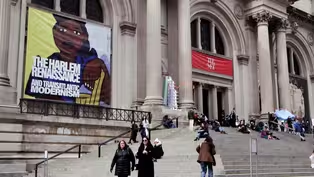
And now the Harlem Renaissance is the subject of an exhibition at one of the country's leading museums.
Jeffrey Brown reports for our arts and culture series, Canvas.
JEFFREY BROWN: Black subjects portrayed by Black artists shaping a new Black imagery and identity, it's the achievement of the confluence of people, places and diverse artistic forms collectively known as the Harlem Renaissance.
Art historian Denise Murrell: DENISE MURRELL, Curator, The Harlem Renaissance and Transatlantic Modernism: It's this idea of the beginning of Black modernity.
It was the first African American-led movement of modern art, of international modern art.
The Harlem Renaissance is the beginning of the modern Black subject that we recognize as part of who we are today.
JEFFREY BROWN: Murrell is curator of The Harlem Renaissance and Transatlantic Modernism at New York's Metropolitan Museum of Art, an exhibition of 160 paintings, sculptures and photographs, many of those by James Van Der Zee from the 1920s to 1940s, that capture the range and transformation of Black life in urban centers amid the Great Migration of millions from the South.
There are well-known figures like Aaron Douglas and Jacob Lawrence, and others such as Laura Wheeler Waring receiving overdue attention.
Schoolchildren, elders, some who'd been born into slavery, queer life brought to the fore, a burgeoning middle and upper class, police brutality and protests, artists looking to both African traditions and to Europe's past and present.
DENISE MURRELL: They were depicting aspects of modern Black life that were not previously part of art history or of popular culture.
They were making these works in direct opposition, resistance to the prevalence of racial stereotyping in the popular culture.
JEFFREY BROWN: And they were doing this in a conscious -- a deliberate, conscious way.
DENISE MURRELL: Yes.
JEFFREY BROWN: We're going to tell the story of contemporary Black life.
DENISE MURRELL: Of our -- right, of our community, as it remakes and redefines itself.
JEFFREY BROWN: Langston Hughes tapped the rhythm and vibrancy of jazz in his poems.
Archibald Motley captured it in the clubs, William H. Johnson in street life Harlem.
DENISE MURRELL: He's creating icons.
He's creating new Black icons.
This is who we are and this is how we want to be seen.
JEFFREY BROWN: There are cultural icons, Marian Anderson and Josephine Baker, an intellectual guiding light, Alain Locke, who wrote in his 1925 landmark book, "The New Negro": "Art must discover and reveal the beauty, which prejudice and caricature have obscured and overlaid."
DENISE MURRELL: He said, we will in our art, in our music, in our literature make works that reflect African American values and cultural aspirations and history and scenes of everyday life.
JEFFREY BROWN: And create and shape our own identity, as opposed to being shaped.
DENISE MURRELL: Yes, by external, by outside forces.
And, as Langston Hughes said, if other people like it, great, but if they don't like it, that's OK too.
JEFFREY BROWN: Murrell is keen to expand the map of this Renaissance to other cities, the Caribbean, and to Europe, where Motley painted Parisian cafe scenes, and where Murrell wants us to see leading European painters like Matisse and Munch were themselves surrounded by and depicting Black subjects.
The exhibition highlights the contributions of historically Black colleges and universities, for a long time, the chief supporters of Black artists and repositories of their works, while mainstream museums and art history books generally treated the Harlem Renaissance as a footnote, rather than a major movement.
Murrell experienced it as a student.
DENISE MURRELL: It was there when you looked for it, but it wasn't there when you were, say, just getting your basic art history 101 survey.
It would not have been part of those courses.
So it has to be something that you are actively seeking out.
And I think that it should be something that is part of how art history is taught from the beginning.
JEFFREY BROWN: In 1969, the Metropolitan Museum mounted an exhibition titled Harlem on My Mind, a social history that, controversially, included not a single painting or sculpture by a Black artist.
How do we look back at that context and then think about this?
DENISE MURRELL: It was a story told about Harlem by people from outside the community.
And there was a deliberate, just based on the lack of knowledge, but to some extent, probably just a deliberate conformity to the still very much segregated art world at the time.
It was an example of what happens when you don't have diverse voices as part of the leadership of any institution, but especially of a museum like the Met.
And the causal factors of that, the Union soldiers are in retreat.
JEFFREY BROWN: Murrell, who joined the museum in 2020, is herself part of a changing art world here at the Met and beyond.
This is the first exhibition she's curated here, and she sees it not so much as a corrective to the museum's past, as a much-needed acknowledgement of the artists' achievement.
DENISE MURRELL: We still have a great bit more to do, but we are beginning to have people at the table who can say, OK, I'm all for doing a great show on Hopper, but we should be doing shows on William H. Johnson, on Augusta Savage, Laura Wheeler Waring, Archibald Motley, Aaron Douglas.
And that is what will ultimately allow the Met to achieve a level of excellence in its - - in the implementation, the realization of its mission to be an encyclopedic museum.
JEFFREY BROWN: The Harlem Renaissance and Transatlantic Modernism is on through July 28.
For the "PBS NewsHour," I'm Jeffrey Brown at the Metropolitan Museum of Art in New York.
AMNA NAWAZ: And join us again here tomorrow night, when we will have a look at the downballot results of Tuesday's primary elections.
And that is the "NewsHour" for tonight.
I'm Amna Nawaz.
GEOFF BENNETT: And I'm Geoff Bennett.
Thanks for joining us, and have a great evening.
Biden adviser on plans to counter spiking cost of housing
Video has Closed Captions
White House adviser discusses Biden's plans to counter spiking cost of housing (5m 33s)

Climate researcher on record rise in ocean temperatures
Video has Closed Captions
Climate researcher on what's causing the record rise in ocean temperatures (6m 23s)

Experts warn of 'imminent’ famine in Gaza
Video has Closed Captions
Experts warn of 'imminent’ famine in Gaza with lack of aid reaching Palestinians (4m 59s)

'Exvangelicals' explores why many are leaving the church
Video has Closed Captions
New book 'The Exvangelicals' explores why many Americans are leaving the church (7m 22s)
New exhibit celebrates impact of The Harlem Renaissance
Video has Closed Captions
The Met's new exhibit celebrates impact and legacy of The Harlem Renaissance (6m 45s)
Social media influencers playing role in election
Video has Closed Captions
How social media influencers are playing a role in the presidential election (5m 56s)
Supreme Court clears way for Texas to deport migrants
Video has Closed Captions
Supreme Court clears way for Texas police to arrest and deport migrants (2m 37s)

What's next for Israel as Netanyahu, Biden rift widens
Video has Closed Captions
What's next for Israel and war in Gaza as rift between Netanyahu and Biden widens (6m 52s)
Providing Support for PBS.org
Learn Moreabout PBS online sponsorship
- News and Public Affairs

FRONTLINE is investigative journalism that questions, explains and changes our world.

- News and Public Affairs

Amanpour and Company features conversations with leaders and decision makers.












Support for PBS provided by:
Major corporate funding for the PBS News Hour is provided by BDO, BNSF, Consumer Cellular, American Cruise Lines, and Raymond James. Funding for the PBS NewsHour Weekend is provided by...