
May 16, 2024 - PBS NewsHour full episode
5/16/2024 | 57m 46sVideo has Closed Captions
May 16, 2024 - PBS NewsHour full episode
Thursday on the NewsHour, former Trump lawyer Michael Cohen returns to the witness stand in the former president's hush money trial. The top humanitarian official for the United Nations looks at current crises and his career helping manage global calamities. Plus, a three-year-old with a rare medical disorder stuck in Gaza and the American families working to evacuate her for treatment.
Problems playing video? | Closed Captioning Feedback
Problems playing video? | Closed Captioning Feedback
Major corporate funding for the PBS News Hour is provided by BDO, BNSF, Consumer Cellular, American Cruise Lines, and Raymond James. Funding for the PBS NewsHour Weekend is provided by...
Support provided by:

May 16, 2024 - PBS NewsHour full episode
5/16/2024 | 57m 46sVideo has Closed Captions
Thursday on the NewsHour, former Trump lawyer Michael Cohen returns to the witness stand in the former president's hush money trial. The top humanitarian official for the United Nations looks at current crises and his career helping manage global calamities. Plus, a three-year-old with a rare medical disorder stuck in Gaza and the American families working to evacuate her for treatment.
Problems playing video? | Closed Captioning Feedback
How to Watch PBS News Hour
PBS News Hour is available to stream on pbs.org and the free PBS App, available on iPhone, Apple TV, Android TV, Android smartphones, Amazon Fire TV, Amazon Fire Tablet, Roku, Samsung Smart TV, and Vizio.
Providing Support for PBS.org
Learn Moreabout PBS online sponsorshipGEOFF BENNETT: Good evening.
I'm Geoff Bennett.
AMNA NAWAZ: And I'm Amna Nawaz.
On the "NewsHour" tonight: Former Trump lawyer Michael Cohen returns to the witness stand in the former president's hush money trial.
GEOFF BENNETT: The United Nations' top humanitarian official looks at current crises and looks back on a career helping manage global calamities.
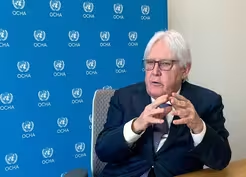
MARTIN GRIFFITHS, U.N. Undersecretary-General for Humanitarian Affairs and Emergency Relief Coordinator: The promises that the world's leaders made these recent decades, these promises are left at the entrance.
AMNA NAWAZ: And a 3-year-old with a rare medical disorder stuck in Gaza and the American families working to evacuate her for treatment.
(BREAK) AMNA NAWAZ: Welcome to the "NewsHour."
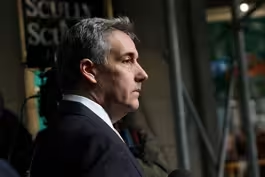
Former President Donald Trump's one-time lawyer Michael Cohen spent his third day on the stand today in a Manhattan courthouse.
GEOFF BENNETT: Cohen is now the key witness in the case against his former boss, and he again faced hours of scrutiny over many lies and misstatements he's made.
William Brangham was again in court today and joins us now.
So, William, Mr. Trump's legal team had Michael Cohen on the stand the entire day.
What were they trying to accomplish with their time with him?
WILLIAM BRANGHAM: Trump's lead lawyer, Todd Blanche, in a somewhat circuitous and occasionally zigzagging line of questions, tried to keep up the attack that they started earlier this week, which is to elicit testimony that proves their point that Michael Cohen cannot be trusted, that he is a fundamentally untruthful, dishonest and unscrupulous witness on this case.
And Blanche went through multiple examples today in the past where Michael Cohen was talking to Congress or talking to federal agents or testifying in other courts of law and he raised his hand to say, I swear to tell the truth, and he did not.
We heard multiple scrutinized examples of that.
Blanche also elicited some testimony about some other dubious practices of Michael Cohen's, like surreptitiously recording other people's phone calls.
Blanche also tried to poke holes in Cohen's earlier testimony where he testified to very specific recollections of phone calls that happened six or seven or eight years ago.
And he elicited testimony saying, Michael Cohen, you get dozens of phone calls a day, thousands over the course of the year.
How is it possible that you could remember the details of a phone call from seven years ago?
And so he went at him quite a bit on those points.
The whole point here, obviously, is that if you undercut Michael Cohen, you undercut the fundamentals of this case, because Cohen is the one who most directly says that Donald Trump orchestrated and was central to this scheme to cover up the hush money payments and the falsification of these business records.
GEOFF BENNETT: So how did Michael Cohen then respond to the scrutiny?
WILLIAM BRANGHAM: A lot of times, Geoff, he admitted to these lies, simply because he has no other option, sometimes because he went to prison for them.
Other times, there's just clear evidence that he said one thing one day and another thing the very next day.
But there were some other cases where he pushed back on this.
Like, there was a lot of talk today about whether or not he has specifically asked for a pardon from then-President Trump.
And, sometimes, Cohen would try to parse word games and have a semantic debate over what the -- whether it was -- whether he meant something in the past tense or the present tense.
But on the whole, Cohen was a pretty firm, soft-spoken, steady witness today.
GEOFF BENNETT: Well, that's interesting because there were some question as to whether or not Mr. Trump's defense team could provoke Michael Cohen into losing his cool or even lashing out.
It sounds like that didn't happen.
WILLIAM BRANGHAM: No, that's exactly right, Geoff.
There was no -- there were clearly sometimes where Todd Blanche tried to do that.
He several times raised his voice today and said, that was a lie, what you were just saying, wasn't it?
And Cohen, for the most part, did not take the bait.
There were other times where Blanche brought up testimony about some very personal and humiliating times in Michael Cohen's life,like, for instance, when he was very frustrated about not getting a job in the White House, and there were texts back and forth with his daughter, where his daughter was saying, dad, it seems like you're clearly getting walked all over by the Trump administration.
But even then, Michael Cohen did not seem to sort of give up the ghost in this case.
There was one interesting example that happened today, though.
It's hard to know on some level how much this jury knows about who Michael Cohen really is, this famously profane, belligerent lawyer.
And Todd Blanche played a clip of one of Michael Cohen's podcasts in court today.
And in that clip he played, all of a sudden, you hear Michael Cohen on these loud speakers screaming, saying, you better believe I want Trump to go to jail.
I want him to rot in hell for all of the things he did for my family.
And it was just this incredibly jarring moment where, for the first time, the jury heard what this Michael Cohen sort of figure had always been characterized as, but thus far had not shown himself to be that on the stand so far.
GEOFF BENNETT: OK, that is William Brangham in New York for us tonight.
William, thank you.
WILLIAM BRANGHAM: Thanks, Geoff.
AMNA NAWAZ: In the day's other headlines: The U.S. military finished work on a floating pier off the Gaza Strip today.
Officials say at least 500 tons of food will begin arriving onshore in the coming days.
The aid is vital to helping the hundreds of thousands of Gazans who are at risk of famine.
Meanwhile, South Africa is asking the top U.N. court to impose new emergency measures on Israel to stop its military operation in Rafah.
South Africa has accused Israel of genocide and says the war is at a - - quote -- "new and horrific stage."
VAUGHAN LOWE, Attorney For South Africa: The key point today is that Israel's declared aim of wiping Gaza from the map is about to be realized.
Further, evidence of appalling crimes and atrocities is literally being destroyed and bulldozed.
AMNA NAWAZ: In response, Israel's Foreign Ministry said today that South Africa was presenting biased and false claims and called on the International Court of Justice to reject the appeal.
Here in the U.S., the House of Representatives passed a measure this afternoon that seeks to force the transfer of bombs to Israel.
The bill passed by a vote of 224 to 187.
Republicans drafted the legislation as a challenge to President Biden's plan to withhold a shipment of 3,500 bombs.
That was meant to discourage Israel from further military action in the Gazan city of Rafah.
The bill is unlikely to pass the Senate, and the White House has said it would veto any such measure.
In Slovakia, authorities confirmed today that the man charged with shooting populist Prime Minister Robert Fico acted alone.
They say the suspect, seen in the cap in this video, had previously participated in anti-government protests and became radicalized after the last election.
Slovakia's interior minister described him as a lone wolf.
MATUS SUTAJ ESTOK, Slovakian Interior Minister (through translator): I want to affirm that, today, the police are working with only one version of the attack, that the perpetrator is currently charged with the premeditated crime of attempted murder, and that we are working with only one version, that it was a politically motivated act.
AMNA NAWAZ: The hospital treating Fico says he's in very serious, but stable condition.
The prime minister is considered a divisive figure in Slovakia and abroad because of his pro-Russian and anti-American positions.
The U.S. Supreme Court rejected a conservative-led attempt to weaken the Consumer Financial Protection Bureau today.
The justices ruled 7-2 that the way the CFPB is funded does not violate the Constitution.
Unlike most federal agencies, the bureau gets its money from the Federal Reserve, rather than a congressional budget process.
Writing the majority opinion, Justice Clarence Thomas said the system -- quote -- "fits comfortably with the First Congress' appropriations practice."
Texas Governor Greg Abbott has pardoned a former U.S. Army sergeant who had been convicted of fatally shooting a protester during a Black Lives Matter demonstration in 2020.
The announcement came just minutes after Texas parole officials announced they were recommending a pardon for Daniel Perry.
He was convicted last year and sentenced to 25 years in prison for the death of Garrett Foster.
Abbott had previously ordered the parole board to review Perry's case.
The Justice Department began the formal process today to declassify marijuana as a less dangerous drug.
The Biden administration wants to move cannabis from being a Schedule I drug, alongside heroin and LSD, to Schedule III, which includes ketamine and some anabolic steroids.
The president called it -- quote -- "an important move toward reversing longstanding inequities."
The plan is subject to a 60-day public comment period and a possible judicial review.
It also does not legalize marijuana outright for recreational use.
Senator Bob Menendez announced today that his wife, Nadine Menendez, has breast cancer and will require a mastectomy.
The announcement comes during the first week of the New Jersey Democrat's bribery trial in New York.
His wife was also charged in the case, but her trial was postponed.
They have been charged with accepting bribes in exchange for using his position to help foreign governments.
Both have pleaded not guilty to all charges.
The leaders of China and Russia reaffirmed their no-limits partnership in Beijing today.
In Tiananmen Square, President Xi Jinping rolled out the red carpet for Vladimir Putin at the start of their two-day summit.
China is one of Russia's closest allies, as both nations face deepening tensions with the West.
VLADIMIR PUTIN, Russian President (through translator): Russia and China are truly united by the common goals of national development and ensuring joint prosperity on the principles of mutual respect, good neighborliness and mutual benefit.
AMNA NAWAZ: The two leaders then signed a joint statement ushering in what they called a new era of partnership.
That includes a shared opposition to the United States on a range of security issues.
Mr. Putin also thanked his host for his proposals on ending the war in Ukraine.
Kyiv and its Western allies have rejected those suggestions.
They say Xi's stance largely follows the Kremlin line.
On Wall Street today, the Dow Jones industrial average briefly topped 40000 for the first time ever.
But, by the end of the day, the index had retreated, slipping 38 points to close at 39869.
The Nasdaq dropped 44 points, and the S&P 500 gave back 11.
And a sculpture of the late Reverend Billy Graham, one of the most powerful Christian evangelists in American history, now resides in the U.S. Capitol's Statuary Hall.
Prominent Republicans joined Graham's family today to unveil his bronze 7'-tall likeness.
Graham died in 2018 at the age of 99.
Still to come on the "NewsHour": a look at the lasting legacy of Brown v. Board of Education 70 years after the landmark Supreme Court decision; lawmakers grill the chair of the FDIC after a report finds employees were harassed and mistreated at the agency; and an emergency room doctor discusses his new book on treating trauma and violence.
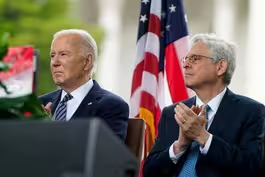
President Biden today used executive privilege to deny House Republicans access to audio recordings from his interview with special counsel Robert Hur.
The October 2023 interview centered on the president's handling of classified documents.
Hur's report described the president as a -- quote -- "sympathetic, well-meaning, elderly man with a poor memory."
House Republicans, including Representatives Jim Jordan and James Comer, requested the audio and planned to hold Attorney General Merrick Garland in contempt of Congress for failing to provide it.
Earlier today, Garland addressed the matter.
MERRICK GARLAND, U.S. Attorney General: There have been a series of unprecedented and frankly, unfounded attacks on the Justice Department.
This request, this effort to use contempt as a method of obtaining our sensitive law enforcement files is just the most recent.
AMNA NAWAZ: Following it all is NPR's Carrie Johnson, who joins us now.
So, Carrie, House Republicans already have transcripts of the interviews provided by the White House.
What's their argument for why they need the actual audio, and why was that request denied?
CARRIE JOHNSON, NPR: Jim Jordan and the House Judiciary Committee signaled that he simply doesn't trust the White House in this transcript.
He wants to see what Biden said and hear what Biden said for himself.
And he said more about the president's state of mind and his memory issues could become more clear if he's able to hear the audio.
The Justice Department and the White House seem to be signaling that they have already made extraordinary accommodations.
They have given written transcripts.
They have given House Republicans correspondence between the Justice Department and Biden's White House counsel and his private lawyers and a couple of classified documents as well.
And they are drawing a line that enough is enough and that House Republicans do not need to hear these audiotapes at this time.
AMNA NAWAZ: But President Biden had insisted that Hur had mischaracterized the interviews when the transcripts came out, but now they won't release the audio.
Doesn't that put the White House in a difficult position here?
CARRIE JOHNSON: It does to some extent, but I think the White House may be making a calculation that it's better to receive criticism on that point than to try to release the audio, which, as the White House counsel said, could then be sliced and diced and chopped up as part of campaign ads before the November election.
AMNA NAWAZ: And what about this move, as we reported earlier, to hold Attorney General Merrick Garland in contempt of Congress for not providing that audio?
Where does that stand now?
CARRIE JOHNSON: The White House has asserted executive privilege, but the House Judiciary Committee went right ahead along party lines this afternoon and voted to hold Merrick Garland, the attorney general, in contempt.
We expect a similar vote overnight by the House Oversight Committee.
Then, of course, Amna, that whole issue has to get on the House floor.
The full House would have to vote.
A majority of the full House would have to vote in order to hold Merrick Garland in contempt.
But now that the White House has asserted executive privilege, Merrick Garland basically has a legal shield, a legal defense, and so he couldn't be prosecuted for this anyway.
AMNA NAWAZ: Carrie, House Republicans' efforts to impeach the president have stalled.
Their attempt to impeach the homeland security secretary failed.
Do they now have their sights set on Merrick Garland?
CARRIE JOHNSON: Merrick Garland seems to think so.
In his remarks to reporters this morning at the Justice Department, he cast this move as yet another in a series of what he called unfounded attacks on the Justice Department, federal agents and prosecutors, Republican attempts to defund the special counsel Jack Smith, who has secured two indictments against former President Donald Trump.
That, Merrick Garland says, is wrong, and he's going to defend the institution and the people who work there.
AMNA NAWAZ: That is NPR's Carrie Johnson joining us tonight.
Carrie, thank you so much.
CARRIE JOHNSON: Thank you.
GEOFF BENNETT: The U.N. warns that the humanitarian crisis in Gaza is growing more acute.
In Southern Gaza, a quarter of the population faces catastrophic levels of food insecurity.
In Northern Gaza, nearly one in three children are severely malnourished.
Nick Schifrin speaks to the U.N.'s top humanitarian official about Gaza, Sudan, and what he calls one of the worst years for humanitarian crises.
NICK SCHIFRIN: The U.N. says every single one of Gaza's 2.2 million or so residents need food assistance and the threat of famine is looming.
One of the leading officials dealing with this crisis is the U.N.'s undersecretary-general for humanitarian affairs and emergency relief coordinator, Martin Griffiths, who will be stepping down soon after a 50-year career on humanitarian and conflict work.
Martin Griffiths, thanks so much.
NICK SCHIFRIN: Welcome back to the "NewsHour."
The executive director of the World Food Program, Cindy McCain, recently said that Northern Gaza is in -- quote -- "full-blown famine."
Do you agree?
MARTIN GRIFFITHS: I would agree with her in substance, in the sense that there is a very, very, as you know, stringent technical process, independent of the U.N., by the way, to identify when famine exists.
But we know from Gaza, we know from elsewhere that don't wait for the declaration, official declaration, to know that people are dying of hunger, kids are dying of malnutrition.
NICK SCHIFRIN: Today, the U.S. military announced that a floating pier designed to deliver humanitarian aid to Gaza has been attached to Gaza.
They have hundreds of tons of aid ready for delivery, thousands more tons in the pipeline.
How much of an impact could this kind of thing have?
MARTIN GRIFFITHS: It's very helpful.
We have always said that any way to get more aid in should be welcomed.
We have also said, as you know, that land access routes tend to be more efficient and can go to scale.
We in the U.N. and the World Food Program are ready and prepared to help distribute that aid coming in off the floating pier in the days to come to Gaza.
NICK SCHIFRIN: There are also security concerns about the pier.
U.N. officials who've been working to prepare the pier had to take cover when the area came under fire.
How serious, from your perspective, are the security concerns for the U.N., for the World Food Program, who's going to be part of this?
MARTIN GRIFFITHS: I think they're very serious.
For the moment, the risk level is one that we can go with on the basis that no aid is coming in the other areas.
So we're looking at being able to fulfill our task of distribution internally and hoping that we can get the right people to help us on the beach to get aid to the World Food Program.
NICK SCHIFRIN: Who are those right people?
MARTIN GRIFFITHS: Well, I think we're talking about contractors, as well as maybe some U.N. staff.
That's where the final stages of making sure that we have got an operation that we are happy, in terms of accountability, as well as risk levels for anybody who's going to be there.
NICK SCHIFRIN: There have been occasions where Hamas has diverted or stolen the aid.
How do you prevent that from happening?
MARTIN GRIFFITHS: Where that's happened, we have negotiated to get that aid back.
And, as far as I'm aware, in all cases, that has succeeded.
We need to get all deliveries safely delivered.
Aid is going in through the north, as you know, Nick, through Erez.
I think 54 trucks got in there yesterday.
NICK SCHIFRIN: The Erez crossing in the north recently opened by Israel.
MARTIN GRIFFITHS: Recently opened, most welcome, by the way.
But on the whole, that aid is going to the needs, which are very extensive, in the north.
Getting aid into the south is incredibly difficult because both of the main crossing points are closed or difficult to get through.
NICK SCHIFRIN: Since the Israeli military launched an operation the ground into Rafah, specifically at the border crossing between Rafah and Egypt, that border has been closed.
Israel blames Egypt for blocking aid.
Egypt blames the Israeli military operation for destabilizing the border.
Why do you think not enough aid is getting through that border?
MARTIN GRIFFITHS: Because it's closed and because Kerem Shalom, the other border crossing, is also a place of great difficulty to get any trucks in.
Added to that, Nick, of course, is the fact that, without fuel inside, it doesn't matter.
You can't move.
You can't move the trucks.
Our stocks inside Southern Gaza of food and other items are more or less done, finished.
We know that there are no more tents yet for people to go to.
There's 600,000 people who moved in the last couple of weeks.
We know that medical supplies may have three weeks.
We know that food in the market is about to run out.
There's no good news about what's happening in Rafah.
NICK SCHIFRIN: As you know, the Israeli government has remained concerned about Hamas infiltration.
And the Israeli military this week said that drone footage shows armed men standing next to U.N. vehicles at a U.N. compound in Rafah.
How does this happen?
And what can the U.N. do to prevent it?
MARTIN GRIFFITHS: Well, I think UNRWA has reacted to that report and is looking into the factual basis.
When did this happen?
Where did this happen?
How did this happen, if it did?
So, until we have got the facts, I'm not going to comment.
NICK SCHIFRIN: After Israeli missiles killed seven World Central Kitchen workers, Israel said that it would improve coordination with humanitarian organizations, including by opening up a new coordination center.
Has Israel done enough to answer the concerns of the U.N., the U.S., and international organizations, especially since that incident?
MARTIN GRIFFITHS: I have just been learning of some promises of progress on that very issue of embedding a U.N. staff member from my own office, indeed, with Southern Command to make sure that we are clearly aware of the trajectory of the conflict and are able to guide our humanitarian operations accordingly.
And I just hope this is going to work.
NICK SCHIFRIN: Let me move you to Sudan, which is the world's largest displacement crisis, one of the world's largest food crises.
Yesterday, the U.N. special envoy to Sudan said the Sudanese people were trapped in -- quote -- "an inferno of brutal violence."
Can famine in Sudan be prevented?
MARTIN GRIFFITHS: Yes.
But will it be prevented?
I don't know.
Five million people at risk of famine.
I'm not aware of that number ever having been at that level of risk.
We need the militaries of both sides, of all sides to give us access to get our convoys through, to get our aid through to the people.
It's the trajectory of the war and the commanders on the ground who are not giving us the access that we need.
NICK SCHIFRIN: And, finally, Martin Griffiths, if I may take a moment to step back, we haven't even talked about Afghanistan, Ukraine, Yemen.
I wonder how you look at this year and this moment after, as I said at the top, a nearly 50-year career focused on humanitarian and conflict aid.
MARTIN GRIFFITHS: Well, I do think it's as bad as it's ever been, and I think it's a year of broken promises, isn't it?
The promises that the world's leaders made these recent decades, these promises are left at the entrance and parked there.
But we still have, across cultures, across communities, across the world -- and I see it in my work -- the depth of humanity of ordinary people, which has not changed.
There's no change in these essential values.
What there is a change in is the leadership that we suffer from, I'm afraid, which don't listen to these straightforward pleas, which all of us, all of us believe in.
We all want a better future for our children and our families, right across the world.
NICK SCHIFRIN: Martin Griffiths, undersecretary-general of humanitarian affairs and emergency relief coordinator, thank you very much.
MARTIN GRIFFITHS: Thank you very much, Nick.
Appreciate it.
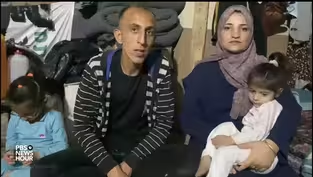
AMNA NAWAZ: Among the families caught in between the Israel and Hamas war is the Abu-Zaiter family, Amjad, Maha, and their two daughters, 5-year-old Sham and 3-year-old Julia.
Julia suffers from an extremely rare neurological disorder called AHC, or alternating hemiplegia, that causes muscle stiffness, seizures, and paralysis.
Only 1,000 cases worldwide have been confirmed.
Before the war, Julia managed with medication.
But AHC is triggered by stimuli, like loud noises and changes in temperature.
In a tent, in a war zone, Julia is today unable to sit or stand and is running out of medication.
A number of families with children who have AHC have rallied to help Julia.
Among them is Simon Frost, who I spoke with yesterday.
Simon, thank you for being here.
SIMON FROST, Father of Annabel: It's good to be here.
Thank you for having me.
AMNA NAWAZ: So, tell us how you came to know about Julia and her family in the first place.
What's the connection there between your families?
SIMON FROST: So my little girl has alternating hemiplegia of childhood.
And so does Julia.
We're a pretty close-knit community in AHC.
And we have a Facebook page where everybody communicates, because parents become quite expert in this disease and tend to consult each other on what's working and what's not working for their kids.
So I came across the family through there.
AMNA NAWAZ: And your little girl is named Annabel?
SIMON FROST: Annabel.
AMNA NAWAZ: She's 8 years old?
SIMON FROST: She is.
AMNA NAWAZ: How is she doing?
SIMON FROST: She's doing OK, but she has episodes, at least a few every week.
So it's nothing like what Julia is facing, but she does face some real problems with AHC symptoms.
AMNA NAWAZ: What did you think when the war first started and you knew that Julia and her family would be over there?
SIMON FROST: So I actually heard about Julia once the war had already started.
I didn't know that she was stuck in a war zone until a few weeks ago.
But when I found out about it, obviously, it terrified everybody in the community.
And knowing that a kid with those type of symptoms, paralysis and seizures and painful dystonia, all of these different symptoms of the disease, can be triggered by various different stimuli, and being in a war zone, where you're hearing all sorts of noise and are terrified at all times, we were fearing for her life and still are.
AMNA NAWAZ: What do you know about how she's fared over the last seven months?
What have you been able to hear from Amjad, her father?
SIMON FROST: So, I know that she's gone through a lot of painful dystonia episodes.
She's been paralyzed on and off for the last six months.
She hasn't had access to her medicines, which can prevent or halt episodes.
And she's been fed from a bottle because her parents can't feed her proper food.
So she's in a desperate situation right now, and everybody's worried about the worst.
But these episodes that she's having, she can't walk, she can't really talk.
She has altered sense of consciousness at this point.
And it's -- it really can affect the brain.
AMNA NAWAZ: Have you ever seen that kind of decline in a child with AHC?
SIMON FROST: So, unfortunately, yes.
Several kids in our disease die every year.
And it's terrifying to think of, but, sometimes, they have these episodes that are just not stoppable.
They look like they can't focus, they can't hear anything.
And it's scary to see.
They're nonresponsive.
Often, they are fully paralyzed.
Sometimes, they go into painful postures, where their muscles are contracted and they can't get out of a contraction.
And this -- it's incredibly painful.
The kids scream.
And there's nothing that you can do as a parent.
So that's what Amjad and the family are facing right now.
AMNA NAWAZ: We were able to connect with him on the ground in Gaza and he sent us this message.
AMJAD ABU-ZAITER, Father of Julia (through translator): We're asking for help to get Julia out of Gaza for treatment, because, if I stay here while the crossings are closed, I will lose my daughter.
And I don't want to lose her.
I want her to receive treatment and to be like other children, to play and stand and be able to walk.
AMNA NAWAZ: Simon, you are in touch with him every day, I understand, for the last several weeks.
What is it like for you to have that contact with him, to hear from him now, to know your family is here on this side of the world and his is there, enduring what they are?
SIMON FROST: Yes, it's desperate.
I think, on both sides, it's desperate.
We're trying our best to get the family out.
We have got an exit plan for them.
We just can't get them across the border at this point.
I know for many other families, they can't get their folks across the border.
We could have her in a high-quality hospital in UAE within 24 hours if the borders were open.
And our plan is to get them -- get the family, as many of them as we can get, to Al-Arish and then they may be back out to UAE, where we have a system of doctors on the ground ready to support her.
AMNA NAWAZ: What happens if you're not able to get her out?
SIMON FROST: Well, we fear for the worst.
We have managed to get medicines to her.
She's on five different medications.
We were able to get those to her through PCRF.
And we have managed to get her to a safe zone outside of Rafah.
We're doing our best to get her across the border, but those clearances are needed.
AMNA NAWAZ: When you say we, you're talking about you and this community of families that you have become a part of through your children.
Why has this become such a mission for you all?
SIMON FROST: Well, I think we all put ourselves in that situation.
We know how hard it is to look after kids with AHC in the best of times.
We're in a warm, comfy home in Washington, D.C.
They're in a war zone.
And it's hard for us.
I can imagine what it's like for them.
And I think it's easy for families to put themselves in that situation knowing what their kids go through.
AMNA NAWAZ: Communication can be spotty, so if you could get a message to Amjad right now, what would you want to say to him?
SIMON FROST: I'd want to say, hold out hope.
We certainly are, but we're doing our very best across the board as a team to get you out and get you and your family to a safe location, where we can get Julia stable.
AMNA NAWAZ: Simon Frost, thank you so much for being here and sharing the story of Julia and her family with us.
We appreciate it.
SIMON FROST: Thanks, Amna.
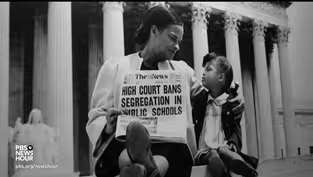
GEOFF BENNETT: Tomorrow marks 70 years since the landmark civil rights ruling of Brown v. Board of Education, when the U.S. Supreme Court declared that, in the field of public education, the doctrine of separate but equal has no place.
President Biden met today with several of the original plaintiffs who brought the case to court and their families.
Afterward, Cheryl Brown Henderson, one of the daughters of the lead plaintiff, Oliver Brown, said they were there to celebrate how the long fight had changed education.
But she was quick to say, much work remains to be done.
CHERYL BROWN HENDERSON, Daughter of Plaintiff: We're still fighting the battle over whose children do we invest in.
Any time we can talk about failing underfunded public schools, there is a problem.
There should be no such thing.
Public institutions, where most of us got our education, should be world-class educational institutions.
GEOFF BENNETT: The families today also recalled how the path to integration was met with intense resistance, fear and violence.
That was echoed at a different ceremony in Washington this past week by another pioneer, Gail Etienne, who was one of the so-called New Orleans Four, who were the first children to desegregate two all-white schools in New Orleans back in 1960.
GAIL ETIENNE, Civil Rights Pioneer: They treated us like animals.
We didn't know it at the time, but that is exactly what they were doing.
There were teachers definitely there that were encouraging them to do that to us, call all kind of names, spit on us.
Anything that you could think of that young children shouldn't go through in school, we went through.
That experience, I will never, ever forget.
GEOFF BENNETT: For more perspective on this, I spoke yesterday with Annette Gordon-Reed.
She's the Carl M. Loeb professor of history at Harvard Law School.
And she was the first Black student to enroll in an all-white school in her hometown in Texas.
And Kevin Young is director of the Smithsonian National Museum of African American History and Culture.
Kevin Young and Annette Gordon-Reed, welcome to the "NewsHour."
KEVIN YOUNG, Director, Smithsonian National Museum of African American History and Culture: Thanks.
ANNETTE GORDON-REED, Carl M. Loeb University Professor, Harvard University: Glad to be here.
GEOFF BENNETT: And, Kevin, I will start with you because you, as I understand it, you knew Linda Brown, who, as a schoolgirl, was at the center of this landmark case.
Her father, Oliver, tried to enroll her at an all-white school not too far from their home in Topeka.
Tell us about her, her family, and their decision to partner with the NAACP and other plaintiffs to challenge segregation in public schools.
KEVIN YOUNG: Well, it's such an important anniversary that we're marking the 70th anniversary of.
And I did indeed grow up in Topeka, Kansas, in part, and went to the very church that Linda Brown played piano and organ at and sang.
She was quite a force then, and I knew and was well aware of the case.
It greeted me every Sunday in the vestibule with reverend Oliver Brown, who had been at that church, St. Mark's Church in Topeka.
And I think it was that kind of spiritual center of the case that she posed and that she still held in Topeka, Kansas, that really is powerful to me.
And I think there's a wrong road that leads to Brown v. Board, but it still remained in Topeka something that was full of history, but also was a living thing.
And I think that's where I first encountered the kind of history you find throughout the museum, but also that this case centers in the change in the nation and the change in our world.
And to hear her singing and expressing herself years later was so powerful.
GEOFF BENNETT: Annette Gordon-Reed, this is an experience that you know well.
You were the first Black student to integrate the Conroe Independent School District in Texas 60 years ago.
What was that experience like for you?
ANNETTE GORDON-REED: Very intense.
This was obviously 10 years or so after Brown.
The school districts across the South were resisting Brown's mandate, had come up with a freedom of choice plan.
And my parents decided to buck the tradition, because the expectation was that white parents would pick white schools and Black parents would pick Black schools.
My parents decided to do something different and sent me to Anderson Elementary School.
And it was tough.
I have to say, it was a tough year.
I was there by myself.
And it was -- took a couple of years before the Supreme Court declared those freedom of choice plans unconstitutional.
Then everybody had to change schools.
But being there by myself was a pretty intense thing.
The thing that really saved me, I think, was, well, obviously, my parents and my family, the support I had.
But my first-trade teacher, Mrs. Daughtry, was absolutely wonderful.
I'm sure they may have picked her to be the person who had me as a teacher.
And she handled things very well.
Some of the kids were supportive, and many of them were not.
So it was just a very intense time.
GEOFF BENNETT: Striking down segregation in the nation's public schools obviously provided a major catalyst for the civil rights movement, which yielded all sorts of progress.
But racial segregation across the country in schools has actually increased dramatically since then.
It's up by 64 percent.
Segregation between white and Black students has increased by 64 percent in the 100 largest districts since the late 1980s.
Kevin Young, what accounts for that?
KEVIN YOUNG: I'm not sure what accounts for it in every place that you're mentioning.
But I think what accounts for Brown's import is starting a process that's still ongoing.
It's a process that took a long time to make it to the Supreme Court.
And we raise up Thurgood Marshall and the others, including the other plaintiffs who were involved in the case.
But I also think it's important to note, as you said, that there's work left to be done.
They reopened Brown v. Board for its original purpose to desegregate Topeka schools when I was living in Topeka.
And so that case continues to resonate in both good and -- ways that still need to be relitigated in some ways, but also to be continually enforced.
GEOFF BENNETT: And, Annette Gordon-Reed, you could argue that schools remain segregated today because neighborhoods in which they're located remain segregated and that education policy in many ways is linked to housing policy.
How do you see it?
ANNETTE GORDON-REED: Oh, absolutely.
That's it.
I mean, we fund schools through property taxes.
And so where you live determines the kinds of the -- the schools that you go to.
And so as long as you have a pattern of segregation in housing, you're going to have segregated schools as well.
So that's been a big driver of it.
So there's a lot of -- there are a lot of moving parts to all of this.
I mean, Brown was important as a symbolic matter.
And, actually, things did change to some degree, but it's largely the symbolic import of saying that separate was inherently unequal and starting people on the road to sort of questioning things that had been taken for granted for many, many years.
But, certainly, housing patterns determine a lot about the composition of schools.
GEOFF BENNETT: Kevin, what more needs to be done to fulfill the ultimate promise of Brown?
KEVIN YOUNG: Well, I think we have to continue to be vigilant in terms of how people can access education just as a start.
I mean, I grew up in public schools before going to college.
And, to me, that was really important to have that education.
Both my parents credited education as the thing that got them beyond.
They grew up in the segregated South, in Louisiana, to be specific.
And they each were the first among their family members to go to college.
And they went all the way.
My father ended up becoming a physician.
And my mother got a Ph.D. in chemistry.
And from there, I think they really saw -- and they went to HBCUs, by the way, when historically Black colleges was the only place they could attend.
And I think it was really important to them to maintain both HBCUs, important excellence -- they raise and generate the most of our professionals in the African American community -- and continue to support them, but also to support education more generally and provide that as something that everyone can access, but then also aspire to.
GEOFF BENNETT: Annette Gordon-Reed, same question.
What work remains, in your view?
ANNETTE GORDON-REED: Well, to get people to recommit to public institutions, not just K-12, but public higher education as well.
There's been a disinvestment in those areas.
And the more you do that, the more problematic they become.
It's sort of like a vicious cycle that continues.
And so I think we have to realize that the nation's schools should be and have been in the past, and certainly K-12 and the university system have been very, very important to creating the country, making the country that it is.
And we should go back to the idea that we should invest in all of our children.
Not just our own children, but all children deserve a chance.
GEOFF BENNETT: Annette Gordon-Reed and Kevin Young, thank you both so much for your insights.
We appreciate it.
ANNETTE GORDON-REED: Glad to be here.
KEVIN YOUNG: Thank you.
AMNA NAWAZ: More than 100 million American households have money in bank accounts protected by the Federal Deposit Insurance Corporation, or FDIC.
The agency's chairman, Martin Gruenberg, is now facing calls to resign.
And, as Laura Barron-Lopez reports, his resignation could change the FDIC's plans for regulating banks -- Laura.
LAURA BARRON-LOPEZ: That's right, Amna.
This all comes after a recent audit and major news investigation found serious problems with the FDIC's workplace culture, including pervasive sexual harassment, bullying, and discrimination on the basis of gender, race, and sexuality, all spanning a period of decades.
Martin Gruenberg has spent the last two days trying to convince skeptical lawmakers on Capitol Hill that he should keep his job.
But that didn't stop a bipartisan wave of anger and reprimands.
SEN. TIM SCOTT (R-SC): The level of intimidation that is embed in the culture after a decade of your leadership, you can't just unravel it.
You can't unscramble that egg.
You have heard me say this to you directly.
You should resign.
Your employees do not have confidence in you.
LAURA BARRON-LOPEZ: For more, we are joined by Rebecca Ballhaus, an investigative reporter who broke this story for The Wall Street Journal.
Rebecca, thanks so much for joining the "NewsHour."
You published a story in November of 2023 after speaking with more than 100 FDIC employees, including 20 women who quit their jobs because of the toxic culture at the agency.
Can you give us a sense of what those women shared with you?
REBECCA BALLHAUS, The Wall Street Journal: Yes, it was really a pretty astounding period of talking to these women over many months.
What I heard was just these horrifying descriptions of harassment they faced from their supervisors, which ranged from supervisors talking about going to strip clubs in front of them, supervisors talking about how women needed to sleep with people to get ahead at the FDIC, just the way that they spoke to women, talking about their appearances and making comments about their eligibility to be dated.
It was just a lot of pretty horrifying stuff, but I think what really stood out to me in my reporting was -- were some of the structural elements.
So the way that the FDIC works with bank examiners is, it hires people directly out of college.
So you're sending, in some cases, young women out into the middle of the country to conduct these bank exams.
They're going out to visit the banks, often with mostly all-male teams.
Their teams are often much older than them.
And you can just see how a situation like that is going to be rife for that sort of conduct.
And I think the fact that there wasn't much of -- wasn't much in place to sort of guard against that really showed in the reporting.
LAURA BARRON-LOPEZ: And that reporting led to the FDIC hiring an outside law firm to conduct a review, which finally came out last week.
It corroborated your initial report.
But did we learn anything more about the scope of these problems?
REBECCA BALLHAUS: I think what was really striking is just how many people the law firm heard from.
So, as you said, I spoke to more than 100 people.
The law firm heard from more than 500 people.
And that was particularly notable for me because so many people had told me that they had a lot of reservations about going to the law firm, that there was a lot of concern that there could be retaliation if they shared their stories with the law firm.
So the fact that they got that many people even with those fears is pretty amazing.
And I think what the report really showed is just how widespread these issues were.
I didn't really know going in whether the report would mostly confirm the examples that I had found or whether there would be a lot more there.
And there were a lot of examples of harassment and discrimination beyond what I had collected that were really horrifying to read.
LAURA BARRON-LOPEZ: When President Biden first took office, he told staffers and appointees that he would -- quote -- "fire them on the spot" if he ever found out that they treated anyone with disrespect or if they bullied anyone.
And this report details that Chairman Gruenberg, as recently as last year, losing his temper in ways that employees felt were -- quote -- "offensive and inappropriate."
Democrats grilled him these past two days, but very few of them have actually called on him to resign.
Why?
REBECCA BALLHAUS: Yes, it's been pretty interesting to watch the reaction.
And I think there's a pretty clear reason why, which is that if he were to resign or be ousted, it would leave the Republican vice chairman in charge of the FDIC, and it would mean that the board of the FDIC would be deadlocked.
So Biden's regulatory agenda and the things that Gruenberg is trying to pass would not happen if -- would likely not happen if Gruenberg were pushed out.
And so I think it's -- and a lot of Republicans made this point today, that it's a sort of political calculus by Democrats in not coming after Gruenberg harder.
I think you did see a lot of Democrats on the House side be pretty harsh in their criticism.
There are at least two House Democrats who now seem to be indicating that they would support him resigning and a couple others who said they had serious doubts.
But I think, on the Senate side, you saw Democrats take a much more measured approach in the hearing.
LAURA BARRON-LOPEZ: And Gruenberg apologized, saying he will change the culture, that he'd take an anger management course.
What reaction, though, are you hearing?
And do you think that he's done enough to save his job?
REBECCA BALLHAUS: I think it looks for now like his job is safe.
I'm not -- there may be other shoes to drop here.
The House is investigating.
They have been speaking to FDIC employees.
The inspector general has said it's investigating.
So more could come out on this.
But absent additional political pressure from Democrats, I'm not sure what would force him out of his job now.
But I think the way he will navigate his employees going forward is going to be interesting to watch, because I think a lot of them are incredibly appalled by the report, have been pretty angry for some time now and skeptical that the agency is going to take steps that will really change this culture.
And I think what -- you're talking about very entrenched problems that are not necessarily or at all attributable to one person.
But I think changing a culture like that from the inside out can be a difficult challenge.
LAURA BARRON-LOPEZ: That's Rebecca Ballhaus of The Wall Street Journal.
Thank you for your time.
REBECCA BALLHAUS: Thanks for having me.
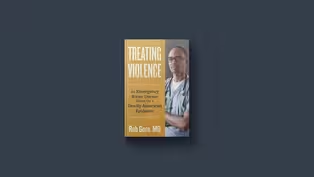
Rob Gore AMNA NAWAZ: A new book offers a firsthand look at the root causes and potential solutions to a critical issue plaguing communities across the country.
That's violent crime.
Emergency room physician Dr.
Rob Gore, shares stories of what he's witnessed and experienced working in cities such as New York, Atlanta and Chicago and overseas in places like Kenya and Haiti.
He created a successful violence prevention program to keep young people from acts of violence before they reach his E.R.
I recently spoke with Dr. Gore about his book, "Treating Violence: An Emergency Room Doctor Takes on a Deadly American Epidemic."
GEOFF BENNETT: Dr.
Rob Gore, welcome to the "NewsHour."
DR.
ROB GORE, Author, "Treating Violence: An Emergency Room Doctor Takes on a Deadly American Epidemic": Well, thanks for having me.
GEOFF BENNETT: Your decision to become a doctor serving those most in need was really influenced by your own childhood, by your own experiences with violent crime.
And you write about being beaten and robbed as a 10-year-old.
How did that searing moment set you on this journey?
DR.
ROB GORE: I was on the corner of our block.
I was coming home from school and these two guys jumped me.
Somebody came from -- grabbed me from behind.
Another guy punched me, and they dug my pockets and stole my bus pass and my dollar that I had.
I didn't have any money.
But it was terrifying.
And I left that space going home thinking, this is never going to happen again.
And I want to make sure that nobody takes advantage of me.
So I started carrying razor blades to school.
I carried razor blades from the age of 10, 11 up to the age of 18.
I carried screwdrivers.
I never carried a gun.
But my goal was to make sure that I was going to be protected at all times.
It's something that, growing up as a Black male, growing up in an urban setting, growing up in a place where you might be considered prey, especially if you're a nerdy kid, you're kind of skinny, and you're not a very imposing figure, they go, oh, wow, that's the person I want to take advantage of.
And if you have been on the receiving end, you want to make sure this never happens to you again.
GEOFF BENNETT: What's gained by viewing violent crime, this epidemic of violent crime, as a public health imperative?
DR.
ROB GORE: Violence is a type of trauma.
And trauma is any sort of injury that comes about as a result of some sort of force.
But violence itself is so different because this is -- it's intended to harm, to kill, to injure.
And it's not like just some sort of accidental process.
And when somebody inflicts a level of injury that's -- that was deliberate, it becomes -- it's almost a personal attack.
And the stress that comes from receiving that trauma, the stress that occurs in many of the communities that I have worked in, the recurrent trauma, the recurrent violence, this experience, creates a level of stress that I wouldn't wish on anybody.
When you're constantly stressed - - and this is some of the things that we have seen overseas.
When you're constantly stressed, when you're under constant duress, and stress can come in many different forms, but when you don't have an ability to process that, when you don't have safety nets that are in place that allow you to have access to a recovery period, you don't do well.
And us looking at violence through this public health lens is really something that we're hoping to really change the scope of and to help keep people alive.
I started doing violence prevention work almost as a way to ensure that I stayed around.
Homicide is the number one cause of death for Black men ages 15 to 34 and the number two cause of death for Latinx men ages 15 to 34.
When I started doing that work, I was in that age bracket.
I'm kind of past that at this point in time.
But I still see people who are my age coming in who are traumatized, coming in who are receiving deliberate injuries because somebody deemed their life less important than their own.
GEOFF BENNETT: Well, when it comes to intervention, what works?
How do you head off violence before it even happens?
DR.
ROB GORE: How do you head off violence before it happens?
I think recognizing that it is occurring.
Some people experience violence so often that they don't even realize that it is a problem.
They think this is something that just occurs in your community.
And so the first thing is recognizing that the trauma that's taking place is not a normal act, is not a normal behavior, and figuring out what are the symptoms that you're experiencing.
If you're experiencing anxiety, depression, if you have already had preexisting mental illness, like depression or bipolar disorder, every subsequent trauma triggers that and makes it even worse.
Then the next thing is to create systems -- and this is more of the long-term approach, create -- systems that help strengthen other supportive factors that can enhance your overall well-being, making sure that people have access to proper education, access to food, access to things that are going to allow them to thrive in a state so they can do really well, not just exist and not just live.
GEOFF BENNETT: Yes.
How have you dealt with the cumulative stress of being on the front lines?
DR.
ROB GORE: That's a great question.
The book itself was really helpful for me, because, as an emergency physician, you see a lot of trauma, you see -- you're in a stressful environment.
The E.R.
exists purely to deal with people who are in a distressed state.
And we aren't always taught to process what we have seen.
We're taught to compartmentalize.
We're taught to tuck it away, so that you can take care of the emergency at hand, and then, when you get some time, go back to it and reflect on it.
But there's not a really designated process to do that.
Now I think people are starting to learn the language about trauma-informed care and trauma -- and overall trauma and wellness practices, but it's not something that we're taught.
And so writing the book itself was a way to reflect on a lot of the stories and things that I have lived, things that I have seen, and people that I have treated as a way to kind of connect dots and come up with a -- almost a template that I can share with other people who may be working in very similar spaces.
GEOFF BENNETT: Dr.
Rob Gore.
The book is "Treating Violence: An Emergency Room Doctor Takes on a Deadly American Epidemic."
Thanks for your time.
We appreciate it.
DR.
ROB GORE: No, thank you so much, Geoff, yes.
GEOFF BENNETT: And that is the "NewsHour" for tonight.
I'm Geoff Bennett.
AMNA NAWAZ: And I'm Amna Nawaz.
On behalf of the entire "NewsHour" team, thank you for joining us.
Biden blocks GOP access to special counsel interview audio
Video has Closed Captions
Biden uses executive privilege block GOP access to special counsel interview audio (3m 49s)
Cohen testifies for 3rd day in Trump hush money trial
Video has Closed Captions
What happened during Michael Cohen's 3rd day of testimony in the Trump hush money trial (4m 43s)
ER doctor reflects on treating trauma, preventing violence
Video has Closed Captions
Emergency room doctor reflects on treating trauma and preventing violence in new book (5m 58s)

FDIC audit reveals toxic culture, chair faces calls to quit
Video has Closed Captions
FDIC chair faces calls to resign after audit details toxic work culture at agency (6m 46s)
The lasting legacy of Brown v. Board and ongoing challenges
Video has Closed Captions
The lasting legacy of Brown v. Board and ongoing education challenges (9m 12s)
Outgoing UN humanitarian chief on handling global crises
Video has Closed Captions
Outgoing UN humanitarian chief on handling one of the worst years for global crises (8m 24s)
U.S. families working to save Gaza child with rare disorder
Video has Closed Captions
American families working to evacuate Gaza child facing rare medical disorder (6m 17s)
Providing Support for PBS.org
Learn Moreabout PBS online sponsorship
- News and Public Affairs

FRONTLINE is investigative journalism that questions, explains and changes our world.

- News and Public Affairs

Amanpour and Company features conversations with leaders and decision makers.












Support for PBS provided by:
Major corporate funding for the PBS News Hour is provided by BDO, BNSF, Consumer Cellular, American Cruise Lines, and Raymond James. Funding for the PBS NewsHour Weekend is provided by...