
May 22, 2024 - PBS NewsHour full episode
5/22/2024 | 57m 46sVideo has Closed Captions
May 22, 2024 - PBS NewsHour full episode
May 22, 2024 - PBS NewsHour full episode
Problems playing video? | Closed Captioning Feedback
Problems playing video? | Closed Captioning Feedback
Major corporate funding for the PBS News Hour is provided by BDO, BNSF, Consumer Cellular, American Cruise Lines, and Raymond James. Funding for the PBS NewsHour Weekend is provided by...
Support provided by:

May 22, 2024 - PBS NewsHour full episode
5/22/2024 | 57m 46sVideo has Closed Captions
May 22, 2024 - PBS NewsHour full episode
Problems playing video? | Closed Captioning Feedback
How to Watch PBS News Hour
PBS News Hour is available to stream on pbs.org and the free PBS App, available on iPhone, Apple TV, Android TV, Android smartphones, Amazon Fire TV, Amazon Fire Tablet, Roku, Samsung Smart TV, and Vizio.
Providing Support for PBS.org
Learn Moreabout PBS online sponsorshipGEOFF BENNETT: Good evening.
I'm Geoff Bennett.
AMNA NAWAZ: And I'm Amna Nawaz.
On the "NewsHour" tonight: A deadly tornado devastates an Iowa town, killing multiple residents and injuring many more.
GEOFF BENNETT: Democratic lawmakers call for a criminal investigation of what they see as big oil's deception about the impact of fossil fuels on climate change.
AMNA NAWAZ: And we look at the role social media plays in the rise in violent crime committed by young people in America.
CONNOR JARNAGAN, Teenager: I was shaking and crying because I really didn't know what was going to happen to me.
I didn't even know if I was going to live.
(BREAK) AMNA NAWAZ: Welcome to the "NewsHour."
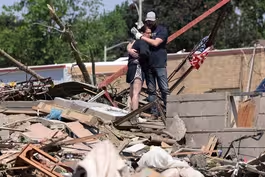
Search efforts are continuing tonight in Iowa, where a devastating tornado tore through one community and led to multiple deaths.
More than 100 first responders were combing through the wreckage today.
GEOFF BENNETT: At least a dozen other people were injured.
And the tornado, part of a series of twisters hitting the state, cut through the heart of a small town about 50 miles southwest of Des Moines.
MAN: There it is, people.
GEOFF BENNETT: A funnel cloud on the horizon became a tornado that churned through Greenfield, Iowa, leaving behind a trail of destruction.
ROGUE PAXTON (Greenfield, Iowa, Resident): It got really, really loud, and we thought we lost our house.
But we were lucky.
Like, everyone else is not so much.
GEOFF BENNETT: Rogue Paxton couldn't believe what happened to the town.
ROGUE PAXTON: Everything is going to be fine because we have each other, but it's just going to be really, really rough.
It is a mess.
GEOFF BENNETT: The losses were especially ate for the town of about 2,000 people.
SGT.
ALEX DINKLA (Iowa State Police): Sadly, we can confirm there have been fatalities with this tornado.
GEOFF BENNETT: Today Iowa State Police Sergeant Alex Dinkla said he still couldn't confirm the number of deaths as the search-and-rescue operation was ongoing.
SGT.
ALEX DINKLA: We're looking to make sure all residents are accounted.
When we have this many homes that have been destroyed and just fully demolished, we want to make sure that every resident, every person is accounted for.
GEOFF BENNETT: Traffic cameras caught the tornado as it ripped through route 30 and overturned a semi-trailer.
Adams County officials said at least one person was killed when a car was blown off the road close to 30 miles Southwest of Greenfield.
Iowa Governor Kim Reynolds compared it to the devastating tornadoes that ripped through Iowa last month.
GOV.
KIM REYNOLDS (R-IA): It's just gut-wrenching.
I was just in Minden, as I said, three-and-a-half weeks ago, and that was horrific.
And I think there's even more debris and just more impaction - - more impacted here.
So it is just horrific.
It's hard to describe until you can actually see the devastation.
GEOFF BENNETT: The National Weather Service received 23 tornado reports on Tuesday, mostly in Iowa, but a few in Minnesota and Wisconsin.
Large parts of the Midwest experienced fierce thunderstorms, and tens of thousands were without power.
The White House said FEMA Administrator Deanne Criswell would head to Iowa tomorrow to survey the damage.
KARINE JEAN-PIERRE, White House Press Secretary: In the meantime, residents in affected areas should remain vigilant and heed the advice of state and local officials.
GEOFF BENNETT: Greenfield's hospital was among the buildings damaged.
Officials said patients were transported to surrounding hospitals and temporary facilities were in place.
JEREMY COOPER, Emergency Management Agency Coordinator: The school is also our makeshift hospital just for -- still for any triage, anybody that might get hurt during our search-and-rescue or cleanup efforts.
GEOFF BENNETT: This has been an especially severe year for tornadoes, with 81 so far in Iowa.
GOV.
KIM REYNOLDS: Right now, we are going to take it pretty seriously.
When they say you need to take cover it, it means take cover.
So, you know, it's important that we listen to the warnings that are available to us right now.
GEOFF BENNETT: And the warnings will continue as peak tornado season extends through the spring and into early summer.
AMNA NAWAZ: In the day's other headlines: Norway, Ireland, and Spain declared that they will formally recognize a Palestinian state, joining some 140 other countries around the world.
Palestinians have sought nationhood in East Jerusalem, the West Bank, and the Gaza Strip since they were seized by Israel in the 1967 war.
This morning in Dublin, the Irish prime minister said he hopes today's decision will create momentum.
SIMON HARRIS, Irish Prime Minister: Each of us will now undertake whatever national steps are necessary to give effect to that decision.
In the lead-up to today's announcement, I have spoken with a number of other leaders and counterparts, and I'm confident that further countries will join us in taking this important step.
AMNA NAWAZ: The recognition is largely symbolic, but it's still seen as a blow to Israel amid its ongoing war with Hamas.
Israel's prime minister fired back today, saying that the three countries are rewarding terrorism.
BENJAMIN NETANYAHU, Israeli Prime Minister (through translator): This evil cannot be given a state.
This would be a terrorist state that would repeat October 7 again and again.
Rewarding terrorism won't bring peace and won't stop us from defeating Hamas.
AMNA NAWAZ: Israel recalled its ambassadors to the three countries following the announcements.
Their official recognition of a Palestinian state will take effect on May 28.
Here at home the families of 19 victims of the school shooting in Uvalde, Texas, are suing nearly 100 state police officers for their botched response to one of the deadliest school shootings in U.S. history.
The families' legal team also announced they agreed to a $2 million settlement with the city of Uvalde.
Friday marks two years since a teenage gunman entered Robb Elementary School, killing 19 fourth graders and two teachers.
The Biden administration is canceling another round of student loans.
The Education Department said today it will erase $7.7 billion in federal debt.
The move will affect 160,000 borrowers.
All told, the Biden White House has canceled $167 billion in loans for more than five million Americans.
But those efforts have faced legal challenges by some Republican-led states, who say the president needs congressional approval for such actions.
Hunter Biden's trial on federal tax charges in California will now start in September.
It had been due to begin next month.
U.S. district Judge Mark C. Scarsi agreed to delay the trial, so that the president's son can prepare for a separate case on gun charges he faces in Delaware.
That trial begins on June 3.
Biden's lawyers had argued they could not prepare for both trials adequately, citing the -- quote -- "uniquely challenging and high-profile nature of the prosecution."
He has pleaded not guilty in both cases.
Former Republican presidential candidate Nikki Haley says she will vote for Donald Trump in November's election.
She may be announcement in Washington today during her first public appearance since suspending her own campaign in March.
The two had been sharply critical of each other during the primary campaign.
The former South Carolina governor was one of the last high-profile governors not to endorse Trump's presidential bid.
In Thailand, an investigation is under way into the Singapore Airlines flight that dropped suddenly amid severe turbulence, leaving one person dead and 20 others in intensive care.
The Boeing 777 flight from London to Singapore made an emergency landing in Bangkok yesterday, shortly after falling 6,000 feet in just three minutes.
Passengers described a scene of sheer terror, as loose items and even people lurched through the cabin.
DZAFRAN AZMIR, Passenger: I saw people from across the aisle just like -- like, going completely horizontal, hitting the ceiling and landing back down in, like, really awkward positions, people getting massive gashes in their head, concussions.
AMNA NAWAZ: Others said that the shuttering was so violent that large pieces of the plane's interior were falling off.
About 140 passengers and crew were flown onwards to Singapore today.
More than 80 others stayed behind in Bangkok.
Britain's prime minister has called a general election for July 4 months earlier than many had expected.
Rishi Sunak made the announcement during a televised address from outside 10 Downing Street.
He's betting that recent signs of economic growth and lower inflation will give voters a reason to extend the Conservative Party's 14-year hold on power.
But the opposition Labor Party is well ahead in most polls.
Their leader, Keir Starmer, is widely expected to become the next prime minister.
Regular use of marijuana has risen to the same levels as alcohol use.
That's according to new research published today in the journal "Addiction."
An estimated 17.7 million people reported using marijuana daily or almost daily in 2022.
That's compared to 14.7 million regular drinkers.
It's also a 15-fold increase since 1992.
The study's author, Jonathan Caulkins, added that -- quote -- "A good 40 percent of current cannabis users are using it daily or near daily, a pattern that's more associated with tobacco use than typical alcohol use."
On Wall Street today, stocks fell amid worries that the Federal Reserve won't cut interest rates soon after its latest meeting.
The Dow Jones industrial average dropped more than 200 points to close at 39671.
The Nasdaq lost 31 points, and the S&P 500 gave back 14 points.
Still to come on the "NewsHour": a look at former President Trump's plans to reform health care if he returns to the White House; the children of an American psychotherapist who's believed to have died in detention in Syria speak out;the United States' first Black astronaut candidate becomes the oldest person ever to fly in space; and bestselling writer Amy Tan turns her literary gaze on the world of birds.
GEOFF BENNETT: In Congress, the top Democrats on two committees are asking the Department of Justice to launch a sweeping investigation of big oil corporations.
They allege that the companies have deceived the public for decades about their complicity in climate change and willingness to address it.
Our Lisa Desjardins has more.
LISA DESJARDINS: Senate Budget Chairman Sheldon Whitehouse and Congressman Jamie Raskin, the top Democrat on the House Oversight Committee, are asking for the kind of action that DOJ brought against tobacco companies about 20 years ago, but against big oil.
This comes weeks after the two released a joint staff report laying out their findings from a three-year investigation of major oil companies.
And Congressman Raskin joins me now from Capitol Hill.
Congressman, you're talking about evidence that, more than 50 years ago, big oil companies knew about fossil fuels' connection to climate change.
And then you're also talking about more modern evidence that they have been deceiving the public.
Can you give us some specific examples?
REP. JAMIE RASKIN (D-MD): Sure.
Fifty or 60 years ago, they clearly understood that the burning of fossil fuels destabilized the climate and warmed the Earth.
And they made a very deliberate decision that, rather than tell government and blow the whistle, they would try to suppress that evidence.
And they suppressed the evidence.
And then, as other scientists in other places began to discover the relationship between fossil fuel combustion and increase in the Earth's temperature and climate change, they denied it and they tried to throw a blanket of uncertainty and confusion over the whole subject.
And even after climate change became a well-accepted and well-acknowledged reality throughout the world of science, they have done whatever they can to try to undermine us making the policy decisions we need to make in order to break from the carbon economy and the carbon model and move to solar energy and wind energy and renewable systems.
So we have very specific evidence of them taking all of those steps, and it goes on even to this day.
So we had lots of evidence of it, and we want to turn it over to the Department of Justice.
Congress obviously has to work on solutions going forward, as we did in the Infrastructure Act and the Inflation Reduction Act.
But we want to make sure that this history is not swept under the rug.
LISA DESJARDINS: I know you also mentioned, for example, some of the public commitments by BP and other companies to the Paris climate agreement and then evidence behind the scenes that they felt like there wasn't a commitment at all in there.
But I want to talk about what you want to happen next.
In your letter to the Department of Justice, you talk about past investigations, specifically the investigation into deceptive practices of the tobacco industry, which you say led to investigations and litigation by state attorneys general and the Department of Justice.
Now, that DOJ tobacco case, of course, was historic.
It was a civil case.
Are you saying here that you believe big oil is complicit in climate change and the harm from climate change in the way big tobacco was found to be harming Americans with cigarettes?
REP. JAMIE RASKIN: Absolutely.
It's a very close analogy, because the tobacco industry was, of course, profiting from their model, which was to sell people cigarettes, get them addicted to cigarettes and then suppress or cloud the evidence of the carcinogenic effects of smoking on the human body.
And, here, what we have is the entire gas and oil industry -- and we're talking about ExxonMobil, BP, several other companies, which understood the way that fossil fuel combustion produced dramatic changes in the climate and warmed the climate in ways that have been costing humanity hundreds of billions of dollars, and the costs are only going up.
And all of this is to the detriment of the public health and the public safety.
So it's a very close analogy.
But, look, we're Congress.
We're lawmakers, and we have to try to figure out how to get out of this mess.
The whole question of civil or criminal liability or culpability lies exclusively with the Department of Justice, and we will let them figure that out.
LISA DESJARDINS: We asked the major oil companies, of course, for comment.
They did not respond to us.
We also asked the American Petroleum Institute to come join us on the program.
Unfortunately, they didn't respond to that.
But they did give us a response to your letter, writing: "This is another unfounded political charade to distract from persistent inflation and America's need for more energy, including oil and natural gas.
U.S. energy workers are focused on delivering the reliable, affordable oil and natural gas Americans demand and any suggestion to the contrary is false."
Obviously, moving to renewable fuels can't happen immediately.
How do you respond to the oil industry saying that you're just playing politics here?
REP. JAMIE RASKIN: Well, we're at levels of gas and oil production higher than we have seen before.
And the economy remains deeply invested and engaged in carbon production.
And, look, the big gas and big oil are culpable primarily for their suppression of these clear scientific findings and facts that they knew of for decades.
But all of us are implicated by virtue of our use of the carbon-producing fuels.
So it's not primarily a moral problem in terms of how do we disengage from the carbon model and move to other forms of energy that are not going to present a dagger at the throat of humanity, but all of the scientists are agreed that we can't keep on going as we have been going on.
LISA DESJARDINS: Congressman Jamie Raskin, thank you for joining us.
Thanks for your time.
REP. JAMIE RASKIN: You bet.
AMNA NAWAZ: This week, Donald Trump suggested he was open to restricting birth control in the U.S. or allowing states to do so.
Then he walked it back on TRUTH Social, saying that he will -- quote -- "never advocate imposing restrictions on birth control."
On the campaign trail, President Biden and former President Trump are proposing vastly different visions for reproductive rights and health care in the U.S. Our White House correspondent, Laura Barron-Lopez, has been covering this.
And she joins me now.
Good to see you, Laura.
LAURA BARRON-LOPEZ: Good to be here.
AMNA NAWAZ: So, on abortion and reproductive rights, in particular, former President Trump has contradicted himself quite a lot.
So what do we know about where things stand now on his views?
LAURA BARRON-LOPEZ: So, Amna, former President Donald Trump has tried to distance himself from some Republicans' proposal to implement a national federal abortion ban -- some have proposed 15 weeks - - and says that he will ultimately leave it up to the states to decide how much they want to restrict this.
He's -- however, he's continued to Bragg about being, he says, responsible for overturning Roe v. Wade.
And the bottom line here, Amna, is that the broad public support for abortion access is why the former president has tiptoed or flip-flopped around this issue, but he has repeatedly said that he would allow states to restrict abortion care as much as they want to, including even tracking pregnancies.
AMNA NAWAZ: So, more broadly, what has he outlined when it comes to a health care platform if he were to win a second term?
LAURA BARRON-LOPEZ: Trump has said repeatedly that he wants to get rid of the Affordable Care Act.
He said that.
He has said that over the years, and he hasn't stopped that rhetoric on the campaign trail.
In November of 2023, he wrote on TRUTH Social that he was -- quote -- "seriously looking at alternatives."
But then, last month, he tried to push back on attacks from the Biden campaign that he was going to, again, seek to repeal the Affordable Care Act and said that he's not running to scrap Obamacare completely, that he wants to make it better.
DONALD TRUMP, Former President of the United States (R) and Current U.S. Presidential Candidate: I'm not running to terminate the ACA, as crooked Joe Biden says all over the place.
It's much too expensive now, and it's not very good.
We're going to make it much better, much stronger, in other words, make the ACA much, much better.
LAURA BARRON-LOPEZ: If that sounds familiar, Amna, it's because it is.
And he ran on a similar platform in 2016.
And when he controlled - - he, along with Republicans, controlled all of government, both chambers, and they attempted to repeal the Affordable Care Act, they failed.
AMNA NAWAZ: So there's been a blueprint of sorts for a potential second Trump term that's been laid out by a group called Project 2025 I know you have been tracking.
What kind of changes are the authors of that project proposing to the health care system?
LAURA BARRON-LOPEZ: So Project 2025 is written by a coalition of right-wing think tanks.
And the health care chapter specifically in that document was written by Roger Severino.
He served in Trump's Health and Human Services Department when Trump was president.
And the authors of that document, including Severino, say that they don't represent the campaign.
But this is a manifesto for any next conservative administration.
And many of the authors are Trump allies or served in Trump's administration.
My producer, Shrai Popat, and I spoke with Roger Severino, who said that Project 2025's health care policies are a response to what he claimed are Biden administration efforts to undermine the nuclear family.
ROGER SEVERINO, Vice President of Domestic Policy, The Heritage Foundation: The idea that you -- that men and women are absolutely interchangeable, that a child does not need a mother or a father, is also very harmful to our society.
So the notion that the Biden administration is pushing is that not only are mothers and fathers totally interchangeable, that there's really no difference that matters between men and women at all.
And when I say that biological realities matter in health and well-being, they do.
LAURA BARRON-LOPEZ: As you can hear there, Amna, Health and Human Services Department under the proposals of Severino would strictly establish that a family structure is between a male, a female specifically.
And that is the bedrock for Project 2025's health care policies.
And so when we look at those proposals, with that in mind, here's what some of them include.
Project 2025 is proposing repealing the Medicare drug price negotiations that President Biden passed, allow federal health care providers to deny gender-affirming care for transgender people, restrict Medicaid access by adding work requirements, and eliminate the Affordable Care Act's coverage of the morning after pill, Ella.
We also spoke with Caroline Ciccone, who is at Accountable.US., a nonprofit who's tracking these policy proposals.
And she essentially said that LGBTQ people, seniors, anyone looking for more access to reproductive care should be very concerned by these proposals.
AMNA NAWAZ: So those are broader health care proposals from Project 2025.
But specifically about abortion access, does Project 2025's proposals line up with what we have heard from former President Trump?
LAURA BARRON-LOPEZ: When we spoke with Severino, he essentially said what former President Donald Trump's line has become, which is that the votes aren't there for a national 15-week abortion ban, that there aren't 60 votes in the Senate for it.
But language across the Project 2025 document makes clear that the authors believe that life begins at conception.
And they specifically state that the Health and Human Services Department should return to be known as the Department of Life.
And they explicitly reject the notion that abortion is health care.
And so some of their abortion policy proposals include scrapping federal funding to Planned Parenthood, undoing the Biden administration rule that shields medical records related to abortion from criminal investigations -- that's if a patient crosses state lines -- reversing the FDA approval of mifepristone, which is one of the two pills used for medical abortion, and mailing -- making mailing abortion pills to patients illegal.
And that's under -- they would do that under the Comstock Act, Amna, a 19th century law that bans mailing anything that could facilitate an abortion.
AMNA NAWAZ: So, Laura, make the comparison for us here.
How does all this compare to what President Biden is proposing on these issues?
LAURA BARRON-LOPEZ: President Biden has focused on the campaign trail essentially making the argument that he wants to build upon his first term.
He, namely, wants to build upon that Inflation Reduction Act piece of legislation.
And so his proposals include capping insulin costs for all Americans.
Currently, it's capped at $35 for Medicare recipients.
Expanding Medicare drug price negotiations.
Currently, Medicare is only allowed to negotiate on 10 drugs, the prices of those 10 drugs.
Protecting access to abortion through codifying Roe v. Wade, or expanding the Affordable Care Act, so keeping subsidies going under the Affordable Care Act that are set to expire in 2025.
And this week, Amna, President Biden's campaign came out with new ads directly targeting former President Trump's rhetoric over the years saying that he would scrap the Affordable Care Act.
AMNA NAWAZ: That's our White House correspondent, Laura Barron-Lopez.
Laura, thank you, as always, for your great reporting.
LAURA BARRON-LOPEZ: Thank you so much.
GEOFF BENNETT: Violent crime is on a downward trend across the country since a pandemic era spike.
But, today, a number of cities are reporting a new rise in violent crime among youth.
In many cases, law enforcement says social media played a central role.
Stephanie Sy reports from Maricopa County, Arizona, about the challenges of addressing teen violence.
STEPHANIE SY: A little over a year ago, Connor Jarnagan's typical suburban teen life took a dark turn.
CONNOR JARNAGAN, Teenager: Until that moment, I did not think people had such an evil in their heart to do something like that to somebody.
STEPHANIE SY: While waiting in the parking lot of an In-N-Out, Connor said he was confronted by about a dozen teen boys.
The leader demanded $20 and Connor resisted.
CONNOR JARNAGAN: I worked for this money.
You are not going to just take it from me.
So, I said no until he punched me with brass knuckles.
The whole time, there was blood just gushing down my head.
I was shaking and crying, because I did not know what was going to happen to me.
I did not know if I was going to live.
It was really scary for me.
STEPHANIE SY: The suburb where it happened, outside Phoenix, is what his mom, Stephanie, described as a bubble, billing itself in recent years as one of the safest cities in America.
STEPHANIE JARNAGAN, Mother or Connor Jarnagan: We live in Gilbert, Arizona.
It is a bedroom community.
I never thought that that would happen to my son.
Letting him go have a burger with friends at dinnertime, like, I did not think that that would be unsafe.
STEPHANIE SY: It turns out the teen who assaulted Connor was part of a group who called itself The Gilbert Goons.
CONNOR JARNAGAN: There's videos of him fighting people all over the Internet.
STEPHANIE SY: The group members were known for posting videos of each other flashing guns, ganging up on teens, and street racing.
Examples of teen violence span social media and the country, from Missouri where a 15-year-old girl attacked another teen, landing her in the ICU, to Stockton, California, where a group of teens filmed the beating and robbing of an 8-year-old.
The violence by The Gilbert Goons, which, although recorded, went unchecked by law enforcement for the better part of a year, culminated in the death of 16-year-old Preston Lord last October.
While a group of attackers pummeled him, some teens called 911, while others stood by, recording on their phones.
CHUCK BONGIOVANNI, Gilbert, Arizona, Councilman: Why do you have 40 kids with a camera recording violence?
I saw a five-second video of Preston before they did CPR.
And I don't ever want to see a video like that again in Gilbert.
STEPHANIE SY: As community grief turned to outrage over the death of Lord, Gilbert town Councilmember Chuck Bongiovanni helped set up a subcommittee to address teen violence.
At a recent meeting, half the attendants were area high school students.
CHRISTINE NJUGUNA, Gilbert Mayor's Youth Advisory Committee: Just one thing I would say would be a big deal while going to these schools is just also teaching children accountability.
You will be accountable, not only with police and everything, but just like general morals.
STEPHANIE SY: While moral accountability is called for by some, many others are calling for stronger law enforcement and curfews.
CHUCK BONGIOVANNI: Now, with social media, it is creating personas these kids usually really wouldn't be if they did not have social media.
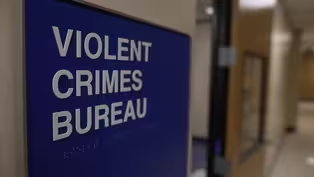
STEPHANIE SY: A 30-minute drive from Gilbert, Commander Gabe Lopez says the number of teens murdered in his city last year rose significantly from the year before, as did the number of teens charged with homicides.
Lopez is head of the Phoenix Police Department's Violent Crimes Bureau.
He points out the scene of a shooting late last year during a particularly violent stretch.
CMDR.
GABE LOPEZ, Phoenix Police Department: I think a total of nine victims are what these two individuals were charged with.
So, of the four people in the car, two were charged with the homicide.
STEPHANIE SY: And they were juveniles?
CMDR.
GABE LOPEZ: They were juveniles.
And, again, the victim was 15, the suspects were 17, and then you had a 10-year-old shot.
STEPHANIE SY: Federal statistics show, in 2020, homicides committed by juveniles were the highest they'd been in two decades.
CMDR.
GABE LOPEZ: The fear that I have, and I think it's shared by others in law enforcement, is people are doing or committing crimes so that they can capture it, so they can post it on their social media feed, so they can get street cred, or so that they can get likes.
JAMES GARBARINO, Psychologist: Youth culture has moved in the direction of celebrity is the number one value.
STEPHANIE SY: Psychologist James Garbarino has spent decades researching adolescent violent behavior.
JAMES GARBARINO: The cultural immersion in violent imagery is so powerful in the United States and, of course, social media, the rise of social media as a context in which those expressions can be offered, it's certainly it's not just limited to 2020 and onward, but it has escalated as well.
STEPHANIE SY: Commander Lopez says social media has also changed the landscape of gang violence.
CMDR.
GABE LOPEZ: Traditionally, it had always been really focused on the neighborhood that you were from, a group of friends that you typically grew up with.
Nowadays, they meet online, they communicate via social media.
It's a hybrid mix of different races, different areas of the city.
It's complicated as far as trying to police that.
STEPHANIE SY: Before Olga Lopez moved to the Phoenix suburbs from California two years ago, she made sure it was a safe town where her son Jeremiah could play on a competitive high school football team.
But, last may, Jeremiah was shot and killed at a fellow student's home in Mesa.
He was 18, weeks away from graduating high school.
OLGA LOPEZ, Mother of Shooting Victim: The teammate who lives in the house along with the young man that lives across the street, were pointing guns at Jeremiah multiple times and recording it and posting it to Snapchat.
STEPHANIE SY: In the video described to her, Lopez says the laser from the guns pointed at Jeremiah shone red dots on his face.
OLGA LOPEZ: One time, Jeremiah says: "Hey, chill."
Another time, Jeremiah is trying to make light of the situation.
A little under 30 minutes later, my son is fatally shot in the back of the head.
I vowed that I would show up with the same grit and determination that he did.
STEPHANIE SY: Olga got the devastating news on May 7.
OLGA LOPEZ: It isn't something that you get over.
It definitely isn't something that time heals.
And every day is like the first week.
STEPHANIE SY: She pours herself into running a nonprofit foundation she set up with her oldest son in Jeremiah's name.
While social media may have played a role in both Jeremiah's death and the attack on Connor Jarnagan in Gilbert, it was also what helped pin down the suspects in their cases.
Jarnagan helped lead police to his attacker.
CONNOR JARNAGAN: They got into his phone, and they looked at his chats and there it was: "I hit this guy and he gave me $20."
STEPHANIE SY: Connor says a lot of teens have been afraid to report on their peers, for fear of retaliation.
CONNOR JARNAGAN: Teens need to come forward and stop being in the shadows, stop recording these fights.
Instead, do something about it and make our communities a safer place.
STEPHANIE SY: He's doing his part by calling for Arizona state lawmakers to ban brass knuckles for minors.
That action is tabled for now.
CONNOR JARNAGAN: I'm hoping both sides of the aisle, Republicans and Democrats alike, can come together on this issue.
STEPHANIE SY: Connor continues to heal.
And part of that, he says, has meant forgiving the teen who attacked him.
For the "PBS NewsHour," I'm Stephanie Sy in Maricopa County, Arizona.
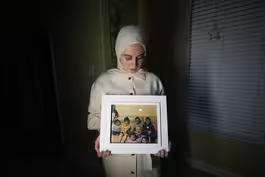
AMNA NAWAZ: The family of an American psychotherapist detained in Syria says the U.S. government has informed them that he died in custody.
Majd Kamalmaz was one of half-a-dozen Americans believed held by Bashar al-Assad's regime.
And, as Nick Schifrin reports, some of them were allegedly tortured, some even murdered -- Nick.
NICK SCHIFRIN: Amna, Majd Kamalmaz wasn't hiking up a mountain or fishing in the ocean, he was with his brood of grandchildren.
When he wasn't with them, he was helping other people's children who had suffered trauma in conflict or natural disasters.
He led an NGO that treated young victims of the war in Bosnia, the tsunami in Indonesia, and Hurricane Katrina.
In 2017, he traveled to Damascus to pay respects after his father-in-law's death.
He never came home.
Last week, the U.S. government told the Kamalmaz family that he was likely killed, a prisoner of Syria.
I'm now joined by two of Majd Kamalmaz's daughters, Ula and Maryam.
Ula, can you tell me about your father?
ULA KAMALMAZ, Daughter of Majd Kamalmaz: He was a kind-hearted, loving, empathetic individual who lived his attributes through his various roles as a family man and a psychotherapist who was devoted to his work and his family.
NICK SCHIFRIN: Maryam, what did the U.S. government tell you about what happened?
MARYAM KAMALMAZ, Daughter of Majd Kamalmaz: So there was around eight U.S. government officials that had gathered for our meeting to discuss my father's fate.
And they very, very clearly stated that they believe they have highly classified information that indicates that he has passed.
This piece of information was highly credible, and they truly believed that he was deceased within the Syrian government's hands within the prisons of the Syrian government.
There was no way for us to continue having any form of hope, basically, that he would be alive.
It was very clear he was gone and very tragic for us as well, because we had been praying and hoping for the past seven years and working very -- as much as we could to do the best that we can to bring him home alive.
And to know that he was gone was devastating.
NICK SCHIFRIN: Ula, how has your family endured this?
And, in any way or in some ways, does this provide a kind of closure?
ULA KAMALMAZ: I'm truly appreciative to have the opportunity to tell his story.
And, as a family, it's been an experience of lots of emotions.
We haven't heard from him for like seven years, nothing, not a phone call, no picture, no communication.
So it has been hard on the family.
My mom, which is his wife, and my grandmother, and his sisters, we kids, grandkids, it's been difficult.
Unfortunately, the worst has come true, that we will never be able to see him.
And this helps us a lot to know that his legacy can live on, and just very appreciative to be able to tell his story.
NICK SCHIFRIN: Maryam, State Department spokesman Matthew Miller was asked about your father earlier this week.
And this is what he said.
MATTHEW MILLER, State Department Spokesman: We saw the statement the Kamalmaz family put out over the weekend, and our hearts go out to them at this difficult time.
I would just say that we have engaged extensively to try to bring Majd Kamalmaz home, and we remain committed to seeking a full accountability - - seeking a full accounting of his fate.
NICK SCHIFRIN: What's your response to that statement?
MARYAM KAMALMAZ: They have told us what his fate is.
And I do appreciate all the work they have put into finding and being able to inform us about our father.
But I'm kind of confused by his statement, because they did very clearly indicate that he had passed.
And I don't hear him saying that in his statement.
NICK SCHIFRIN: And, further, what do you want the U.S. government to do now?
Or what will you and the family do now?
MARYAM KAMALMAZ: Usually, when a situation as this happens, that an American citizen that has never been charged with a crime, no case, no trial is murdered within the prison, you would expect the president of the United States possibly to call our family, as well as a statement put out, some form of accountability to be put on the Syrian government, as well as looking into persecuting them in a criminal lawsuit.
How could we be silent about an innocent person's death within the hands of another government?
This is an American's life.
Is it not valuable to the U.S. government?
They're completely mute right now.
NICK SCHIFRIN: The official U.S. policy on Syria is against normalization with the Assad regime until there's a political solution and that U.S. sanctions will remain on Assad until then.
Is that what you see this administration doing?
Are they doing enough?
MARYAM KAMALMAZ: I believe that the administration is not doing enough.
They need to push harder for accountability.
As you know, seven years -- my father was gone for more than seven years, and not once did the Syrian government acknowledge his detainment, even though we know for 100 percent that they had him.
And I believe the administration is not doing enough to learn our family members' fates and to bring them home, whether alive or not.
Though I am grateful that they were able to bring us this piece of information, it's still disappointing that they are not publicly acknowledging what they have told us.
NICK SCHIFRIN: Maryam and Ula Kamalmaz, we are so sorry for your loss.
Thank you very much for taking the time to speak to us tonight.
MARYAM KAMALMAZ: Thank you.
ULA KAMALMAZ: Thank you.
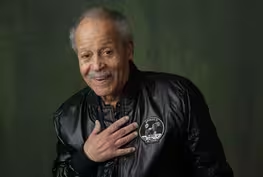
GEOFF BENNETT: More than 60 years after he was selected, but ultimately passed over to become this country's first Black astronaut, Ed Dwight finally made it to space.
On Sunday, he flew aboard Blue Origin's New Shepard 25 rocket as it skimmed space on a roughly 10-minute flight.
Ed Dwight was an Air Force pilot when then-President John F. Kennedy championed him as a candidate for NASA's early astronaut corps.
But his plans for space travel were sidelined, and he was never granted the opportunity due to racism within the program.
Dwight left the air force and went on to make a name for himself as a celebrated artist and sculptor.
With Sunday's flight, he makes history as the oldest person to ever go to space at age 90.
I spoke with Ed Dwight earlier, and I asked him about his historymaking flight.
ED DWIGHT, Former U.S. Air Force Pilot: I was more interested in the power and the noise and the lifting, going straight up in the air, instead of flying an airplane from a runway or something.
And it was quite fast.
And we got up to the speed fairly quickly.
The getting into space part was more interesting to me than anything else.
The weightlessness, I had -- I lived in a world of weightlessness, so that didn't bother me.
I never got out of my seat.
We were laying down in the capsule, so I never got out of my seat.
There was a big 10-foot-tall window that was next to me, and I was more fascinated with what was going on outside than what was going on inside.
When we did get a zero-g, the other members of the crew, they had designed a dance.
These are all grown men now designing a dance that they -- a ballerina dance that they were going to do during the weightlessness.
So, I kind of watched them a little bit, but, again, I spent all my time looking outside.
The thing that kind of shocked me a little bit was the separation, because they have explosive bolts to hold the capsule to the booster.
And it was extremely loud, and it felt like we ran into something, and I was confidently sure that we were destined to fall to Earth.
GEOFF BENNETT: Did you feel a sense of vindication?
Did you feel any semblance of justice, especially given the way that you were denied the opportunity to go to space some 60 years ago, despite being eminently qualified and being tapped by then President John F. Kennedy?
ED DWIGHT: Right.
Well, people -- that's a big question that they ask.
And for 60 years, I actually told myself that, oh, hell, I didn't need that, because I'm an action soldier, and I'm always going out and doing things positive, and doing big projects, and having a good time at it.
And so I didn't have a lot of time to think about being angry or sorrowful or anything of the sort, because I had to take a look at the job that was my job at 60 years ago.
And my -- if you look at it philosophically, my job was to start a conversation about Blacks in space, and that was my job.
But, then again, as I got closer and closer to it, especially in the last few days, I got to thinking about it, and I said, well, this thing is really going to happen here.
It took 20 years for them to come around to that.
But here I was -- I was making art for NASA.
They were flying my sculptures into space.
They were naming asteroids after me.
And I knew all the Black astronauts really, really well, because we were all buddies.
And we had a club, and we called ourselves the Afronauts.
(LAUGHTER) GEOFF BENNETT: Well, let me ask you about that, because when you returned to Earth on Sunday, you were greeted by NASA astronauts, space shuttle veterans Leland Melvin, Charlie Bolden and Bernard Harris.
ED DWIGHT: Right.
GEOFF BENNETT: And from where I sit, their success is directly linked to your experience, to your sacrifice.
Do you see it that way?
ED DWIGHT: Oh, of course I do, because they tell me that every time we talk.
"If it wasn't for you, Ed, we wouldn't be doing this."
And it was kind of an accepted kind of relationship that we had.
And so they just consider me one of them that just hadn't gone up.
So I have been close to the program, and I have been close.
I have got a big display at -- in the Pentagon.
And I have been recognized all these years.
And nobody has just -- like I was isolated and living on another planet or anything.
And every one of these guys considered me a part of it.
So that part was good.
So it all came together at the tail end of the thing last Sunday.
GEOFF BENNETT: So, Mr. Dwight, congratulations on your historymaking flight.
And thanks so much for being with us today.
We appreciate it.
ED DWIGHT: Well, thank you very, very much for having me.
I enjoyed it.
AMNA NAWAZ: She is a novelist-turned-naturalist.
New York Times bestselling author Amy Tan has turned her intense gaze to the world of birds and shared her private drawings and musings in a new book.
Jeffrey Brown recently joined her at her Northern California home for our arts and culture series, Canvas.
AMY TAN, Author, "The Backyard Bird Chronicles": He's asking a question.
Yes.
Yes, yes, yes, you can come.
JEFFREY BROWN: It's a backyard bird call, part of the daily routine of observing and interacting with the many species of birds, more than 60 and counting, that regularly visit the Sausalito, California, home of a flightless creature named Amy Tan.
AMY TAN: I'm the flightless creature with the food.
I'm here.
JEFFREY BROWN: It's now captured in her new book, "The Backyard Bird Chronicles," gathered from six years of looking and learning.
AMY TAN: It's a chronicle of me learning to be a curious child again, a chronicle of hope, a chronicle of learning to observe more closely and match it with emotions and questions about morality and mortality.
It's so many things to me.
It was a diary of my life during this period.
JEFFREY BROWN: Tan is best known for her fiction, beginning with "The Joy Luck Club" in 1989, books often grounded in her own Chinese-American experience.
Her turn to birds was partly stirred by the ugliness she saw in the human world, including a rising bigotry, even violence, directed toward Asian Americans.
AMY TAN: I noticed that there was a lot of overt racism going on.
It was as though people thought it was their freedom of expression, that it was now a need to express this, a very small segment of society, but it was frightening to me.
It made me feel that it had always been there, and some of it was directed toward me, and I'd never had that experience.
I needed to take myself out of that, this hatred of being different, and take myself into a place where the things -- the very things that were different were the most beautiful.
JEFFREY BROWN: She'd love to draw as a child growing up in Oakland, California.
But a pursuit of any kind of art wasn't encouraged at home or school.
She's kept a high school report card declaring this future beloved writer "lacks imagination or drive necessary to a deeper creative level."
Long ago, she made a promise to herself.
AMY TAN: I told myself as an adult that when, I reached the age of 65, I would allow myself the indulgence of learning to draw.
JEFFREY BROWN: You told yourself this?
At what point?
AMY TAN: I would -- when I was like in my 30s or 40s, I said, when I'm 65, I will retire from my job, and I will learn to draw.
Well, I became a writer.
I'm never going to retire.
So what am I going to do?
So, at age 65, I remembered the dream, and I said, I'm going to start to draw.
JEFFREY BROWN: And she did start to draw birds, drawing as a way of close observation, of coming to know the names and habits of specific species, little birds like the dark-eyed junco and orange-crowned warbler, big creatures, including the great horned owl, always focusing on birds she can see and that can see her in and around her own home, a gorgeous setting overlooking the San Francisco Bay, which she made into even more of a birdie haven by putting up numerous feeders, creating a garden habitat.
So do you have favorites at this point?
AMY TAN: I have different favorites.
Sometimes, it'll be the oak titmouse, because he's so funny and he's little and he scolds me or the other birds.
JEFFREY BROWN: The drawings became part of a daily journal filled with her notes and questions, personal, curious, learning as she went.
She's not an expert, she wants us to know, but she's getting there, and she's definitely, her word, obsessed.
On June 30, 2019, she writes: "I have been spending more hours a day staring at birds than writing.
How can I not?"
Now, I see you have got your binoculars.
So, you're ever... AMY TAN: Always.
JEFFREY BROWN: Always?
AMY TAN: Always.
JEFFREY BROWN: Ever ready, just walking around the house?
AMY TAN: As soon as I get up and put on my clothes, I put on my binoculars.
JEFFREY BROWN: Really?
AMY TAN: Because I have all these windows.
And you never know what's going to land on a tree right in front of me.
JEFFREY BROWN: So, at any moment, you're -- you're sort of going about your day here, but you're looking around.
AMY TAN: I'm there.
JEFFREY BROWN: Yes.
AMY TAN: And then I look.
JEFFREY BROWN: Tan has fun in these pages, imagining, for example, the windowsill wars, interspecies aggression, though, as a hermit thrush says: "We don't use terms like that.
We're birds."
But she also observes the crucial daily tasks, the life-and-death struggles.
AMY TAN: I think what miraculous creatures these are.
So many of them don't survive.
They die through lack of food or they get taken by another bird, but... JEFFREY BROWN: Which you're seeing out -- right out your doors here.
AMY TAN: I'm seeing it in action.
What I see out there is not birds.
I see drama.
I see stories that unfold.
And each day, I would write down what the story was, what the drama was, and how I was moved by it, how my curiosity was piqued.
JEFFREY BROWN: And here, in a fascinating way, is where Amy Tan, the fiction writer, is also at work.
AMY TAN: I imagine myself being the bird and what it must be thinking.
JEFFREY BROWN: You imagine yourself?
AMY TAN: I'm the bird.
JEFFREY BROWN: You're the bird.
AMY TAN: Yes.
I'm the bird looking at the person that is really me.
And what does a bird see?
What am I thinking when a bigger bird comes up to me?
What am I thinking if a smaller bird comes up to me?
How do I tell that bird, this is mine?
So I'm watching this happening and imagining I'm that bird as I'm drawing.
And it brings me so much closer into what's happening, this drama, the conflict that's happening, or the courtship that's happening, the -- all of that.
And in that way, it's very similar to writing a novel, because I become the characters.
JEFFREY BROWN: These days, many people tell Tan of how their own bird obsession began or grew during the pandemic, a kind of refuge that grew, as for her, into a sense of wonderment and appreciation.
AMY TAN: I started asking all the obvious questions.
And it became so much more interesting to me, and it grew.
It just took off.
And now I couldn't stop.
I wanted to find the answers.
But, of course, the answers would always elude me.
And the reason why is because I'm not a bird.
I can't possibly know the intentions... JEFFREY BROWN: It turns out you're not a bird.
AMY TAN: I am not a bird.
(LAUGHTER) AMY TAN: I can try to pretend I'm a bird or imagine I'm a bird, but the thing is, I don't know the intentions of a bird, and I always remind myself I don't know that.
And that's what makes it wonderful as well.
They will always be a mystery .
JEFFREY BROWN: From the backyard and all its mystery, I'm Jeffrey Brown for the "PBS NewsHour" in Sausalito, California.
AMNA NAWAZ: And join us again back here tomorrow night for a look at how invasive goldfish are threatening the Great Lakes' fragile ecosystem.
And that is the "NewsHour" for tonight.
I'm Amna Nawaz.
GEOFF BENNETT: And I'm Geoff Bennett.
For all of us here at the "PBS NewsHour," thanks for joining us, and have a good evening.
American detained by Syria died in custody, family says
Video has Closed Captions
Family of American held by Syria demands accountability after learning he died in custody (6m 22s)

Amy Tan turns her literary gaze on the world of birds
Video has Closed Captions
Amy Tan turns her literary gaze on the world of birds in 'The Backyard Bird Chronicles' (7m 35s)
Deadly tornado devastates small town of Greenfield, Iowa
Video has Closed Captions
Small Iowa town becomes latest community devastated in active tornado season (3m 16s)
First Black astronaut flies in space after 63-year wait
Video has Closed Captions
First Black astronaut candidate on making it to space after 63-year wait (5m 52s)

Rep. Raskin on urging DOJ to investigate 'big oil'
Video has Closed Captions
Rep. Raskin on urging DOJ to investigate 'big oil' for deception on climate change (6m 25s)
Social media's role in the rise of youth violence
Video has Closed Captions
Social media's role in the rise of youth violence (8m 6s)

Trump's plans for healthcare, reproductive rights if he wins
Video has Closed Captions
Trump's plans for healthcare and reproductive rights if he returns to White House (7m 20s)
Providing Support for PBS.org
Learn Moreabout PBS online sponsorship
- News and Public Affairs

FRONTLINE is investigative journalism that questions, explains and changes our world.

- News and Public Affairs

Amanpour and Company features conversations with leaders and decision makers.












Support for PBS provided by:
Major corporate funding for the PBS News Hour is provided by BDO, BNSF, Consumer Cellular, American Cruise Lines, and Raymond James. Funding for the PBS NewsHour Weekend is provided by...