
May 28, 2024 - PBS NewsHour full episode
5/28/2024 | 57m 46sVideo has Closed Captions
May 28, 2024 - PBS NewsHour full episode
May 28, 2024 - PBS NewsHour full episode
Problems playing video? | Closed Captioning Feedback
Problems playing video? | Closed Captioning Feedback
Major corporate funding for the PBS News Hour is provided by BDO, BNSF, Consumer Cellular, American Cruise Lines, and Raymond James. Funding for the PBS NewsHour Weekend is provided by...
Support provided by:

May 28, 2024 - PBS NewsHour full episode
5/28/2024 | 57m 46sVideo has Closed Captions
May 28, 2024 - PBS NewsHour full episode
Problems playing video? | Closed Captioning Feedback
How to Watch PBS News Hour
PBS News Hour is available to stream on pbs.org and the free PBS App, available on iPhone, Apple TV, Android TV, Android smartphones, Amazon Fire TV, Amazon Fire Tablet, Roku, Samsung Smart TV, and Vizio.
Providing Support for PBS.org
Learn Moreabout PBS online sponsorshipAMNA NAWAZ: Good evening.
I'm Amna Nawaz.
GEOFF BENNETT: And I'm Geoff Bennett.
AMNA NAWAZ: On the "NewsHour" tonight: The defense and prosecution make their closing arguments in former President Trump's criminal hush money trial.
GEOFF BENNETT: Israeli tanks reach the center of Rafah, as outrage and tensions intensify in the wake of Sunday's deadly strike on a refugee camp.
AMNA NAWAZ: And Sudan's brutal civil war brings mass killing, torture and looming famine to millions of people caught in the crossfire.
MOHAMMED YAHYIA, Sudan Social Development Organization: People's eyes now on Ukraine and Gaza, but we got not a lot of help here in Sudan.
Basically, people need food and medicine.
(BREAK) AMNA NAWAZ: Welcome to the "NewsHour."
In New York City today, both the prosecution and the defense made their final case to jurors in the criminal hush money trial of former President Donald Trump.
GEOFF BENNETT: Prosecutors reiterated the allegation that Donald Trump falsified business records to conceal news of an alleged affair that could have harmed his chances of becoming president.
For their part, Mr. Trump's defense team argued the charges are baseless, that no laws were broken, and that the prosecution's case relies on the testimony of an untrustworthy witness.
William Brangham has been following the trial from New York and joins us now.
So, William, per New York law, the defense offered its closing arguments first, and Donald Trump's team has long argued that these charges are baseless.
Overall, how did they try to persuade the jury to vote not guilty?
WILLIAM BRANGHAM: Geoff, Trump's lead lawyer, Todd Blanche, leaned into what you just referred to before, which is that, while we all call this the hush money case, it's really about this falsification of business records that are meant to cover up the hush money payment to Stormy Daniels that was made by Michael Cohen.
And Todd Blanche really leaned into that, telling jurors, this is not a hush money case, this is a paper case.
And he argued that Donald Trump had nothing to do with creating any of that paper.
That's the 34 charges here that are 34 different invoices, ledgers, checks and check stubs that are the -- central to this case.
And Blanche argued there's no clear evidence that Donald Trump created those, orchestrated those, knew anything about those.
There's no evidence that he did that with the intent to conceal anything, and certainly no evidence that he tried to do that to win an election.
He argued that "The National Enquirer" scheme, this whole catch-and-kill scheme that was set up back in 2016, was not illegal, that there - - that NDAs, these nondisclosure agreements, aren't illegal.
There's nothing wrong about them, in essence, and that they're quite common.
He also stressed -- and this was a key part of what he had to say -- is that the central witnesses here, Stormy Daniels partly, but Michael Cohen principally, simply cannot be trusted and that they had personal and financial reasons to make up stories about Donald Trump and his alleged scheme in all of this.
GEOFF BENNETT: Well, tell us more about that, William, because Michael Cohen is clearly the prosecution's key witness here.
How did Mr. Blanche try to undercut his testimony in particular?
WILLIAM BRANGHAM: Blanche spent a good deal of his time trying to do this and illustrated a whole series of examples of Michael Cohen lying, both in the past and allegedly on the stand in this particular case.
And the critical part of this is that there are cases where Michael Cohen in this case is the only one testifying to the centrality of Donald Trump's role in this alleged scheme.
So giving jurors a reason to doubt Michael Cohen is critical.
And so that was a huge part of his closing today.
Several times, Blanche would bring up examples of Cohen allegedly lying and then punctuate that by saying, that was a lie.
And Blanche actually gave Cohen his own special title for not telling the truth.
He said, you know how people call Tom Brady the GOAT, you know, the greatest of all time?
Michael Cohen is the GLOAT, the greatest liar of all time.
GEOFF BENNETT: Well, as we said this morning, the defense went first.
This afternoon, it was the prosecution's turn.
Give us a sense of how they have tried to recast to their case to the jury.
WILLIAM BRANGHAM: Recast is the right word, Geoff.
When -- while the defense focused on the financial records and how you can't trust Michael Cohen, prosecutor Joshua Steinglass quickly sketched out a much broader focus that he wants the jury to be thinking about.
And that is how these efforts, back in 2016, the catch-and-kill scheme with "The National Enquirer," and then separately with Stormy Daniels and the alleged cover-up of that, that those were all an effort to basically create a fraud on the American voting public, that hush money payments deprived voters of critical information that the prosecutors argue could have changed the course of that election.
Again, that is not what Trump is charged with here.
He's charged with these falsification of records.
And Steinglass did start getting into the granular detail of those today.
But prosecutors want jurors to see this first and foremost as an improper, illegal effort to protect then-candidate Trump and now protect, later protect President Trump.
GEOFF BENNETT: And, William, with the defense calling Michael Cohen the greatest liar of all time, how did the prosecution try to counter that narrative today?
WILLIAM BRANGHAM: That's right.
Steinglass spent a lot of time trying to do Michael Cohen image rehabilitation today.
He acknowledged, yes, he's a liar, yes, he's pled guilty to lots of lies, but that a lot of his evidence was backed up by cell phone data or other documentary evidence.
In a particularly cutting moment, Steinglass said -- and this I take it as a common line that prosecutors use -- is, he said, we didn't choose, we, the prosecutors, didn't choose Michael Cohen.
We didn't pick him up at the -- quote -- "witness store."
The defendant, Donald Trump, chose him as his fixer.
I mean, Steinglass noted that Trump's team has said, if Cohen was, in fact, making all of these stories up, why didn't he make up better stories?
Why didn't he tell a better lie that said Trump told Michael Cohen in some meeting, let's definitely cook up the books?
Steinglass said he didn't say those things.
Why?
Because he limited himself to what actually happened.
And so Steinglass argued that, after 2018, Cohen started telling the truth, and that has not changed.
GEOFF BENNETT: All right.
Well, in the time that remains, William, let's talk about the federal classified documents case against Donald Trump, because the special counsel, Jack Smith, his office was just denied a request for a gag order on Donald Trump following an extraordinary allegation that Donald Trump made.
Bring us up to speed on that.
WILLIAM BRANGHAM: Again, Geoff, extraordinary is absolutely the right word.
That's because, last week, Donald Trump accused President Biden of sending FBI agents to his home with the intent to assassinate him.
This all goes back to the execution of the search warrant that the FBI did looking for those classified documents two years ago.
And, as we know, they found many, many classified documents at Trump's home.
There were some documents that were recently unsealed this week.
And, in them, Trump seized on language that was basically boilerplate language about how the FBI executes these types of search warrants.
And even though they are completely routine, basic, sort of boilerplate language, Trump exaggerated what happened.
And he sent out a fund-raising e-mail.
I want to put this up.
It says: "Biden's DOJ was authorized to shoot me.
You know they're just itching to do the unthinkable.
Joe Biden was locked and loaded, ready to take me out and put my family in danger."
Again, there is no evidence that any of that was true.
Special counsel Jack Smith asked for a gag order, saying this is dangerous to federal agents.
The judge denied that gag order.
GEOFF BENNETT: William Brangham.
William, thanks so much.
We appreciate it.
WILLIAM BRANGHAM: Thanks, Geoff.
AMNA NAWAZ: In the day's other headlines: President Joe Biden will be formally nominated as the Democratic Party's presidential nominee through a virtual roll call.
That's instead of the usual process, which takes place at the party's convention.
This year's Democratic National Convention is scheduled to start on August 19, which comes after Ohio's ballot deadline.
In a statement, DNC Chair Jaime Harrison said that this plan will ensure that -- quote -- "Ohioans can exercise their right to vote for the presidential candidate of their choice."
The Treasury Department is easing some financial restrictions on Cuba in an effort to boost the island nation's private sector.
One of the biggest changes would allow Cuban entrepreneurs to open U.S. bank accounts and access them online.
A senior U.S. official told reporters today - - quote -- "We're taking an important step to support the expansion of free enterprise and the expansion of the entrepreneurial business sector in Cuba."
Cuban officials have said there are about 11,000 private businesses in Cuba, accounting for roughly one-third of the island's employment.
Violence storms swept through North Texas this morning, leaving more than one million businesses and homes without power.
In Dallas, strong winds blew the roof off a hardware store and toppled trees, crushing cars and blocking streets.
Golf-ball-sized hail pummeled the area late yesterday.
It follows a weekend of deadly weather that killed at least 25 people across seven states.
White House officials said today that the FEMA administrator will visit hard-hit Arkansas tomorrow to assess the damage.
KARINE JEAN-PIERRE, White House Press Secretary: The federal government stands ready to support as needed.
As we turn towards recovery, we urge residents in the affected areas to remain vigilant and continue listening to state and local officials.
We also want to encourage everyone nationwide to prepare now for potential severe weather in your area.
AMNA NAWAZ: The extreme weather in Texas has also affected the state's primary voting today.
Roughly 100 voting sites in Dallas County were knocked offline due to power outages.
A U.S. appeals court has fast-tracked the timeline for TikTok's legal battle against the U.S. Justice Department.
The social media app is challenging a law requiring its Chinese parent company, ByteDance, to divest its U.S. assets by January of next year or face a ban.
The court set oral arguments for September, after a group of TikTok creators joined TikTok and the DOJ in asking the court to expedite the process.
Turning overseas, Belgium committed $1 billion in military aid to Ukraine a day after Spain pledged the same amount.
Ukrainian President Volodymyr Zelenskyy sealed the deal in Brussels today, where he toured an air base.
As part of its pledge, Belgium will send 30 F-16 fighter jets to Kyiv.
In the meantime, Russian President Vladimir Putin warned European nations against increasing their involvement in the war.
VLADIMIR PUTIN, Russian President (through translator): Representatives of NATO countries, especially in Europe, especially in small countries, they must be aware of what they are playing with.
They must remember that this is, as a rule, a state with a small territory and a very dense population.
And this is a factor that they should keep in mind before talking about striking deep into Russian territory.
AMNA NAWAZ: Also today, Zelenskyy signed a $137 million security deal with Portugal.
That package includes both military and financial aid.
Taiwan's legislature passed a package of bills seen as favorable to China because they limit the powers of the island's president.
The changes were pushed by the opposition Nationalist Party, which supports unification with China.
During a fiery session in Parliament, lawmakers from the Democratic Progressive Party, which supports independence, protested on the floor and threw garbage bags at the other side.
Outside of the chamber, massive crowds gathered to protest the changes.
It's unclear whether the bills will make it to the president's desk for final passage.
On Wall Street today, stocks ended mixed after consumer confidence rose in May following three months of declines.
The Dow Jones industrial average lost 216 points to close at 38852.
The Nasdaq rose nearly 100 points to close above 17000 for the first time ever.
And the S&P 500 ended virtually flat.
And we have a unique passing of note.
The world's longest-serving flight attendant has died.
Bette Nash spent nearly 70 years in the air.
She began her career with Eastern Airlines in 1957.
Nash died on May 17 following a recent breast cancer diagnosis.
She was still employed by American Airlines at the time of her passing.
The carrier wrote on social media that Nash -- quote -- "inspired generations of flight attendants.
Fly high, Bette."
Bette Nash was 88 years old.
Still to come on the "NewsHour": Pope Francis apologizes for using a homophobic slur; a look at President Biden's plans to reform immigration if he wins in November; and how the reclassification of marijuana could change drug enforcement policy.
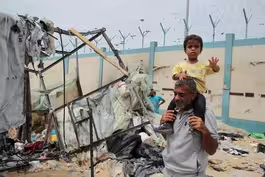
GEOFF BENNETT: Today, Israel kept up its operations in Rafah in Southern Gaza.
That's despite global outrage over an airstrike Sunday that killed displaced Gazans sheltering in tents.
Nick Schifrin reports on Israel's initial investigation into that incident and speaks to a senior State Department adviser on the Middle East as the violence continues.
NICK SCHIFRIN: In Southern Gaza today, another makeshift home to which Gazans had fled now ruined and riddled with bullets.
In the shadow of a U.N. office with constant Israeli drones overhead, survivors are exhausted and hopeless, their little protection long ago pierced.
FOUAD MAAROUF, Displaced Gazan (through translator): I went into the tent and found the woman was bleeding and the children were bleeding.
All the children that were in the tent were wounded.
Not one of them came out in one piece.
NICK SCHIFRIN: A few miles north, in what Israel has labeled a safer zone, today the living felt outnumbered by the dead.
Gazan officials say this violence hit Al-Mawasi, Israel's -- quote - - "humanitarian area" north of Rafah city.
But an Israeli official told "PBS NewsHour" there was no Israeli military activity in the area at that time.
And, today, the Israeli military said the Sunday strike that incinerated a tent city, burning and killing what a humanitarian organization today estimated to be 200 civilians, also targeted and killed two Hamas leaders.
Israel says its initial strike hit 180 meters, or almost 600 feet, from the camp for the displaced, and the fire was not caused by its weapon.
REAR ADM. DANIEL HAGARI, Spokesperson, Israeli Defense Forces: We are looking into all possibilities, including the option that weapons stored in a compound next to our target which we did not know of may have ignited as a result of the strike.
NICK SCHIFRIN: But that was cold comfort to the toddler who wouldn't flee without her prized possession.
Those fleeing Rafah today have nowhere to go, but they say they can't stay here.
The U.N. said today one million had fled Rafah just in the last three weeks.
As for humanitarian aid, the U.S. said today it had to temporarily pause the use of its military-built pier into Gaza after waves had damaged it.
Overall today, the U.N. says 200 trucks entered Gaza -- that's the number as of yesterday -- far short of the 500-plus trucks Gaza needs daily.
For more on the humanitarian situation in Gaza, as well as U.S. policy toward Israel, we turn to Ambassador David Satterfield, senior adviser to the State Department.
He recently stepped down as U.S. special envoy for Middle East humanitarian issues.
He is also the director of Rice University's Baker Institute for Public Policy.
Ambassador Satterfield, thanks very much.
Welcome to the "NewsHour."
As we just noted, Israel today said the fire that killed so many in a tent camp on Sunday was caused by a secondary explosion.
Is this exactly the kind of incident that you were warning Israel about when you were warning it against a major operation in Rafah?
DAVID SATTERFIELD, Former U.S. Special Envoy for Middle East Humanitarian Issues: We were concerned in advance of the Rafah operation about two things, first, the effect of displacement, again, because these people have been multiply displaced, of a significant civilian population.
That displacement has in fact occurred.
Our second concern was about the physical impact of an operation, however confined, on the ability to move humanitarian assistance from Kerem Shalom, from Rafah terminal, into Gaza proper.
And, there, we have had significant challenges since the operation began.
NICK SCHIFRIN: When it comes to the threshold of punishing Israel for a Rafah operation that the U.S. has warned against, Jake Sullivan, the national security adviser, said this last week: JAKE SULLIVAN, U.S. National Security Adviser: One of you asked me the last time I was standing at this podium, how are you going to judge this?
And I said that there's no mathematical formula.
What we're going to be looking at is whether there is a lot of death and destruction from this operation, or if it is more precise and proportional.
And we will see that unfold.
NICK SCHIFRIN: Does the incineration of so many people in that tent camp on Sunday match -- quote -- "a lot of death and destruction"?
DAVID SATTERFIELD: We continue to regard what is happening on the ground in Rafah as a limited operation in terms of its scope.
But the effect, heartbreaking as it is, to see the images of civilians, women and children, in particular, suffering in this, we are not in a position to make an independent judgment on what was responsible, who was responsible for that incident.
NICK SCHIFRIN: But even if you don't know exactly who or what was responsible, the kind of images we saw and the kind of numbers we saw from the Sunday incident, is this not exactly what the U.S. was concerned about?
DAVID SATTERFIELD: We are concerned about maximum efforts being undertaken by Israel to protect as much as possible in this conflict, which Hamas brought about, the ability of civilians to live in as much security as possible.
This is a very tough fight.
We understand that.
We understand the need to address the Hamas battalions that remain in Rafah.
But the manner of addressal has to be done as carefully as possible.
NICK SCHIFRIN: Is there a number of deaths, or is there a particular military movement that would cross the threshold that President Biden has set that would lead to more weapons withholdings?
DAVID SATTERFIELD: It's not a mathematical question.
There is not a certain number that creates a threshold here.
It is the totality of what is going on.
And the president has made this, as have other senior officials, that we do not believe a full-blown ground maneuver campaign in Central Rafah is appropriate, or could be supported by the United States.
We have not, as of this moment seen such a campaign.
NICK SCHIFRIN: And yet we have seen, according to the U.N., some one million people flee Rafah in the last three weeks.
Again, did you warn the Israelis that this kind of displacement would happen, and have they prepared enough for it?
DAVID SATTERFIELD: We expressed two primary concerns.
One was that, no matter how precise an operation was in terms of its intent or actual scope, the effect on a multiply displaced population would be a much larger exit from Rafah than Israel itself had instructed or planned for.
And, in fact, we have seen exactly that take place.
Our second concern is that such a displacement would need to have adequate preparation in terms of shelter, in terms of feeding, sanitation, medical support for those moving.
We did not believe, prior to the operation beginning, that such a credible, executable plan existed.
We do not see adequate support for that population that moved on the ground today.
NICK SCHIFRIN: Zooming out, do you think Hamas can be defeated with a military operation?
DAVID SATTERFIELD: The defeat of Hamas requires two things.
It does require military action.
Hamas has a terrorist army that started out at some 30,000 persons.
Only a portion of those numbers have been taken off the battlefield.
Yes, military action is required, but political action is also required.
You cannot defeat an idea without a counteridea.
And the administration has been very clear we believe Israel must outline, and outline clearly, a commitment to an alternate political vision, to an alternate horizon than Hamas' grim Islamist extremist vision.
And that is a credible pathway to a two-state resolution.
NICK SCHIFRIN: The U.S.' approach to Netanyahu has been to offer him a choice.
You can either go down the current road of fighting, perhaps endlessly, in Gaza, or you can take the so-called high road, the project that the U.S. has been working on, not only that envisions a future of Gaza, but also perhaps normalization with Saudi Arabia.
What happens if Netanyahu does not take the choice that the U.S. is pushing for?
DAVID SATTERFIELD: Nick, I'm not going to comment on hypotheticals, but I will say there is an opportunity here for the region, for Israel, for Palestinians to move forward in a different way, in a more positive direction than in the past.
It's essential here that Gaza not return to what it was before October 7, that the people of Gaza, those 2.2 million, not be held in rigid control by a terrorist group.
They, the Palestinians, deserve more, and all of us are working to try to hold out the prospect of more and better for them.
NICK SCHIFRIN: Ambassador David Satterfield, thank you very much.
DAVID SATTERFIELD: Thank you, Nick.
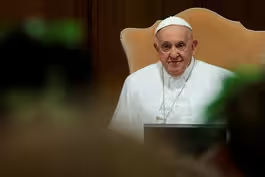
GEOFF BENNETT: Pope Francis has issued a rare apology after word broke that he allegedly used an offensive and derogatory Italian slur referring to gay men, while reaffirming his position against their admission to seminaries and the priesthood.
The pope made the remark in a closed-door meeting with Italian bishops last week.
Reactions have been divided over whether the pope's use of the slur was intentional or a linguistic gaffe.
To discuss the implications of this, we're joined by Marianne Duddy-Burke, executive director of Dignity USA.
It's an organization that focuses on LGBTQ rights and the Catholic Church.
Thank you for being with us.
MARIANNE DUDDY-BURKE, Executive Director, Dignity USA: Glad to be here.
GEOFF BENNETT: In issuing the apology, a Vatican spokesperson in a statement said: "The pope never intended to offend or express himself in homophobic terms, and he apologizes to those who felt offended by the use of a term reported by others."
How does all of this strike you, the use of the word?
And we should note there's some debate about the intent, but also the underlying point that gay men shouldn't be allowed to train in seminaries as priests?
MARIANNE DUDDY-BURKE: Well, the reality is there are literally tens of thousands, if not millions, of gay men who are priests or gay men who are in seminaries training to be priests.
And our church and the service to the people of God that the church provides just could not happen without those who serve currently and without the priests, bishops, and perhaps even popes who were gay who have served our church in the past.
So the gays in the priesthood is a reality.
God calls whom God wants to call to ordained ministry and to other ministries in our church.
The fact that a slur was used, whether intentional or not, really points to the fact that our church is still conflicted to a great degree about the issues of gender and sexual orientation, whether in the priesthood or beyond.
And, sometimes, that just comes to the fore, as it did in this instance.
GEOFF BENNETT: And yet Pope Francis has done more than any pontiff to make the Catholic Church more inclusive to LGBTQ people, maybe not in terms of doctrine, but certainly in terms of tone, regarding the church's approach and attitude.
How do you reconcile all of that?
MARIANNE DUDDY-BURKE: Well, Geoff, I think the issue is that it is not reconcilable.
It's a fundamental conflict.
You cannot simultaneously want to welcome, affirm, and offer the full range of services to our church and at the same time uphold official teachings that say that we are fundamentally flawed in some way in terms of God's vision for humanity.
When you try and hold those two things together, it just doesn't work.
And I think that Pope Francis has become emblematic of the conflict that exists at every level of our church in every country where the church is present.
GEOFF BENNETT: Tell me more about that, because, as you were making that point, I was thinking of the pope allowing priests to bless same-sex couples, while making clear that the church still views marriage as the holy union of a man and a woman.
How does the church really navigate desire to be more welcoming while also hewing to traditional Catholic doctrine?
MARIANNE DUDDY-BURKE: Well, the church winds up tying itself in knots, to be honest, with these kinds of issues.
You may have seen the pope's recent clarification in a TV interview that he is not allowing the blessing of same-sex couples.
He is allowing the blessing of the individuals in that -- couples.
Now, most of us understand that is a distinction without a difference, right?
But in the Catholic Church, upholding that distinction still has some kind of theological importance.
The way that most Catholics live, certainly in this country and in many other places around the world, is that they recognize that the love that exists between two committed people of the same gender is just as holy, is just as sacred, and should be blessed in the same way that the love between a woman and a man who decide to make that kind of commitment.
GEOFF BENNETT: The United Methodist Church, as you well know, I'm sure, recently struck down their longstanding anti-LGBTQ policies.
The Episcopal Church, the Lutheran Church, the Presbyterian Church have all removed their barriers to LGBTQ participation in the pulpit and at the altar.
Do you ever foresee the Catholic Church taking a similar step?
MARIANNE DUDDY-BURKE: Well, again, I think the reality is that most Catholics have already taken that step in their own consciousness.
What is missing is for the leadership of the church and the dogma of the church to change.
And we're seeing this ever-widening Gulf between the people of the church and its leadership.
And, in many cases, that is leading people to disaffiliate from the institutional church, even as they hold their faith and many of the primary teachings of Catholicism very dear.
GEOFF BENNETT: Marianne Duddy-Burke is executive director of Dignity USA.
Thanks so much for your insights and for your time this evening.
MARIANNE DUDDY-BURKE: Thanks for having me.
AMNA NAWAZ: The Biden administration is preparing an executive action that would allow President Biden to temporarily shut down the U.S. southern border.
This comes amid pressure from both sides of the aisle to curb the flow of border crossings.
Our White House correspondent, Laura Barron-Lopez, has been covering this.
And she joins me now.
So, Laura, what do we know about this expected executive order?
LAURA BARRON-LOPEZ: This executive action would use a section of U.S. immigration law, Amna, that's known as 212(f) authority that gives President Biden the powers to suspend the entry of migrants temporarily.
It's going to be expected to be similar language that was used in the bipartisan Senate border deal that failed.
For example, if there is an average of 5,000 migrants encountered each day over the course of seven days, then this authority would be triggered, and President Biden would be able to shut down the border until those encounters fall.
Now, the White House and a White House official told me that no final decisions have been made about an executive action that is potentially being considered.
But sources told me that this specific executive action could come as early as next week after the Mexican elections on June 2.
AMNA NAWAZ: So, when you look at who has been encountered at the U.S. southern border recently, who would this kind of executive action impact?
LAURA BARRON-LOPEZ: Sources told me that this executive action is expected to apply to most migrants, but unaccompanied children often receive humanitarian exemptions in an executive action like this.
The big picture, Amna, is that this is going to restrict who can seek asylum ultimately.
And when you look at the picture on the southern border right now, it's important to note that, since December of 2023, the total number of encounters by Border Patrol at the southern border has decreased from almost 250,000 to roughly 129,000 in April this year, according to Customs and Border Protection.
And most of those are single adults.
AMNA NAWAZ: So, I know you have been talking to immigration lawyers, to your Democratic sources.
How is news of this expected order going down among them?
LAURA BARRON-LOPEZ: One immigration advocate I spoke to said that the administration should expect legal challenges to this.
I also spoke to Melissa Adamson, who is an immigration lawyer for the National Center for Youth Law, who said that closing the border could ultimately end up being very harmful to children and to families.
MELISSA ADAMSON, National Center for Youth Law: So what we saw in 2020 was that closing the border exposes children to more exploitation, to kidnapping, to physical and sexual violence while they're stranded in Mexico and they wait to cross the border.
And it also leads to increased family separation, because if family units aren't allowed to lawfully present, they may make the impossible choice of trying to send their children across the border alone as unaccompanied minors to try to seek safety in the United States.
We know that, if people can't cross at ports of entry, then they're forced to seek more and more dangerous routes in mountainous areas, in remote desert locations.
And when that happens, we know that it leads to more injuries and illness and death as people try to get into the United States.
LAURA BARRON-LOPEZ: When I asked the administration about concerns like that from Melissa Adamson, they said that the president is trying to balance both humane pathways of entry for migrants, as well as enforcing control at the border and enforcing border security.
And the White House spokesperson said that they're constantly exploring policy options for the president to take, but they specifically took aim at Republicans for ultimately killing the bipartisan border deal.
Another expert I spoke to, Erika Pinheiro, who runs Al Otro Lado, which is a nonprofit that helps migrants, helps refugees at the border, said that, no matter what, if this executive action is implemented, migrants will continue to come, and that, when she talks to many migrants at the border, they often are not aware of restrictions that are put in place by administrations, be it this administration's or prior ones.
AMNA NAWAZ: So we know that real immigration reform, meaningful immigration reform, has to come through Congress.
As you mentioned, the president tried to do that through Congress.
There was that bipartisan Senate bill that Republicans backed away from.
Give us a sense of what kind of political pressure President Biden is under right now on this specific issue.
LAURA BARRON-LOPEZ: Multiple Hill sources told me that members of Hispanic Caucus leadership met with President Biden and Vice President Kamala Harris, as well as White House staff, last week at the White House.
They talked about this coming executive order.
They also pressed the president, saying that they wished that he would consider other executive actions that could essentially expand work permits for migrants that are already in the United States.
They also raised concerns about the president's outreach to Latino voters.
And some Hispanic lawmakers told me that they ultimately worry that this executive order, as well as language in the bipartisan border bill that a number of Democrats supported in the Senate, would set a standard for future actions, future asylum actions that could be more severe, more restrictive.
Now, again, the president is balancing those concerns with those of moderate Democrats that are facing potentially tough reelections who want tougher actions taken at the border, as well as facing attacks from Republicans who are falsely claiming, Amna, to stir up support among their base, that violent crime has increased because of immigration, despite the fact that the data doesn't show that.
And for a sense of how voters rank it, a Gallup poll from April 2024 found that immigration was the top issue facing the U.S. for Americans they surveyed, outranking the economy.
And immigration, Amna, has repeatedly been a top issue for many voters this year so far.
AMNA NAWAZ: All right.
That is our White House correspondent, Laura Barron-Lopez.
Laura, thank you for your reporting.
LAURA BARRON-LOPEZ: Thank you.
GEOFF BENNETT: Sudan's civil war has left tens of thousands dead and displaced millions over the nearly 14 months since the Sudanese military and paramilitary Rapid Support Forces plunged the country into a devastating war.
The capital, Khartoum, is a battleground, as is its neighboring city of Omdurman.
And it's from there that Lindsey Hilsum of Independent Television News reports.
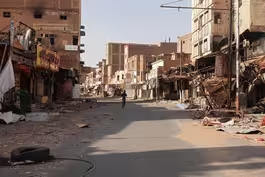
LINDSEY HILSUM: They want to show they're on top, soldiers and police of the Sudan Armed Forces in the center of Omdurman doing the sign of the falcon: We have seized our prey.
The aim is to demonstrate to us that they're back in control and that the people are happy to see them.
But such triumphalism is premature.
They may have driven the Rapid Support Force militia out of this part of Omdurman in March, but their enemy still occupies Omdurman's twin city, the capital, Khartoum, and much of the rest of Sudan.
We drive through a city of ruins.
Imagine the shopkeepers, the people who lived here, the lives destroyed by this futile war.
Families rescue a few belongings from looters.
Every hundred meters or so, new local recruits have erected another checkpoint.
Everyone's nervous.
General Abdel Fattah Burhan presides over devastation, over a country that's coming apart, the legitimacy of his leadership open to question.
The last battle for this part of Omdurman was fought here in the middle of March.
This area was absolutely littered with bodies.
The Ministry of Health came and removed hundreds.
But the RSF is still just about four kilometers up the road.
The battle for the capital of Sudan is not over yet.
Walls that remain intact hide the greatest horrors.
This house was owned by a poet who fled to Saudi Arabia.
The RSF took it over, but they didn't just trash the place as they did elsewhere, but turned it into a torture or maybe execution chamber.
They dug a pit and placed a pulley on an iron bar on the ceiling to hoist people up and suspend them.
Rumors of what happened here spread.
After the RSF was driven out, the homeowners asked a neighbor to come and check.
WALEED AHMED, Neighbor: When I came here, I was shocked at what I saw in front of me.
What could possibly have gone on here?
Afterwards, I told other people in the neighborhood there was something strange in this house.
I mean, from the side of the iron bar and the holes in the ground, it's obvious that something terrible happened here.
LINDSEY HILSUM: We found a document listing names, 31-year-old Omar Ahmed Adam (ph), a 30-year-old woman, Manal Hassan (ph), 12 names in total, all accused of great betrayal, in other words, not supporting the RSF.
And amongst the debris, mementos of the happy family who once lived here, who can never in their worst imaginings have predicted what would happen in their home.
So there were really big battles here, yes?
RASHEED AHMED, Sudan: Yes.
LINDSEY HILSUM: I walked a few yards around the corner with Rasheed Ahmed, who stayed at home here in old Omdurman for four months until the fighting became too intense.
Outside his house, we can smell death.
The piles of earth are makeshift graves.
RSF slogans have been graffitied on the walls.
RASHEED AHMED: It's my car.
LINDSEY HILSUM: Is this your car?
RASHEED AHMED: It's my car, yes.
LINDSEY HILSUM: It was your car?
RASHEED AHMED: It was, yes.
(LAUGHTER) LINDSEY HILSUM: His house was badly damaged.
A rocket hit after he left.
But the cornicing, with which his grandfather adorned the walls when he built the house in the 1940s, remains.
RASHEED AHMED: We don't expect it to happen to us.
In all our dreams, we can't imagine this.
Always, we hear about wars outside Khartoum and outside Omdurman, not in Omdurman, not in Khartoum.
Very bad.
Very bad.
LINDSEY HILSUM: Do you think you will live here again?
RASHEED AHMED: Sure.
Sure.
It's my house.
It's my home.
We will build here again, inshallah.
LINDSEY HILSUM: The children still play, even if they fled their homes and are living in a school that doubles as a center for the displaced.
Their mothers, of course, can't forget what brought them here.
INANN, Sudan (through translator): The RSF attacked our homes and tried to rape our girls.
We managed to hide them upstairs, but the RSF men killed the girls' aunt and two uncles who were trying to defend them.
Now our situation is difficult.
Of course, our men can't find jobs.
LINDSEY HILSUM: In the absence of international aid, neighborhood groups are pitching in.
Do you think that the international community has let you down?
MOHAMMED YAHYIA, Sudan Social Development Organization: Yes, yes.
Unfortunately, I think so.
I think that people's eyes now on Ukraine and Gaza, but we got not a lot of help here in Sudan.
Basically, people need food and medicine, basically, OK?
LINDSEY HILSUM: Food and medicine, as simple as that?
MOHAMMED YAHYIA: As simple as that.
LINDSEY HILSUM: Because, in war, you see the best, as well as the worst of humankind, the best being people like Dr. Mohammed Banaga, who started a soup kitchen for displaced people funded by local shops and friends in the Sudanese diaspora.
And you stayed here throughout the war.
Were you not afraid?
DR. MOHAMMED BANAGA, Medical Doctor: No, no, no, I'm not afraid.
Afraid of what?
LINDSEY HILSUM: Afraid of being killed?
DR. MOHAMMED BANAGA: Man will kill -- will die once, no, not twice, once.
(LAUGHTER) LINDSEY HILSUM: This family just escaped Wad Madani to the southeast of Omdurman, where the RSF recently seized control.
All over Sudan, people are going hungry because they have lost everything, the economy has collapsed, and armed men frequently steal what little aid is available.
AHMED SULEIMAN, Sudan (through translator): The situation is very bad.
They're killing civilians, looting them and throwing them out of their homes.
They took their livelihoods, their crops and everything they have.
LINDSEY HILSUM: Ruin upon ruin, rout on rout, not a paradise lost, but a country.
Neighboring powers are fueling this war, the United Arab Emirates arming the RSF, Iran and Egypt backing the Sudan Armed Forces.
If the parties aren't forced to negotiate, what will be left of Sudan?
Nothing that can be reassembled, but a failed state in a forever war, its people dispersed and destitute.
GEOFF BENNETT: That report was from Lindsey Hilsum of Independent Television News.
AMNA NAWAZ: This month, President Biden announced the Department of Justice is planning a historic shift in the federal approach to marijuana, reclassifying it from what's known as a Schedule I drug to Schedule III.
This would make federal treatment of marijuana far less restrictive and consider it less dangerous, putting it in the same category as Tylenol with codeine and ketamine.
It would classify it as a drug that has potential for abuse, while still being acknowledged for its medicinal benefits.
The president talked about the decision in a video posted on X. JOE BIDEN, President of the United States: Far too many lives have been upended because of failed approach to marijuana.
And I'm committed to righting those wrongs.
You have my word on it.
AMNA NAWAZ: Joining us now is Natalie Fertig.
She's federal cannabis policy reporter for Politico.
Natalie, thanks for being here.
NATALIE FERTIG, Federal Cannabis Policy Reporter, Politico: Thanks for having me.
AMNA NAWAZ: So this is the next step in a reclassification process that the president began back in 2022, right?
So walk us through the timeline here.
Where in that process are we now?
NATALIE FERTIG: So, we just began a 60-day comment period, where the DOJ said, we have now made our formal decision.
We have issued a draft rule that we're going to reschedule cannabis.
So the 60 days started last week, and now this could end five months from now or this could end six or seven years from now, depending on if there's legal challenges in that process.
AMNA NAWAZ: OK, so still a lot we don't yet know, right?
NATALIE FERTIG: Right.
AMNA NAWAZ: We should note, we have seen a real sea change when it comes to cannabis legalization in America over the past decade or plus.
If you take a look at the map, some 24 states have legalized marijuana possession for adults.
Some 38 states have established medical marijuana programs.
So more than half of all Americans now live in states where marijuana is recreational, legal at the state level.
So what does this classification or what would this classification change in a practical way?
NATALIE FERTIG: There's a lot of things that it would not change, actually.
But the main difference that it would have is on the cannabis industry itself in the states where it is legal.
It would change the amount of taxes that they have to pay, meaning there might be more money in the cannabis industry's pocket, which means they could expand in legal states.
AMNA NAWAZ: And what does that mean?
There's some, what, 15,000 cannabis dispensaries in the country right now.
So, potential tax changes?
Does it change how they interact with banks or anything else?
NATALIE FERTIG: It's not clear exactly how the big banks will approach the change in schedule.
That's one of those remain to be seen once this -- all the dust settles.
But what -- it would have an impact on the amount of taxes that they pay.
AMNA NAWAZ: It's also been reported that dispensaries would have to register with the DEA, like other pharmacies would.
Is that true?
And how would that change the industry?
NATALIE FERTIG: Yes.
So, under Schedule III or under Schedule I, where they currently are, they need to register with the DEA.
They do not currently.
And so one of the other questions of rescheduling is, will the DEA start to enforce some of the rules that the cannabis industry is currently already breaking, like getting registered with the DEA?
AMNA NAWAZ: So this is something President Biden mentioned in that video he released too, was the impact on the criminal justice system, in particular, people who have already been convicted of marijuana-related crimes.
What would this change mean for them, either retroactively or people who are currently incarcerated?
NATALIE FERTIG: One of the biggest criticisms of Biden's rescheduling movement is that it doesn't have a big impact on people who have criminal records, especially at the state level.
The majority of people who have criminal records for cannabis are in the state criminal justice system, not in the federal criminal justice system.
Biden did issue some pardons for people with low-level nonviolent marijuana offenses, but that's just a couple thousand people.
AMNA NAWAZ: We do know the proposal needs to move through the DEA.
How are they likely to look at this?
Do we know if that proposal is going to move through, and when would we see that kind of approval?
NATALIE FERTIG: Yes, so what we just saw recently was the DEA and the DOJ coming out and saying we have looked at the review that was sent to us by HHS, and we are recommending a reschedule.
People get to comment on that.
There might be some legal challenges to that.
And so, when the dust settles, there would need to be some big changes or big challenges for the DEA to change its mind on that.
It's likely to be a reschedule.
But then that reschedule is also likely to get challenged in the courts, which means in the end this might be up to the court system.
AMNA NAWAZ: It's so fascinating too when you take a look back and you see the America in which this is all unfolding.
We can now say -- there was a study published in the journal "Addiction" last month that showed marijuana use now surpasses daily alcohol consumption in the U.S. for the first time in history.
And Americans have very different views when it comes to pot right now.
You look at the latest Gallup numbers from a poll last year, found some 70 percent of adults now support legalization.
That is the highest number ever reported in that survey.
What does your reporting tell you about the why behind all of this, why President Biden is pushing for these changes now?
NATALIE FERTIG: Well, a big part of that sea change has come from the youngest generation.
Gen Z and millennials, my generation, are much more likely to be consuming cannabis than generations before them.
And they're also much more likely to poll in favor of cannabis.
And Biden is heading into a really important election right now.
He's not necessarily doing as well among those voters, the younger voters, as he would like to.
So there's some hope that, potentially, amongst Democrats, something like this with marijuana could push some of those voters that are skeptical or annoyed or frustrated with the president to turn out to vote in November.
AMNA NAWAZ: We will see if it does, in fact.
Natalie Fertig, federal cannabis policy reporter for Politico, great to have you here.
Thanks so much.
NATALIE FERTIG: Thanks.
Thanks for having me.
GEOFF BENNETT: There is a new original voice in the world of poetry.
Indigenous New Zealander Tayi Tibble's poems about what it means to be a young Maori woman have resonated with audiences far beyond her home in the Pacific.
Jeffrey Brown met up with the acclaimed poet New York City as part of our arts and culture series, Canvas.
TAYI TIBBLE, Poet: My ancestors ride with me.
They twerk on the roof of the Uber as I'm pulling up late to the party.
They gas me full tank and yas me in the mirror.
JEFFREY BROWN: Indigenous ancestors, mascara wands and glitter, all part of the world and work of Tayi Tibble, a proud member of New Zealand's Native Maori community.
TAYI TIBBLE: My ancestors ride with me.
Don't tell me what they would do.
I know them better than you.
And I think it's really important, and it's kind of like my ancestral given duty to remember and learn our old stories and bring them forward.
But at the same time, I need to be telling new stories for our future generations and also for our ancestors too.
I'm sure they like to hear what we're getting up to.
JEFFREY BROWN: The 28-year-old's poetry is deeply rooted in her Maori identity, but also her experience as a young woman navigating friendship, sex, contemporary life.
TAYI TIBBLE: I draw a lot on our traditional narratives and stories, but, at the same time, I grew up in the era of Kim Kardashian, and I'm really wanting to express this indigenous identity that is multifaceted and modern.
JEFFREY BROWN: One way you do that is through language, mixing in words.
TAYI TIBBLE: I like to use our indigenous language in my poetry.
I like to have layers of them on the page, and I like to feel like everything is at my disposal.
JEFFREY BROWN: Tibble's perspective has resonated with readers and critics at home and further afield.
Her first book, "Poukahangatus," won New Zealand's highest award for a debut poetry collection.
She's the first ever Maori poet to have work published in "The New Yorker."
And in 2021, she landed publishing deals here and in the U.K. TAYI TIBBLE: It's really exciting, honestly.
JEFFREY BROWN: We met Tibble at Poets House in Manhattan before the final stop of a whirlwind book tour for the U.S. release of her second collection, "Rangikura," which means red sky.
TAYI TIBBLE: Thank you guys so much.
When I wrote these poems, I had no idea that they were going to be able to travel and allow me to travel and connect with people far from where I'm from.
So, anything from this is just extraordinary for me.
JEFFREY BROWN: She's a member of two tribes with traditional homelands on the eastern coast of New Zealand's North Island.
But she grew up farther south in Porirua, a city with a large Maori and Pacific Islander population on the outskirts of Wellington, the nation's capital.
TAYI TIBBLE: Me and my family have been in Wellington, the capital city, for about four generations.
So, for four generations, we haven't been on our lands.
And our lands are so important to us as indigenous people and who we are.
JEFFREY BROWN: Her family's story isn't unusual.
During and after World War II, many Maori moved from their tribal lands in the countryside into urban centers to find paid work.
NARRATOR: The old ways of a simple rural life with the farm feeding the family are passing.
JEFFREY BROWN: Between 1936 and 1986, the Maori population radically flipped from 83 percent rural to the same proportion living in cities.
But with little government support and a worsening economy in the 1970s and early '80s, many struggled with poverty and social problems.
TAYI TIBBLE: I wonder how it feels to be tethered somewhere by a sense of home, to be buried in your urupa, and to find that, when you die, you have been waiting for yourself this whole time all along.
JEFFREY BROWN: Writing about her identity and this history of displacement, Tibble says, helped her reframe what she initially felt was a story of disconnection.
TAYI TIBBLE: Yes, it was colonization that definitely forced a lot of Maori to leave the traditional ways.
I used to kind of think it was a sad story, but now I feel like that urban Maori identity or urban indigenous identity is just, like, as valid as a traditional one.
JEFFREY BROWN: If I ask you who you are, do you say, "I am a New Zealander or a Maori" or both?
TAYI TIBBLE: I would say I'm Maori, and then I would say I'm Pacifica or Polynesian, or Tangata o le Moana, people of the Pacific Ocean.
JEFFREY BROWN: Tibble draws parallels between the long voyages her Polynesian forefathers took across the Pacific in canoes and her own travels far from home.
It's not the Pacific Ocean, but you're by water.
Water is important to you?
TAYI TIBBLE: Water definitely serves a connector between islands, between places, but also between different histories and time.
JEFFREY BROWN: And, she says, between herself and other acclaimed indigenous writers she's connected with while in the U.S., like Tommy Orange and Sasha LaPointe.
TAYI TIBBLE: I just feel like I'm picking up on an ancestral tradition, which was to go and share our knowledge and then to gain new knowledge and return home with new stories to share.
JEFFREY BROWN: Stories Tayi Tibble says she will continue to tell through her poetry.
For the "PBS NewsHour," I'm Jeffrey Brown in New York.
GEOFF BENNETT: And join us again here tomorrow night for Judy Woodruff's look at how Alaska changed its primary elections to break partisan gridlock.
And that is the "NewsHour" for tonight.
I'm Geoff Bennett.
AMNA NAWAZ: And I'm Amna Nawaz.
On behalf of the entire "NewsHour" team, thank you for joining us.

Biden considers temporarily closing border to curb crossings
Video has Closed Captions
Biden considers temporarily closing southern border to curb flow of migrant crossings (6m)

How marijuana's reclassification could change drug policy
Video has Closed Captions
How marijuana's reclassification could change U.S. drug policy (5m 35s)
Israeli tanks reach central Rafah as outrage intensifies
Video has Closed Captions
Israeli tanks reach central Rafah amid outrage following deadly strike on refugee camp (9m 9s)

Poet Tayi Tibble draws on guidance of Polynesian ancestors
Video has Closed Captions
Māori poet Tayi Tibble draws on guidance of Polynesian ancestors in 'Rangikura' (5m 25s)
Pope apologizes for using slur while discussing gay clergy
Video has Closed Captions
Pope apologizes for using slur while discussing opposition to gay men in priesthood (5m 48s)
Sudan's civil war brings killings, torture, famine
Video has Closed Captions
Millions living through nightmare as Sudan's civil war brings killings, torture, famine (7m 29s)

What happened during closing arguments in Trump's trial
Video has Closed Captions
What was said during closing arguments in Trump's hush money trial (7m 42s)
Providing Support for PBS.org
Learn Moreabout PBS online sponsorship
- News and Public Affairs

FRONTLINE is investigative journalism that questions, explains and changes our world.

- News and Public Affairs

Amanpour and Company features conversations with leaders and decision makers.












Support for PBS provided by:
Major corporate funding for the PBS News Hour is provided by BDO, BNSF, Consumer Cellular, American Cruise Lines, and Raymond James. Funding for the PBS NewsHour Weekend is provided by...