
November 17, 2023 - PBS NewsHour full episode
11/17/2023 | 57m 46sVideo has Closed Captions
November 17, 2023 - PBS NewsHour full episode
Friday on the NewsHour, Israeli forces continue operations in Gaza as Palestinian civilians remain cut off from critical humanitarian aid. Protests against a proposed police training facility in Atlanta persist despite a crackdown on demonstrations. Plus, major questions about water rights remain in Maui as communities continue the long recovery from wildfires.
Problems playing video? | Closed Captioning Feedback
Problems playing video? | Closed Captioning Feedback
Major corporate funding for the PBS News Hour is provided by BDO, BNSF, Consumer Cellular, American Cruise Lines, and Raymond James. Funding for the PBS NewsHour Weekend is provided by...
Support provided by:

November 17, 2023 - PBS NewsHour full episode
11/17/2023 | 57m 46sVideo has Closed Captions
Friday on the NewsHour, Israeli forces continue operations in Gaza as Palestinian civilians remain cut off from critical humanitarian aid. Protests against a proposed police training facility in Atlanta persist despite a crackdown on demonstrations. Plus, major questions about water rights remain in Maui as communities continue the long recovery from wildfires.
Problems playing video? | Closed Captioning Feedback
How to Watch PBS News Hour
PBS News Hour is available to stream on pbs.org and the free PBS App, available on iPhone, Apple TV, Android TV, Android smartphones, Amazon Fire TV, Amazon Fire Tablet, Roku, Samsung Smart TV, and Vizio.
Providing Support for PBS.org
Learn Moreabout PBS online sponsorshipAMNA NAWAZ: Good evening.
I'm Amna Nawaz.
Geoff Bennett is away.
On the "NewsHour" tonight: Israeli forces continue operations in Gaza and violence escalates in the occupied West Bank, as Palestinian civilians remain cut off from critical aid.
Protests continue against a proposed police training facility in Atlanta, despite a crackdown on demonstrations.
And major questions about water rights remain in Maui as communities continue the long recovery from wildfires.
KAPUA'ALA SPROAT, University of Hawaii at Manoa: In these incredibly isolated island communities, water was and remains the source of all life.
In many ways, I mean, this is a fight for the soul of Hawaii.
(BREAK) AMNA NAWAZ: Welcome to the "NewsHour."
United Nations officials today said that starvation was an increasing possibility in Gaza, as they were forced to stop food and aid deliveries due to a lack of fuel.
The communications blackout continues with no generator power.
Israel has now said it will allow two tankers a day to enter for U.N. operations.
That's about half of what they need.
And that's just for the most vital operations.
Palestinian officials said today that the death toll has surpassed 12,000.
Leila Molana-Allen reports.
LEILA MOLANA-ALLEN: In Central Gaza's Nuseirat camp, residents search the rubble for the living and the dead, their bare hands their only tools, after an Israeli airstrike reportedly killed at least 40 people.
In Southern Gaza's Khan Yunis, once a refuge for the Abu Zanad family, now smashed concrete.
Hani Abu Zanad has lost hope, HANI ABU ZANAD, Khan Yunis Resident (through translator): Every second of every minute, there's a massacre.
What humanitarian cease-fires?
They say the south is safe.
What safety?
LEILA MOLANA-ALLEN: Just yesterday, Israeli forces dropped leaflets warning Khan Yunis residents to move elsewhere.
Many here were forced to leave their homes in North Gaza.
They came here because the IDF told them the south is safe.
Alaa Abu Hasira lost 11 members of her family, including both her children.
ALAA ABU HASIRA, Displaced From Gaza City (through translator): We were in Gaza City and as a result of the conflict, we moved to Khan Yunis.
All my sisters died and my son and daughter also.
I wish I had taken her in my arms.
And my twin sister also died.
LEILA MOLANA-ALLEN: South Gaza's Nasser Hospital is overwhelmed.
Streams of wounded are brought here, including children, two sharing a single bed, as doctors pump oxygen manually, babies injured by burning shrapnel and falling buildings.
The grief is crippling.
In the north, IDF troops occupied parts of Gaza cities Al Shifa Hospital for a third day.
MAN: RPGs.
LEILA MOLANA-ALLEN: Yesterday, the IDF released this video of weapons they say were found on the hospital grounds, but, so far, they have haven't shown evidence of their claim that Hamas runs a command center underneath Al Shifa.
Dr. Ahmed El Mokhallalati is a senior plastic surgeon inside Al Shifa.
DR. AHMED EL MOKHALLALATI, Al Shifa Hospital: They have found nothing.
They have found here no single resistance, no single gunshot against them within the hospital area.
It's totally aggressive attack on the hospital, which is totally full of civilian patients.
LEILA MOLANA-ALLEN: The hospital has been under siege for over a week.
He described the terrifying conditions inside.
DR. AHMED EL MOKHALLALATI: The snipers have almost shot everyone who tried to move within that building.
We can move only in the middle of the day.
If I have any patients who need help, I can't go there.
There is no communication at all.
It's totally scary.
We can't even checking and searching the east part of the hospital.
And no one is firing against them.
They keep bombing all the areas around.
They keep firing all over the areas.
LEILA MOLANA-ALLEN: Palestinian health officials say more than 600 patients, including 36 premature babies, remain trapped inside the hospital.
Six babies have died.
And thousands of displaced civilians are still taking shelter in the hospital complex.
In Israel, 65-year-old Yehudit Weiss' family is in mourning.
Weiss was one of around 240 hostages kidnapped by Hamas terrorists on October 7.
Yesterday, the IDF recovered her body from near Al Shifa.
Her brother, Avishay Kaminer, feels betrayed.
AVISHAY KAMINER, Brother of Victim: Such tragedies could have been avoided if we only had someone who really cared about all those kidnapped.
LEILA MOLANA-ALLEN: In the occupied West Bank's Jenin refugee camp, hundreds gathered for the funeral of three men killed last night in Israeli drone strikes.
The IDF said at least five militants were killed in the fighting.
More than 200 Palestinians have been killed by the IDF since October 7.
Israeli forces also raided hospitals in Jenin.
Eyewitness video shows medical staff coming out of a hospital with their hands up.
Hospitals, protected by international law, are increasingly under attack in this war.
Palestinians, homeless and helpless, say they have no safe harbors left.
For the "PBS NewsHour," I'm Leila Molana-Allen.
AMNA NAWAZ: In the day's other headlines: A government shutdown has been averted for now.
President Biden signed into law a temporary spending bill to maintain funding for at least two more months, as Congress negotiates a long-term package.
The bill notably does not include a White House request for wartime aid to Israel and Ukraine.
Meanwhile, in Ukraine, the country's military says it's making gains in the Kherson region.
The Ukrainian Marine Corps claimed today more than one, 200 Russian troops have died in that operation and that they have destroyed dozens of Russian tanks, combat vehicles and artillery systems.
Ukrainian troops aim to push Russian forces from the eastern bank of the Dnipro River.
That could open a route to Russian-annexed Crimea.
Flooding in eastern Africa has now claimed the lives of at least 130 people.
Heavy rains since October have inundated parts of Ethiopia, Kenya and Somalia in what aid agencies have called a once-in-a-century event.
People in Kenya had to hold onto ropes to cross streets today after downpours submerged parts of Mombasa.
Residents are frustrated their government hasn't done more to help.
JOSEPH WANJE, Mombasa, Kenya, Resident (through translator): As you can see, everything has been damaged.
Operations have stalled.
Many people have been affected, and everywhere is flooded with water.
We elected leaders, but we can't see any help.
We're just asking the government to come and work on the drainage.
AMNA NAWAZ: The deluge comes after parts of the region experienced their worst drought in four decades.
Back in this country, former first lady Rosalynn Carter is now in hospice care at her home in Plains, Georgia.
The Carter Center said the 96-year-old, who's suffering from dementia, has been spending time with her family, including former President Jimmy Carter.
Mr. Carter, who's 99, has been in home hospice care since February.
The head of the House Ethics Committee introduced a resolution to expel embattled Representative George Santos.
That comes a day after the committee released a report citing -- quote -- "overwhelming evidence" that the New York Republican used campaign donations for personal expenses.
The House won't vote on the resolution until after they return from their Thanksgiving break.
Honda is recalling more than 250,000 vehicles in the U.S. for potential crash risks.
The automaker warned bearings could cause engines to lag or stall.
The recall affects certain Honda Pilot SUVs, Odyssey minivans and Ridgeline pickup trucks, along with two different Acura models.
Wall Street closed out its third straight winning week today.
The Dow Jones industrial average gained two points to close at 34947.
The Nasdaq rose 12 points, and the S&P 500 added six.
And it is beginning to look a lot like Christmas today in Washington, with the arrival of this year's Capitol Christmas tree.
The 63-foot Norway spruce made the journey all the way from West Virginia's Monongahela National Park.
Each year, a different national park provides the tree for the West Lawn of the U.S. Capitol.
The holiday tradition dates all the way back to 1964.
Still to come on the "NewsHour": Jonathan Karl discusses his new book on Donald Trump's influence over the GOP; how some Arab and Muslim Americans view U.S. support for Israel and how it might affect their votes; David Brooks and Jonathan Capehart weigh in on the week's political headlines; plus much more.
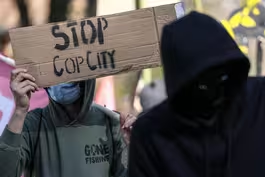
Dozens of people in Atlanta are facing racketeering charges in connection with protests over what they call Cop City, a proposed training center for police and firefighters.
William Brangham has that story.
WILLIAM BRANGHAM: Protests against this proposed 85-acre training center have been going on for more than two years.
In January, protester Manuel Teran was killed in a gunfight with police as they were clearing out a site where activists were camped.
This summer, the state's attorney general, Chris Carr, obtained a sweeping indictment using the state's anti-racketeering law, charging 61 protesters and characterizing them as -- quote - - "militant anarchists."
This week, hundreds of marchers were met with flashbangs and tear gas, and, today, more crowds gathered near the proposed training site, again calling for a halt to the project.
Chamian Cruz is a reporter for WABE in Atlanta who is covering it all.
Chamian, welcome back to the program.
These protests have been going on for quite a long time, and there's so many different groups involved.
There's environmentalists, police abolitionists, faith leaders, indigenous tribes.
Overall, what is it that they most object to about this facility?
CHAMIAN CRUZ, Criminal Justice Reporter, WABE: Yes, like you said, there are a lot of layers to this.
And people have been protesting this project for more than two years because it is an 85-acre facility that's estimated to cost about $90 million.
And it's going in this area where it is surrounded by low-income majority-Black neighborhoods.
And people say that it's going to disproportionately affect these people.
I mean, a lot of people say they don't want to hear officers firing their guns and training in their backyards.
WILLIAM BRANGHAM: And what do police and the city officials who approved this project say they need it for?
CHAMIAN CRUZ: Yes, the mayor has said that this project is needed to have a well-trained police force and also firefighters, and that it's needed to improve their de-escalation training and to boost morale and be able to recruit more officers in the city.
WILLIAM BRANGHAM: I mean, the siting of a police training facility is not normally the kind of thing that stirs such opposition.
Do you have a sense as to why this has set off such a furor?
CHAMIAN CRUZ: Well, I will say that protests have been going on for more than two years.
And I started covering it in January, when State Troopers shot and killed a protester at the site.
And that's really when people around the country started paying more attention to what's going on here.
After that shooting happened, a special prosecutor investigated the case.
And in late August, he determined that the shooting was justified and that he would not be pressing charges or bringing charges against the officers involved.
And that's only sparked even more protests.
WILLIAM BRANGHAM: As I mentioned, the attorney general is using the RICO laws, which are normally used against organized crime, to go after some of these protesters.
What is he alleging that they are doing that is part of this illegal conspiracy?
CHAMIAN CRUZ: Well, he's alleging that protesters are organizing around the country to raise funds and commit violent acts.
Earlier this year, in the city, people were marching, and they started destroying several buildings and setting police cars on fire.
And so they're calling this, it's organized crime.
And that's why they're bringing these racketeering charges against them.
WILLIAM BRANGHAM: I see.
And where do those protesters who were charged, the 61, where do their cases stand right now?
CHAMIAN CRUZ: So, these 61 protesters were arraigned earlier this month.
And, at that arraignment, we learned that state prosecutors have collected about five terabytes worth of evidence.
And we expect the defense to take months to review all of this.
And so, at that hearing, a judge set a final plea hearing for June, so next summer.
And we really expect that to go on for months.
WILLIAM BRANGHAM: I know that you have been on the ground talking to some of the protesters themselves.
Do you have a sense as to how long they're willing to keep this protest up?
CHAMIAN CRUZ: That's a question that I have been asking people every time that I'm out there.
And they always tell me, we're not going to stop, that these racketeering charges, they see them as an attempt to silence people and dissuade them from protesting this project.
But they always tell me, like, no, we're going to keep going.
Even if or when this project is completed, we're going to be protesting because, like I said, this is one of the largest facilities of this kind in the country.
And since this project has started construction, we have seen other cities also trying to build their own police training center.
WILLIAM BRANGHAM: There is a public referendum that opponents have been gathering signatures for, and they hope that that will get to the ballot and be voted on.
This is something that Atlanta's mayor, Andre Dickens, has dismissed.
And I wonder, how has the mayor been navigating this entire crisis?
CHAMIAN CRUZ: So, when these organizers began collecting the signatures, he said that he would stand back and allow this process to go through.
But once the organizers submitted 116,000, signatures, which is double the amount that they needed to get the issue on the ballot, now the case is in legal limbo.
And he said that it's invalid, and the city has refused to begin verifying these signatures.
And there's actually a hearing scheduled for next month where a judge will determine next steps.
WILLIAM BRANGHAM: All right, that is Chamian Cruz of WABE in Atlanta.
Thank you so much for bringing us up to speed on this.
CHAMIAN CRUZ: Thank you.
AMNA NAWAZ: Still a year to go before Election Day 2024, and the Republican presidential field continues to shrink.
So far, polls have shown that former President Trump continues to lead the field and could likely be the party's nominee to challenge President Joe Biden.
Jonathan Karl is ABC's chief Washington correspondent and the author of "Tired of Winning: Donald Trump and the End of the Grand Old Party."
Jon joins me now.
Jon Karl, welcome to the "NewsHour."
Thanks for joining us.
JONATHAN KARL, Author, "Tired of Winning: Donald Trump and the End of the Grand Old Party": Thanks for having me, Amna.
AMNA NAWAZ: So, you write that Trump today has remade the party in his own image.
What does that mean?
What are the key ways the party is different today than it was, say, back in 2015?
JONATHAN KARL: The party is largely driven around him, his personality, the image of Trump as the guy that is the ultimate winner, the image that he's cultivated for himself.
Policy seemed to have receded into the background.
I mean, there are a few broad brushstrokes on things like immigration, tariffs, largely a more isolationist approach to the world.
It's very different on those policies from the party of Reagan and McCain and Bush and Romney.
It's a very, very different party.
In fact, most of those figures, certainly the Bushes, Romney, Jon McCain before his death, had essentially been banished from the party once Trump came in.
I think it's a very different party.
AMNA NAWAZ: And when you look at just some of the events we have seen among Republican lawmakers in the last few weeks, right, there was the chaos of electing a new speaker in the House.
There was an alleged shove between the former speaker and one of the people who voted to oust him, a sitting senator threatening to fight a hearing witness.
Are all of these sort of characteristics in that new party in the image of Trump?
JONATHAN KARL: I mean, it's toughness, it's brashness, it's image over substance, I think a lot of that, for sure.
And it's interesting with -- McCarthy is one of the people that helped Donald Trump come back.
He left the White House in 2021 in disgrace.
He was a defeated president, an impeached president, a president that was facing all but certain legal criminal prosecutions.
And Kevin McCarthy went down to visit him eight days after he left the White House.
I think, largely, the calculus, he wanted to get Trump's support, at least not have Trump working against him, so he could become speaker of the House.
But it followed the pattern.
So many people who have come into contact with Trump, whether it's his opponents or his allies, or people who have worked for him, have had their lives turned upside down.
Kevin McCarthy did get elected speaker.
It wasn't easy.
And then he got unceremoniously pushed aside.
AMNA NAWAZ: Jon, the party had chances to break with President Trump.
We thought January 6 might be one of those dates.
And you include this remarkable photo from right after Vice President Pence was evacuated.
His wife is literally closing curtains in their new secure room to try to hide them from view as protesters outside are chanting, "Hang Mike Pence."
When you ask Mr. Trump about that a few months later, he makes excuses for that.
He defends those people.
And you write this in the book: "I figured these words would surely be the last straw, driving top Republicans to finally disavow the leader of their party once and for all."
But that is not what happened.
Why not?
JONATHAN KARL: Well, and the specific quote from back then that I thought was so incredibly damning is that he was defending the people that were calling for Pence's execution.
He was saying, well, they were angry.
And then he went further to say that, how could you pass on a fraudulent vote?
In other words, making the argument, making the case for those that were arguing -- chanting, "Hang Mike Pence."
To this day, he has never criticized those chants.
He has never said anything remotely critical about that, about that whole effort.
And, in my interview, he was justifying it.
Look, I think that what happened is two very critical moments, one, as I mentioned, McCarthy going to see him just after he left the White House.
The other, though, was Ronna McDaniel.
Trump threatened -- the day that he left the White House on January 20, 2021, he threatened to leave the Republican Party and start his own party.
And Ronna McDaniel, like, begged him to stay in.
And then when that didn't work, she threatened him.
Her and the leadership of the RNC made it clear they were going to stop paying his legal bills and they were going to make it virtually impossible for him to raise money the way he had been raising money using their mailing list.
And Trump relented and he stayed in the party.
I mean, what if McCarthy had said, good riddance, we're not -- I'm not going to go back there and kiss the ring again, I'm not going to - - Trump's gone, we have to move forward?
What if Ronna McDaniel said, go ahead, try it, try to make your own party?
At that point, he was disgraced.
His popularity was at an all-time low.
And they instead felt that they needed to bring him in, to keep him in, because, if he left, the hardcore supporters, even if it wasn't a majority of the party at that point, would leave, and they would have a hard time winning.
Well, guess what?
He stayed, and then they went and lost over and over and over again.
AMNA NAWAZ: Jon, this is your third book about Trump.
And after the second one, "Betrayal," you said you felt a degree of optimism as you finished it, because, at the time, Mr. Trump and others' efforts to overturn the election didn't work and the system held.
How do you feel now going into 2024?
JONATHAN KARL: Well, I think it's an ominous time.
This is actually a different Trump.
Many of the characteristics are the same, but he is far more willing even than he was on January 6, I think, to trash the norms of American democracy, the things that make American democracy work.
And he has many fewer restraints, virtually no restraints, because, on January 6, my optimism was based on the fact that there were good people around him, people who supported him who refused to do his will at the end when he tried to break the system.
Well, those people are gone now.
I'm still optimistic by nature.
I look at the way voters rejected in the midterm elections the efforts to -- the lies about the election being stolen.
So, I'm still ultimately optimistic about all of this.
But the bottom line is, the people that stood up to him have been exiled from the Republican Party, and this is going to be a tough battle.
AMNA NAWAZ: Jon Karl is the chief Washington correspondent for ABC News and the author of the new book "Tired of Winning: Donald Trump and the End of the Grand Old Party."
Jon, thank you.
Good to talk to you.
JONATHAN KARL: Thank you, Amna.
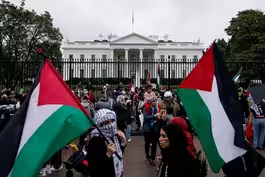
AMNA NAWAZ: President Biden's response to the ongoing Israel-Hamas war has angered Muslim and Arab Americans.
Those voters represent a key voting bloc for Democrats that helped Biden to win in the swing state of Michigan in 2020.
Here's Laura Barron-Lopez with more.
LAURA BARRON-LOPEZ: Amna, the Biden administration has vowed unequivocal support to Israel and refuses to call for a cease-fire, as more than a reported 11,000 Palestinians have been killed.
Biden has repeatedly called for extended humanitarian pauses to aid civilians in Gaza and recover hostages.
But Arab and Muslim voters say it's not enough.
SUEHAILA AMEN, Michigan: My name is Suehaila Amen, and I live in Dearborn Heights, Michigan, and I work in education.
LEXIS ZEIDAN, Michigan: Lexis Zeidan, 31 years old.
I was born and raised in Dover, Michigan, and I currently reside in Detroit, Michigan.
RAISA FATIMA, Michigan: My name is Raisa Fatima, and I am a law student at the University of Michigan.
ALI ABAZEED, Chief Public Health Officer, City of Dearborn, Michigan: My name is Ali Abazeed.
And the founding director of health and chief public health officer for the city of Dearborn.
When you cast aside the numbers of Palestinians in Gaza being killed, when, in response to a question around a cease-fire, which, in my view, is the most bare minimum request that can be made at this point, and the response being none, no possibility of a cease-fire from the president of the United States, we have no choice but to think about our reconsideration of our vote going into 2024.
RAISA FATIMA: A group of us have been phone-banking at the University of Michigan Law School, and we have sent in hundreds of calls to our local representatives, our state senators, our U.S. House of Representatives, and we haven't received any callbacks.
LEXIS ZEIDAN: They feel betrayed, they feel dehumanized, they feel demoralized by our administration right now.
And what we're seeing and what we're witnessing is that their loyalty to the Arab American community is dispensable to them.
ALI ABAZEED: For us in Dearborn, a lot of us come from backgrounds of war.
My family is in Southern Syria.
They know war far too well.
A lot of folks in Dearborn have lived through war in Lebanon, in Yemen, Palestinians themselves, who's connected to Gaza and the West Bank is well-documented.
And so this community knows war all too well, knows the traumas of war.
RAISA FATIMA: I don't think our elected officials are doing enough to address the harm of the type of rhetoric they're using.
And we're seeing very real consequences, even just within the United States.
There's a 6-year-old boy who was killed in Chicago.
There's been a rise in Islamophobia.
But this hasn't been given equal weight or even nearly enough weight as it should be.
SUEHAILA AMEN: I don't feel that there is any weight in walking back from this.
Rolling out a strategy to combat Islamophobia, a little too late, Mr. President.
RAISA FATIMA: There's these gestures towards ending Islamophobia.
And on the other hand, there's conflation of Muslim activism with antisemitism and hate speech.
The language being used by the White House and the Democratic Party really is rooted in Islamophobic comments.
The censure of Rashida Tlaib, it's emblematic of the censorship of Muslim voices in America.
SUEHAILA AMEN: There has always been a push post-9/11 to have us sitting at the table so that our voices were heard, but yet we're seeing today, especially, that all of those conversations and all of the opportunities that we have had to have our voice heard hasn't - - has only fallen upon deaf ears.
Why are we even bothering to have a seat at the table and bothering to share our voices, when no one's actually listening to anything that we have to say and then continue to misinterpret, misconstrue or misuse the words that we do share?
And it's putting us in a position where you're damned if you do, damned if you don't.
LEXIS ZEIDAN: The sad reality of what we're facing as voters in this country is that we are no longer voting for the lesser of two evils.
In November, we will remember.
LAURA BARRON-LOPEZ: Muslim and Arab leaders are warning the Democratic Party that if President Biden doesn't change his approach, he may lose their support in 2024.
A recent "NewsHour"/Marist poll found that 34 percent of Democrats disapprove of Biden's handling of the conflict, up from 19 percent of Democrats last month.
Joining me now to discuss the political ramifications is Wa'el Alzayat, CEO of the Muslim advocacy group Emgage.
Wa'el, thanks so much for being here.
What are you hearing from Muslim and Arab voters about President Biden's handling of the Israel-Hamas conflict and especially as the death toll continues to rise in Gaza?
WA'EL ALZAYAT, CEO, Emgage: We're hearing deep frustration, anger, sadness and a feeling of betrayal.
The Muslim American community in 2020, according to the Emgage impact polling that we conducted following the elections, found that 85 percent of Muslim voters, those who actually cast a ballot, said that they voted for Joe Biden and Kamala Harris.
Many of them organized, many of them contributed, certainly cast their votes in protection of our democracy and, quite frankly, to get rid of Donald Trump.
And now they feel that betrayal, that having, supported an administration that said that they value democracy and will confront authoritarianism, uphold human rights, is essentially giving a carte blanche to someone like Bibi Netanyahu to commit war crimes, and which have produced incredible carnage and devastation.
Beyond the 11,000 killed, the concerns are that Gaza become uninhabitable and burden not only the region, but the international community for generations to come.
LAURA BARRON-LOPEZ: The administration, Biden himself will say that they have tried to stress to Netanyahu to abide by the laws of war.
But in a state like Michigan, in a population where there is a large population of Muslim voters, Biden won, President Biden won that state by a margin of 154,000 votes.
Do you think that the president could lose that state next year?
WA'EL ALZAYAT: Absolutely.
And, in fact, we really assess, given the polling that we're seeing showing the president behind in some of the swing states, including Michigan, that the elections will probably be closer to what we saw in 2016, when Donald Trump won that state by 11,000 votes.
And according to the Emgage data of voters who are registered and casting ballots, there are 205,000 registered Muslim American voters.
It doesn't take a math genius to realize that they could absolutely have an impact.
LAURA BARRON-LOPEZ: Are Muslim and Arab voters going to vote for the Republican nominee, which, at this point, it looks like it will be former President Donald Trump?
Will they stay home?
Or are they going to vote third party?
WA'EL ALZAYAT: Well, look, I think we need to understand that Muslim American voters, like American voters of all backgrounds and ethnicities and religions, understand what's at stake next year.
We have lived through this.
Through four years of Donald Trump and MAGA Republicans.
We have experienced the Muslim ban and really the outright bigotry and racism against Black, brown, disabled, LGBTQ, Arab, Muslims, immigrants, people of all backgrounds.
So, therefore, I think we are way ahead of the elections next year.
Where the community is today, according to our polling, only 5 percent are telling us they would vote for Joe Biden, which is way down from that 85 percent I mentioned.
However, what we're focused on right now is getting that cease-fire, getting the humanitarian assistance in.
And, really, it's up to the voters next year to make that decision.
LAURA BARRON-LOPEZ: I wanted to ask you about those stakes that you mentioned, because you mentioned Trump -- Trump's Muslim ban.
He has said that he would extend that if he wins reelection in 2024, and he has specifically said that he would bar refugees in Gaza.
So, are the voters that you're talking to aware of that potential consequence if they vote third party or if they decide to stay home?
WA'EL ALZAYAT: They absolutely are, which is really what's so frustrating about this situation we find us in as Americans.
Look, Joe Biden and the Democrats built a big tent party, right?
And, essentially, this policy is risking fracturing that coalition, not just for Muslim voters, but for young voters, for Black voters, for progressive voters, for people of decency who are just not OK with Israel bombing its way out of a problem that it's partly responsible for, which is the occupation and the siege of Gaza for the last 17 years.
This is being forced upon us.
And my fear is that this misguided policy driven by, quite frankly, a neocon approach that takes us back to the ugly days of the war on terror that is fracturing this coalition and could possibly hand this country and our future to the dark forces of MAGA Republicans.
This is not on Muslim voters.
This is on this administration.
LAURA BARRON-LOPEZ: Well, I have to ask, because the president has said that he doesn't think a cease-fire is realistic because he thinks that Hamas has to be vanquished because of the fact that they said that they will continue to attack Israel.
So, because the president doesn't appear ready to support a cease-fire anytime soon, what exactly do Muslim and Arab voters that you talk to want to see from him?
Is there something else that he could potentially do to win back their support?
WA'EL ALZAYAT: He can call for a cease-fire, but also he can absolutely not give $14 billion to Bibi Netanyahu to spend as he pleased.
We can condition the support.
We can make sure that they are abiding by Leahy vetting, which ensures that U.S. weapons and money is not ending up harming or killing civilians.
We can absolutely increase humanitarian delivery.
Right now, only a few trucks are getting in, which includes the lifting of the siege on the civilian population.
LAURA BARRON-LOPEZ: Wa'el Alzayat of Emgage, thank you for your time.
WA'EL ALZAYAT: Thank you so much.
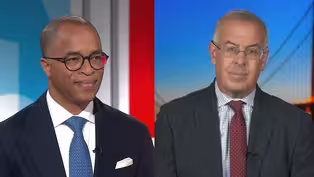
AMNA NAWAZ: The Biden administration's foreign policy efforts are at center stage this week, while, here at home, some compromise on Capitol Hill, but big funding questions ahead.
We turn now to the analysis of Brooks and Capehart.
That is New York Times columnist David Brooks, and Jonathan Capehart, associate editor for The Washington Post.
And welcome to you both.
It's good to see you.
Let's jump right into foreign policy, and that big meeting between Presidents Biden and Xi, a year in the making, a year of rising tensions between the two nations.
Jonathan, the bar for success for that summit was low, I think it's fair to say, just reestablish communications and reset.
Did they meet that bar?
JONATHAN CAPEHART: I think they did meet that bar.
I mean, yes, this meeting was a year in the making.
It was a meeting that had to happen.
It was a meeting that, quite frankly, I think the world was happy to see.
You can't have the two global superpowers at each other's throats, as they have been over the last year, with Chinese military planes buzzing U.S. military planes, and other things that have been happening.
And so the fact that President Xi came to the United States at the APEC conference, or outside the APEC conference in San Francisco, met with the president of the United States, had what seems like, looks like good meetings, it's all for the good.
They need -- China and the United States need to talk to each other.
Even if they are in competition with each other, they still need to talk to each other.
AMNA NAWAZ: David, what were your key takeaways from that summit?
DAVID BROOKS: Yes, I found it quite heartening, actually.
Like so many people, I have been alarmed by the intense military buildup China has been doing.
Their military spending has been really expanding at an explosive pace.
And because of their superior manufacturing base, in many ways, they can outdo us.
So, for example, they can produce 21 nuclear subs a year.
We can struggle to get one or two.
And that military buildup made me think, you don't spend that much money unless you're thinking of doing it.
And Xi clearly wants to take over the whole - - Taiwan at some point in his reign.
And so I was looking at possibly at another war, yet another war in the world sometime in the next year.
And that looks a lot less likely, in part because Xi clearly projected, understand there's been a shift in the balance of power over the last year.
The Biden administration has done a good job building alliances, but, most importantly, the Chinese economy is suffering.
For the first time in 40 years, the U.S. economy is growing faster in the Chinese economy.
The Chinese economy has the -- this real estate crash.
And so it really needs American investment and Western investment and Western import - - or things they can export.
And so he clearly seemed to project the idea that he understands his vulnerability.
It doesn't mean he's changed his goals, but there seems to be a sense that that sense of triumphalism that could lead him to the hubris and to an invasion of Taiwan, it seems a little less likely now.
AMNA NAWAZ: Well, we do know among the topics the two presidents discussed were those wars in Ukraine and in Gaza.
And I want to ask you both about some of that growing concern we have been seeing here in the U.S. with that last conversation, what Laura and her guests referred to, that -- we should be clear, overall American support for Israel remains high among the majority of Americans.
But as the war goes on and we have seen Gazan death toll soar, we are seeing this shift.
Here are some poll numbers from our "NewsHour"/NPR/Marist poll earlier this week.
When people are asked about the Israeli response, about 38 percent now say it's about right.
And about 38 percent also say it's too much.
That second 38 percent is worth noting, because that is up 12 points in just the last month.
So, Jonathan, is the White House doing enough to message to those folks whose concerns are growing?
JONATHAN CAPEHART: I don't -- well, clearly not, because, as we saw in Laura's piece, whatever the administration is doing is not - - it's not getting through, or folks just feel that Israel, in responding to the terrorist attacks against it, is going too far.
But we knew this was going to happen.
I remember, in the aftermath of October 7, the conversation moved very quickly to -- from Israel has the right to defend itself to, how long will that window stay open?
Because past practice has been, if Israel gets attacked, it responds with overwhelming force.
As the death toll goes up, as the destruction goes up, as the pictures, the heartrending pictures come back into American homes, we're going to see that too much go up, which then gets back to the bigger question.
And that is, it's not so much the messaging of the White House and whether the American people hear it.
It's whether the messaging and the pleading from the White House, from the president and the secretary of state on down to Prime Minister Bibi Netanyahu to remember that he's a small-D democratic country and must abide by the rules of war, whether that's getting through.
And that is the big -- that, to me, is the bigger question.
AMNA NAWAZ: David, the further away we move from the horrors of that day on October 7 - - and I, like many others, have seen the videos that the Israeli officials shared.
It is horrific, and it does not leave you.
We know U.S. lawmakers are now seeing some of those videos of the Hamas terror attack.
But the further away we get from that day, concern here does grow.
So what do you make of that increase here among Americans watching the war unfold?
DAVID BROOKS: Yes, I think the big story here is that there's been a rupture between liberals and progressives.
And so, if you look at Joe Biden, Hakeem Jeffries, Chuck Schumer, Barack Obama, Hillary Clinton, people you would call liberals, they argue that, listen, we had cease-fires.
We have had multiple cease-fires with Hamas, and every time they use the cease-fire as an excuse to rearm and reload, and then they break the cease-fire and you get more and more bloodshed.
And so the argument they make is, we can't go through this cease-fire rhythm over and over and over again.
We just have to solve the problem.
The old strategy was just failing, and so that's their case.
And then, more on the progressive side, they have shifted and adopted a policy which has not been the traditional Democratic policy of, more or less, one state.
"From the river to the sea" is what gets chanted.
And so it's not clear to me what they think that one state looks like, but it's clearly not the traditional policy we associate with the Democratic Party, which has been very supportive of Israel.
And I think it's not only on the Middle East.
On a bunch of other issues, you're seeing this beginning -- this rupture between progressives, who tend to be younger, and liberals, who tend to be older.
And we're seeing it in spades in the case of Israel-Gaza policy.
AMNA NAWAZ: I do want to get to Capitol Hill, because we do have a little bit of good news, and I like to be able to say that.
(LAUGHTER) AMNA NAWAZ: There's -- there was some compromise among lawmakers with Democratic House Speaker Mike Johnson, did get a temporary funding bill through the House, passed the Senate.
The president has now signed it.
They have sort of kicked the can a little bit down the road here.
But, Jonathan, tell me about Speaker Johnson's approach here to bring the hard-liners, address them in this way, get Democratic help to get this temporary bill across the line right now.
JONATHAN CAPEHART: Look, I was a big skeptic, very skeptical of the new speaker's ability to avert a government shutdown.
I was preparing for a government shutdown.
And, instead, he came up with this odd, laddered, whatchamacallit thing that he... AMNA NAWAZ: We have a new phrase here, right?
JONATHAN CAPEHART: What's it called, laddered C... AMNA NAWAZ: It's a laddered continuing resolution.
JONATHAN CAPEHART: Resolution.
AMNA NAWAZ: Yes.
JONATHAN CAPEHART: The first one ending January 19 and the last -- second one ending on February 2.
And he did it with overwhelming Democratic votes.
Basically, he did the statesman thing.
He kept the government open.
What he also did was do the exact same thing that former Speaker Kevin McCarthy did that got him booted and made him former Speaker McCarthy.
And so you hear -- there are rumblings from the House Freedom Caucus about they don't like this.
And so I see the speaker as being in -- right in the middle of a vise, motion to vacate on one side, and on the other side, a bunch of Democrats who are willing to help him govern the country and keep the government open as long as he keeps doing the right thing.
I don't know how long Speaker Johnson lasts, but I'm happy he has given us this good news to talk about.
AMNA NAWAZ: David, how long will those House Freedom Caucus members grant him a grace period?
DAVID BROOKS: This is one case where my completely unrealistic optimism paid off.
(LAUGHTER) DAVID BROOKS: I'm glad that my temperament is that way.
I think a couple things happened.
The first, what you believe depends on where you sit.
And once you become the speaker and you actually have responsibility, power tends to make people more responsible and more sober, not in the case of Donald Trump, but in the case of most other human beings.
JONATHAN CAPEHART: I'm glad you said that, David.
(LAUGHTER) DAVID BROOKS: And so I think that happened.
I think the Democrats looked, and, the last time, they didn't help, and McCarthy lost his seat, they wound up with an even more conservative speaker.
So why continue that process?
And so I think -- at the end of the day, I think people decided we can't have yet another catastrophe on our watch that's self-inflicted.
And so there was enough sanity to do the right thing.
AMNA NAWAZ: Jonathan, we only have a minute left, but I have to ask you about the latest in the George Santos saga before we go on.
Just a quick look here at what the House Ethics Committee report listed in terms of how he misused campaign funds.
We can just leave that up while we talk about this.
But they have tried to expel him before.
They are moving to expel him again.
He says he will not run for reelection.
Will he get expelled this time?
JONATHAN CAPEHART: Uh-huh.
Oh, yes.
AMNA NAWAZ: Yes?
JONATHAN CAPEHART: Yes, because you have got the New York Republicans who desperately want him out.
They have been trying to get him out before this Ethics report came out.
And do yourself a favor and read the Ethics report.
I mean, I have been in Washington a long time.
I have read some Ethics reports.
But this one is breathtaking in... AMNA NAWAZ: Why?
What stuck out to you?
JONATHAN CAPEHART: Well, because the guy is - - it's like a pyramid scheme.
He's robbing here and paying himself there, and the stuff he spent money on and stuff at -- thousands of dollars at Hermes, thousands of dollars at Ferragamo, purchases at OnlyFans, and we just -- it's not a furniture store.
So, the fact that he is... (LAUGHTER) JONATHAN CAPEHART: He's out.
I will just leave it at that.
He is out.
AMNA NAWAZ: David, you have about 20 seconds.
What would you like to say?
DAVID BROOKS: Well, he doesn't look like he wears Hermes.
So I'm impressed.
I don't know where that clothing is going to.
There's an argument to be made -- that has been made you shouldn't expel somebody who hasn't been convicted, because it's too politically temptation.
But this guy deserves to be expelled.
And I expect -- I agree with Jonathan, he's going to get expelled.
AMNA NAWAZ: And let me just say, as we go into this Thanksgiving holiday week, I am grateful for you both.
Thank you so much.
Good to see you.
JONATHAN CAPEHART: You too, Amna.
DAVID BROOKS: Good to see you.
AMNA NAWAZ: The deadly wildfires that tore through Maui just over three months ago destroyed thousands of structures and killed 100 people, but they also reignited a long-simmering concern among Native Hawaiians over who controls one of their most precious natural resources, water.
Here now is William Brangham again, who was in Maui to report this story recently.
WILLIAM BRANGHAM: This modest little stream trickling through the Waikapu Valley in Central Maui represents one small victory in a generations-long struggle, because, for years, there was no water.
HOKUAO PELLEGRINO, Farmer: These streams dried up overnight, and not by Mother Nature, but by the hands of men.
WILLIAM BRANGHAM: But now freshwater from the mountains freely flows down to Hokuao Pellegrino's ancestral farm.
With that water, this educator and farmer can now grow taro, or kalo, a crop that has deep cultural and historical meaning on these islands.
HOKUAO PELLEGRINO: We believe that we come from this plant, that it is our elder brother, and we will do anything and everything in our power to protect it.
WILLIAM BRANGHAM: For more than 100 years, growing kalo here was nearly impossible because, in the 19th century, sugar plantations founded by Americans and Europeans diverted streams across the island to irrigate their fields.
HOKUAO PELLEGRINO: When the streams were diverted by the sugar plantations, the traditional irrigation systems went dry.
The land cracked literally in all these... WILLIAM BRANGHAM: From dryness.
HOKUAO PELLEGRINO: From dryness, yes.
And those plants died.
NARRATOR: Sugarcane needs water.
It's a thirsty crop.
The planter's solution, burrow tunnels through the mountains, build siphons, raise flumes, and dig ditches, miles of them.
WILLIAM BRANGHAM: What did that do to the Native people who were living here?
HOKUAO PELLEGRINO: Besides taking away their food source, it was their livelihood, it was their traditions, their language.
WILLIAM BRANGHAM: In a matter of decades, to feed the booming sugar industry, much of Maui was transformed, including the town of Lahaina.
It was once known as the Venice of the Pacific, with lush forests, wetlands and ponds, a vision that's hard to imagine now after this summer's inferno burned so much.
I'm standing in one of the many fields in Lahaina that burned, and in addition to the historic water diversions that went on here, the fight over water is now also complicated by climate change and reduced rainfall and increased drought.
KAPUA'ALA SPROAT, University of Hawaii at Manoa: In an area that was already water-scarce, over a century of plantation mismanagement has really created a tinderbox.
WILLIAM BRANGHAM: University of Hawaii Law Professor Kapua'ala Sproat has helped Native Hawaiians reclaim some legal control of the island's precious fresh water.
KAPUA'ALA SPROAT: In these incredibly isolated island communities, water was and remains the source of all life.
In many ways, I mean, this is a fight for the soul of Hawaii.
WILLIAM BRANGHAM: Hawaii's Constitution protects water as a public trust, but, today, some of Maui's water systems, including three-quarters of West Maui's, remain under control of water and development companies, some of which are direct descendants of plantations.
KAPUA'ALA SPROAT: These plantations are no longer the backbone of the economy, but, at the same time, they continue to take almost all of the water resources from our streams and communities for their private commercial gain.
HOKUAO PELLEGRINO: Sugar plantation is gone, right?
But it's only been replaced with lawns and golf courses and hotels and large water users.
WILLIAM BRANGHAM: Sproat helped successfully represent Pellegrino and other Native Hawaiians in part of an almost 20-year legal fight to restore water to four historic streams.
HOKUAO PELLEGRINO: That was really truly a David versus Goliath.
Me, personally, I really just wanted to grow kalo and feed my family.
WILLIAM BRANGHAM: As simple as that?
HOKUAO PELLEGRINO: Very simple.
But we knew it was going to take time.
WILLIAM BRANGHAM: His group's victory was part of a steady progress made by Native Hawaiians over the years.
But when the wildfires swept through Lahaina, killing 100 people and destroying thousands of buildings, some raised questions about whether those legal fights over water made this disaster worse.
During the fire, the administration of Hawaii's Democratic governor, Josh Green, suspended the state's water code and, with it, protections for Native farmers water rights.
The next day, a major real estate developer, the West Maui Land Company, asked state officials if it could permanently reduce the amount of water it had to provide those farmers.
West Maui made the request for -- quote -- "fire suppression in our community."
Soon after, Governor Green seemed to echo those concerns.
GOV.
JOSH GREEN (D-HI): There has been a great deal of water conflict on Maui for many years.
It's important that we're honest about this.
People have been fighting against the release of water to fight fires.
WILLIAM BRANGHAM: Advocates say they have never opposed diverting water needed to fight fires and argue they're not to blame for this tragedy.
HOKUAO PELLEGRINO: This idea that we're pinning one side against the other is just a continued false narrative.
Putting water in the stream ensures that we have water in our tap.
By protecting this resource, it would protect all of us, not just Hawaiians.
KEKAI KEAHI, Farmer: Almost arrogantly, they refuse to listen to the law.
WILLIAM BRANGHAM: Kekai Keahi, a Native Hawaiian farmer and leader, has long advocated for increased oversight of the West Maui Land Company.
The company and its subsidiaries have been fined repeatedly for breaching water laws, including taking too much out of a stream.
KEKAI KEAHI: I think West Maui Land Company used this tragic time and people's hurt and pain, thinking that we'd be distracted, to try and push their agenda of trying to regain this water that they lost, and Josh Green helped them out.
WILLIAM BRANGHAM: West Maui Land Company rejects those assertions.
In a statement to the "NewsHour," it said it simply wants to guarantee that enough water is available to fight fires when needed.
Several weeks after the fires, officials reinstated the state's water code.
But many in Lahaina and across Maui remain outraged.
MAN: Water is life.
Life comes from water.
But what happens when that life-giving source is mismanaged?
WILLIAM BRANGHAM: Water rights have become a rallying cry for locals and Native Hawaiians as the state continues the rebuilding process.
Last month, hundreds attended a state water commission meeting, demanding an overhaul of how water is managed in Lahaina.
MAN: I truly believe that the homes of my ohana and all of us here that have lost would still be there had there been responsible management of our water resources.
WILLIAM BRANGHAM: Back in Central Maui, past his kalo patch, in the stream that his legal battle helped restore... HOKUAO PELLEGRINO: Let's see how lucky we are.
WILLIAM BRANGHAM: ... Hokuao Pellegrino says bringing water back to Lahaina's streams will not only revive traditional farms; it could also help heal long-damaged ecosystems.
HOKUAO PELLEGRINO: And here it is.
There it is.
WILLIAM BRANGHAM: It did just that in his own backyard.
These Native freshwater snails, now common here, could not survive without this water.
HOKUAO PELLEGRINO: Imagine, these have to go all the way down to the ocean to spawn.
WILLIAM BRANGHAM: These guys?
HOKUAO PELLEGRINO: Yes.
When you start to see things like this, then you know it makes it all worthwhile, because these guys don't have a voice.
They require us to speak up for them.
WILLIAM BRANGHAM: In the wake of those devastating fires, a growing chorus of Native Hawaiians seem to be doing just that.
For the "PBS NewsHour," I'm William Brangham on Maui, Hawaii.
AMNA NAWAZ: And be sure to tune into "Washington Week with The Atlantic" tonight on PBS.
Jeffrey Goldberg and his panel will discuss former President Trump's echoing of authoritarian dictators and the decline of civility in the GOP.
And, tomorrow, on "PBS News Weekend," how nurse practitioners are filling a much-needed health care gap and the fight to allow them to provide more care for patients independently.
And that is the "NewsHour" for tonight.
I'm Amna Nawaz.
On behalf of the entire "NewsHour" team, thank you for joining us, and have a great weekend.
Arab and Muslim Americans on Israel support and their votes
Video has Closed Captions
Arab and Muslim Americans on how U.S. support for Israel could affect their votes in 2024 (10m 10s)
Brooks and Capehart on Biden's meeting with Xi
Video has Closed Captions
Brooks and Capehart on what Biden accomplished in his meeting with Xi (10m 59s)

Israeli airstrike leaves at least 40 dead in southern Gaza
Video has Closed Captions
Israeli airstrike leaves at least 40 dead in southern city once a refuge for Gazans (5m 2s)

Jonathan Karl explores Trump's grasp on GOP in new book
Video has Closed Captions
Jonathan Karl explores Trump's grasp on GOP in new book, 'Tired of Winning' (7m 10s)

Maui faces water rights questions amid wildfire recovery
Video has Closed Captions
Maui faces water rights questions as island continues wildfire recovery (8m 27s)
News Wrap: Biden signs bill to avert government shutdown
Video has Closed Captions
News Wrap: Biden signs temporary spending bill to avert government shutdown (3m 46s)
Protests against 'Cop City' continue despite crackdown
Video has Closed Captions
Protests against Atlanta's 'Cop City' continue despite crackdown demonstrations (6m 6s)
Providing Support for PBS.org
Learn Moreabout PBS online sponsorship
- News and Public Affairs

FRONTLINE is investigative journalism that questions, explains and changes our world.

- News and Public Affairs

Amanpour and Company features conversations with leaders and decision makers.












Support for PBS provided by:
Major corporate funding for the PBS News Hour is provided by BDO, BNSF, Consumer Cellular, American Cruise Lines, and Raymond James. Funding for the PBS NewsHour Weekend is provided by...