
November 24, 2024 - PBS News Weekend full episode
11/24/2024 | 26m 45sVideo has Closed Captions
November 24, 2024 - PBS News Weekend full episode
Sunday on PBS News Weekend, with multiple nominees to Trump’s Cabinet accused of sexual misconduct, we look at the future of the #MeToo movement. Then, how contaminated water in northern Michigan is dangerously affecting military veterans and their families. Plus, with more than 15 million adults diagnosed with ADHD, why treatment remains a big hurdle for most.
Problems playing video? | Closed Captioning Feedback
Problems playing video? | Closed Captioning Feedback
Major corporate funding for the PBS News Hour is provided by BDO, BNSF, Consumer Cellular, American Cruise Lines, and Raymond James. Funding for the PBS NewsHour Weekend is provided by...
Support provided by:

November 24, 2024 - PBS News Weekend full episode
11/24/2024 | 26m 45sVideo has Closed Captions
Sunday on PBS News Weekend, with multiple nominees to Trump’s Cabinet accused of sexual misconduct, we look at the future of the #MeToo movement. Then, how contaminated water in northern Michigan is dangerously affecting military veterans and their families. Plus, with more than 15 million adults diagnosed with ADHD, why treatment remains a big hurdle for most.
Problems playing video? | Closed Captioning Feedback
How to Watch PBS News Hour
PBS News Hour is available to stream on pbs.org and the free PBS App, available on iPhone, Apple TV, Android TV, Android smartphones, Amazon Fire TV, Amazon Fire Tablet, Roku, Samsung Smart TV, and Vizio.
Providing Support for PBS.org
Learn Moreabout PBS online sponsorshipLAURA BARRON-LOPEZ: Tonight on PBS News Weekend, with multiple nominees to Trump's Cabinet accused of sexual misconduct, we look at the future of the MeToo movement.
Then how contaminated water in Northern Michigan is having a dangerous impact on military veterans and their families.
MAN: Like you had burn pits in Iraq and like you had Agent Orange in Vietnam.
But this happened on American soil.
And not only did it happen to the veterans, but it happened to their wives and their children.
LAURA BARRON-LOPEZ: With more than 15 million adults diagnosed with ADHD, why treatment remains a big hurdle for most.
(BREAK) LAURA BARRON-LOPEZ: Good evening.
I'm Laura Barron-Lopez.
John Yang is away.
Israeli Defense Forces and Hezbollah traded attacks today, leaving the Lebanese army stuck in the middle.
One soldier was killed and 18 others wounded when an Israeli strike hit an army base in southern Lebanon.
The IDF later apologized, saying its operations were directed at militants, and Hezbollah fired a barrage of rockets and other projectiles into Israel, wounding seven.
The death of a dual Israeli-Moldovan citizen is being called a terror incident by Prime Minister Benjamin Netanyahu.
He announced today that the body of Zvi Kogan was found after the ultra-Orthodox rabbi went missing last week in the United Arab Emirates.
Kogan was also known for participating in the group Chabad, which supports Jewish visitors and residents in the UAE.
Israel is again warning against non-essential travel there.
World leaders have finally come to an agreement to help developing countries cope with the damaging effects of climate change.
At the United Nations Climate Summit, richer nations agreed to pay $300 billion per year to poorer countries by 2035.
Most of the money will go toward deploying solar and wind energy, helping communities adapt to floods and fires, and improving emergency plans in the wake of disasters.
But many developing countries say it's not enough.
Experts recommended more than $1 trillion to tackle the challenge.
Former Oklahoma Senator Fred Harris has died.
He served in the Senate for eight years, pushing for civil rights, backing anti-poverty programs and advocating for indigenous communities.
Harris also chaired the Democratic National Committee and ran for president twice.
Fred Harris was 94 years old.
And one of the country's most well-known game show hosts.
Chuck Woolery has died.
He was the original host of Wheel of Fortune and the longtime face of Love Connection.
Later in life, he became a conservative podcaster.
Chuck Woolery was 83 years old.
Still to come on PBS News Weekend, contaminated water in northern Michigan is affecting military veterans and their families and why millions of adults struggle getting treatment for ADHD.
(BREAK) LAURA BARRON-LOPEZ: President elect Donald Trump has finished naming his top cabinet nominees, and there's a noticeable pattern across some of them, allegations of sexual misconduct or assault.
First, there's Trump's failed pick for attorney general, Matt Gaetz.
A woman testified to House investigators that when she was a 17-year-old minor, she had sex with Gaetz at a party.
Two other women testified that Gaetz paid them for sex multiple times.
Gaetz has denied the allegations.
He withdrew his nomination last week, unable to secure enough support as more details surface.
But he's not alone.
Trump's picked to lead the Defense Department Pete Hegseth is accused of sexually assaulting a woman in 2017 in a California hotel room.
According to a police report released last week, the woman said Hegseth took her phone and blocked her exit.
It was first reported to police by a nurse after a patient requested a sexual assault exam.
Hegseth settled with the woman last year, but denies any wrongdoing.
There's also Robert F. Kennedy Jr., Trump's nominee to be Secretary of Health and Human Services.
He's accused on multiple occasions of groping a 23-year-old woman who once worked for him as a live in nanny.
And Donald Trump himself has been publicly accused of sexual misconduct by two dozen women, including forcibly reaching under their skirts and kissing them without consent.
Last year, he was found liable in civil court of sexual abuse and defamation.
Despite these sexual misconduct allegations, Trump will soon be in the Oval Office.
And if confirmed, his nominees will be in top jobs across government, raising questions about the future of the MeToo movement.
Deborah Tuerkheimer is a law professor at Northwestern University and the author of "Credible: Why We Doubt Accusers and Protect Abusers."
She joins me now.
Deborah, thanks for joining.
When the MeToo movement swept the country around 2017, it brought down giants of Hollywood, Silicon Valley media, you name it.
And it appeared to have changed society's expectations when it came to addressing sexual abuse or assault.
But now we're seeing a second Trump administration being staffed with people accused of sexual misconduct.
What signal does it send that these people may be filling some of the highest positions in government and leading the military or determining health policy?
DEBORAH TUERKHEIMER, Author, "Credible: Why We Doubt Accusers and Protect Abusers": Well, it sends a powerful signal that the work of the MeToo movement is woefully incomplete, that there's a lot of work left to be done.
The movement made a lot of progress.
It surfaced the commonality of abuse.
It got us talking about abuse.
And for several high profile men, there was accountability.
But the structures of power that MeToo was taking aim at are still very much in place.
And we've seen that, I think with particular intensity in the last few weeks with the election of Donald Trump and then his selection of these men to fill his Cabinet.
LAURA BARRON-LOPEZ: Some Republican senators have called the allegations against Pete Hegseth the nominee for the Defense Department.
They have called those allegations concerning.
But the majority of Republicans have either been quiet or have dismissed those allegations as media reports.
Why the insistence on confirming these picks, and why not choose other nominees?
DEBORAH TUERKHEIMER: Well, I think what's going on at some deeper level is a contest between competing worldviews around male sexual entitlement.
And Donald Trump has been very clear.
We can think back to the release of the Access Hollywood tape and to his boast that he could do anything to the finding of civil liability.
And Donald Trump is elected.
The public, at least the public that elected him, did not feel that any of this was important enough to be disqualifying.
And he clearly feels enabled and emboldened to select individuals who face their own credible allegations.
Really by way of reinforcing the idea that men in power have a range of entitlements, including sexual entitlements, and that there will be no impunity for this kind of abuse.
LAURA BARRON-LOPEZ: What does the current political situation say about how the MeToo movement is viewed right now?
Is this a setback?
Are the changes that movement ushered in jeopardy at all?
DEBORAH TUERKHEIMER: Well, I think that the movement has been facing a backlash for some time, and we've seen various indications of that.
Certainly the election of Donald Trump is another indication of some backlash, but the movement, it will move forward.
I think that the movement came about in part because of Donald Trump's on that Access Hollywood tape and then his subsequent election, and a sense on the part of so many survivors that it was time to end the impunity that men who abuse have enjoyed for so long.
So this is a long pendulum swinging back and forth that we're seeing, and there's no reason to believe that this is where the pendulum stops swinging.
LAURA BARRON-LOPEZ: It's not just Donald Trump, Pete Higseth or RFK Jr. Two other people Trump has named to his administration are facing allegations.
Elon Musk and SpaceX were sued by former employees for creating a workplace that they said treated women as sexual objects.
And then Linda McMahon, the nominee for Secretary of Education, is facing allegations of covering up sexual abuse toward children from her time at the WWE.
So what does this say about how those in power handle allegations and abuse and how they may run the departments that they're being nominated for?
DEBORAH TUERKHEIMER: Well, the amount of abuse that goes on in our society goes on because there are structures that tolerate it.
And so the examples that you cite are illustrations of this.
And it is absolutely a powerful and frankly, devastating message to survivors and those who care about them when individuals are heading departments that are charged with ferreting out just this kind of abuse.
And those individuals have themselves run afoul of these rules and norms that the MeToo movement is trying to promote and trying to reinforce.
LAURA BARRON-LOPEZ: Deborah Tuerkheimer, thank you for your time.
DEBORAH TUERKHEIMER: Thank you.
LAURA BARRON-LOPEZ: Across the nation, hundreds of military sites have contaminated waterways with toxic forever chemicals.
Last night we brought you the story of one Michigan community pressuring the Air Force to clean up the decades old contamination.
Tonight, special correspondent Megan Thompson reports on the potential health impacts of that toxic water and the veterans who fear it has made them sick.
CRAIG MINER: Four, five, six, seven.
Almost all the grandchildren.
There's Mitchell in the center.
MEGAN THOMPSON (voice-over): Craig and Carrie Minor's home in Cedarville, Ohio, is filled with family photos.
CARRIE MINOR: This is my favorite picture.
Taylor's holding Mitchell's head up.
And I just love that picture of all four of the kids.
MEGAN THOMPSON (voice-over): Mitchell is the Miner's third child, born in 1989 with severe disabilities.
CRAIG MINOR: Mitchell had cerebral palsy and he had microcephaly major seizure disorders.
He was completely a quadriplegic.
MEGAN THOMPSON (voice-over): Carrie provided around the clock care for him until he died in 2020 at the age of 30.
CRAIG MINOR: He was a daddy's boy.
We loved him dearly.
MEGAN THOMPSON (voice-over): Doctors suggested a virus could have caused Mitchell's disabilities.
But a year before he died, Craig saw something on TV that made him think otherwise.
CRAIG MINOR: They were talking about contamination that all these bases through firefighter foam and Wordsmith's name came up.
MEGAN THOMPSON (voice-over): Wurtsmith is in the former Air Force base in Oscoda, Michigan, where Craig was stationed for four years as a B52 bomber pilot.
It's also where the family lived when Carrie was pregnant with Mitchell.
The base made headlines after widespread groundwater contamination was discovered in 2010.
It was caused by firefighting foam crews used for decades to practice putting out jet fuel fires containing chemicals called per and polyfluoralkyl substances.
PFAS for short.
COURTNEY CARIGNAN, Michigan State University: PFAS have been shown to affect multiple systems in the body.
So here's our freezer.
MEGAN THOMPSON (voice-over): Courtney Carignan is an environmental epidemiologist at Michigan State University who studies the effects of PFAS on human health.
She says there's some level of PFAS in almost every American's blood.
COURTNEY CARIGNAN: They're used in a lot of different products that most people use or have in their homes.
Things like Scotchgard nonstick pans.
MEGAN THOMPSON (voice-over): There are around 15,000 different types of PFAS.
And once in our bodies or the environment, they don't break down quickly.
It's why they're known as forever chemicals.
COURTNEY CARIGNAN: Our bodies actually see them as useful.
We don't excrete them, they don't break them down, and they're being reabsorbed and recirculated in the body.
And so it can take years for PFAS to be eliminated.
And so when we have a sample come into the lab.
MEGAN THOMPSON (voice-over): Carignan says PFAS exposure is believed to cause a litany of health problems like cardiovascular disease and kidney and testicular cancers.
MAN: My blood's been tested.
I got five different PFAs, PFNA, PFXHS, P4P this, P that in my blood.
95 percent above the - - whatever it is.
I'm just so upset.
MEGAH THOMPSON (voice-over): The discovery of PFAS 14 years ago still has many Oscoda residents angry and concerned about their health.
The base closed in 1993, but the PFAS have been leaking into nearby lakes, rivers, and some residents well, water.
LOWELL MILLER: I usually only use a sinker down here when the current's really heavy.
MEGAH THOMPSON (voice-over): Lowell Miller grew up across the lake from the base in the area where PFAS were found in the drinking water.
LOWELL MILLER: Pretty much once or twice a week, we'd have venison and fish.
MEGAN THOMPSON (voice-over): In this rural area, hunting and fishing are a source of tourist dollars and an affordable way to put food on the table, but only when it's safe.
The state of Michigan now warns that fish, deer, and other game from certain areas should not be eaten.
LOWELL MILLER: It definitely changed things up here because a lot of the people that were living off of that, they have to worry.
A lot of them have moved.
MEGAN THOMPSON (voice-over): But contaminated fish and meat were just the start of Miller's worries.
In 2015, he lost his father to lung and brain cancer.
Four years later, his mother died from a rare form of cervical cancer.
Two of his siblings also had cancer and other health issues.
LOWELL MILLER: Sure, you know, cancer, I guess, is getting bad all over the place, but it just seems to be targeting people more around the area.
So it just makes me wonder.
MEGAN THOMPSON (voice-over): But he's not giving up hunting and fishing.
It's how he earns a living with his handmade fishing lure business and YouTube channel.
LOWELL MILLER: Hello, everybody.
Welcome to another adventure.
Honestly, after losing my mom and my dad, I don't have anything anymore.
I really don't.
So to me, you know, the way I'm looking at it is if I die from eating fish, at least I'm enjoying my life, you know?
MEGAN THOMPSON (voice-over): The state of Michigan is collecting blood samples from Oscoda residents to determine their PFAS exposure.
Veterans who served at wordsmith in the 70s, 80s and 90s when firefighting foam was being used, want something similar done for them.
But the federal agency tasked with studying it for the Pentagon has declined, saying there isn't sufficient information to know when the base drinking water became contaminated or how much PFAS was in the water decades ago.
CRAIG MINOR: People have their head buried in the sand.
MEGAN THOMPSON (voice-over): If the government wouldn't connect the dots, Craig Miner decided he would.
CRAIG MINOR: This whole thing here goes way back.
MEGAN THOMPSON (voice-over): Minor, who has a law degree and a degree in chemistry, compiled hundreds of pages of government documents, made YouTube videos, testified at a U.S. Senate field hearing.
He even wrote a book.
CRAIG MINOR: They dumped the PFAS on the ground 500 yards from the main water wells.
MEGAN THOMPSON (voice-over): Minor found documents showing the Air Force poured firefighting foam on the ground next to the base's drinking water source.
Even after 3M, the manufacturer recommended it not be disposed of that way.
Minor also found tests done by the state of Michigan in 2016 showing PFAS levels in the groundwater near those wells as high as 46,000 parts per trillion.
The new EPA drinking water standard is 4 to 10 parts per trillion.
CRAIG MINOR: Bottled water wasn't a thing back then.
So you drank, you cooked in it, you showered in it.
MEGAN THOMPSON (voice-over): Minor had his blood tested and estimates that back when he was on base, he had roughly 250 times more PFAS in his blood than what the National Institutes of Health considers safe.
CRAIG MINOR: The only way you're getting that kind of exposure is if you were drinking it.
MEGAN THOMPSON (voice-over): Minor believes PFAS contributed to his son Mitchell's poor health and his own.
CRAIG MINOR: Recently, I've had quintuple bypass surgery, so every artery in my heart was blocked.
We eat really well.
I don't drink.
I don't smoke.
This is all the meds.
MEGAN THOMPSON (voice-over): Studies show a strong correlation between PFAS exposure and high cholesterol.
But that's just Minor's latest issue at Wurtsmith.
In his 20s, he developed a tumor on his back and an enlarged prostate state.
He's also had vision problems, bone pain, and an enlarged heart, liver and spleen.
CRAIG MINOR: There's no cameras inside my body or anybody else's body.
We can never go to the exact point and say, aha, I see PFAS present and this thing is happening.
MEGAN THOMPSON (voice-over): To receive disability benefits from the Veterans Administration, a person must prove their condition is connected to military service.
But according to a recent report, illness caused by chemicals is very hard to prove.
Some health issues are deemed presumptive, automatically connected to service, so veterans can skip the red tape.
But historically, troops exposed toxic chemicals have had to wait about 34 years for a presumptive to be established.
In September, the VA announced it's considering the first PFAS presumptive for veterans with kidney cancer who were exposed.
In a statement to PBS News Weekend, a VA press secretary said, our top priority is providing veterans with the healthcare and benefits they deserve, and the VA is delivering more benefits to more veterans than ever before.
CRAIG MINOR: Not only do you need to clean up the PFAS in the ground, but you need to clean it up in the people.
MEGAN THOMPSON (voice-over): After more than 20 years in the military, Craig Minor qualified for full VA benefits, mostly because he started getting sick while he was still serving.
But his fight isn't over because he believes so many more people deserve the same recognition and care.
CRAIG MINOR: Like you had burn pits in Iraq and like you had Agent Orange in Vietnam.
But this happened on American soil.
And not only did it happen to the veterans, but it happened to their wives and their children.
MEGAN THOMPSON (voice-over): For PBS News Weekend, I'm Megan Thompson in Cedarville, Ohio.
LAURA BARRON-LOPEZ: ADHD, or attention deficit hyperactivity disorder, impacts the lives of nearly one in nine children in the U.S. And while the disorder is often associated with kids, it can affect people of all ages.
Ali Rogan has more on the diagnosis and treatment of adult ADHD.
ALI ROGIN: More than 15 million U.S. adults currently have an ADHD diagnosis, and only about half of them receive their diagnosis before the age of 18.
Those are the findings of a recent CDC report looking at the state of ADHD among adults in the US.
The report also notes that most struggle with access to treatment for the condition.
Maggie Sibley is a professor of psychiatry and behavioral sciences at the University of Washington School of Medicine.
She's also a clinical psychologist at Seattle Children's Hospital.
Maggie, thank you so much for joining us.
Why are so many adults who have ADHD not diagnosed when they are children?
MAGGIE SIBLEY, University of Washington School of Medicine: This is a pretty interesting finding that we're seeing coming out of the CDC.
And if you look closer, it seems like there are certain people, especially women and people who are a little bit older, when ADHD might not have been as much on the public's consciousness that are mostly responsible for this.
And we see that ADHD looks different in girls.
And so we see that people who may not have been recognized when they were younger grow up, learn about what ADHD is and then often start to recognize it in themselves.
ALI ROGIN: You mentioned that it can be different in girls, but what about differences in the ages?
Does it manifest itself differently in adults than it does in children?
MAGGIE SIBLEY: So the core symptoms of ADHD, which are difficulty paying attention, which can look like carelessness, forgetfulness, disorganization, and difficulties in hyperactivity or impulsivity, which can look like having trouble thinking before you act, or being a really high energy person in a way that can get you in trouble, that stays the same no matter how old you are.
But the ways it interferes with your life can really change based on what period of your life are in.
Hyperactivity in a young child can be running around and jumping on chairs and on furniture.
Hyperactivity in an adult might be having a really active mind, not being able to settle down and relax.
It might be taking on too much and then getting overwhelmed.
So we see it basically coming out in different parts of people's lives depending on how old they are.
ALI ROGIN: How has our understanding of ADHD in adults changed over time?
What have we learned?
What important things inform our understanding of how it presents in adults?
MAGGIE SIBLEY: We really only realized that ADHD lasted into adulthood in most people in the last 20 years.
And what we learned was that ADHD is a disorder that actually most people don't grow out of.
And when you become an adult, it can interfere with your work.
It can interfere with your interpersonal relationships.
It can also interfere with things like your financial stability and your health.
And so it's really important for adults with ADHD to get diagnosed and get help so.
So that it can prevent more serious problems from happening for them down the road.
ALI ROGIN: What about tools like smartphones, the Internet, social media?
Do those modern tools exacerbate some of the symptoms of ADHD?
MAGGIE SIBLEY: We're all distracted, probably by the electronics in our world around us.
But it's really important to know that not all distraction and not all distractibility is ADHD.
So ADHD is generally a biologically determined chronic condition that people have their entire life.
They're going to be experiencing those symptoms whether they're in the age of smartphones or whether they're not.
But if a person doesn't have the symptoms of ADHD outside of the chaotic world that they're living in, if you could take all that away and the person kind of goes back to a normal state, then we would not say that person has ADHD.
On the other hand, I think we are seeing, and I've seen census data on this in the last couple years, that more people feel they're having trouble concentrating in their life.
But if you go to a good doctor who knows the difference between environmentally determined concentration problems and ADHD, they'll be able to help you sort out whether or not this is a diagnosis that's a fit for you, or whether you need to make some lifestyle modifications to help with your distractibility.
ALI ROGIN: And why are so many adults, though, who have been diagnosed with ADHD struggling to get the proper treatment?
MAGGIE SIBLEY: Out of the pandemic we saw a huge spike in help seeking for ADHD, but the demand for care has far outgrown the amount of care that's available.
And so we've seen a stimulant medication shortage in this country over the last couple years.
People haven't been able to get medications because there's been a higher demand for them than supply that's available based on the quotas that the government sets on them because they're a controlled substance.
We've seen wait lists for people to get psychological care that have been months and even years for people.
And so people, you know, are realizing that they have this need for treatment.
But we don't have enough providers out there who are trained in ADHD care to meet their demands.
ALI ROGIN: Experts in this field are working now on guidelines to help better treat adults with ADHD.
Why are those guidelines going to be important once they're put in place?
MAGGIE SIBLEY: It's going to provide a compass for providers who want to learn how to treat ADHD well but haven't known exactly how to do that.
It's tough to make diagnoses of ADHD in adults.
So when we have clear guidelines on how to's for professionals for good diagnosis and treatment and we start providing trainings at a society wide level on how to implement those guidelines, we're going to see the standard of care in this country hopefully rise up pretty high.
And that's what we're really looking forward to about those guidelines.
ALI ROGIN: Professor Maggie Sibley with the University of Washington School of Medicine, thank you so much.
MAGGIE SIBLEY: Thank you so much.
LAURA BARRON-LOPEZ: And that's our program for tonight.
I'm Laura Barron-Lopez.
For all of my colleagues, thanks for joining us.
Have a good week.

The future of #MeToo as Donald Trump returns to power
Video has Closed Captions
The future of #MeToo as a second Trump administration prepares to take power (6m 44s)
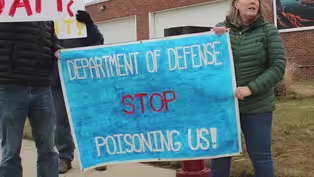
How toxic water in Michigan is affecting military veterans
Video has Closed Captions
How toxic water in northern Michigan is affecting military veterans and their families (8m 40s)

Why millions of adults with ADHD struggle to get treatment
Video has Closed Captions
Why millions of adults with ADHD struggle to get treatment (5m 52s)
Providing Support for PBS.org
Learn Moreabout PBS online sponsorship
- News and Public Affairs

FRONTLINE is investigative journalism that questions, explains and changes our world.

- News and Public Affairs

Amanpour and Company features conversations with leaders and decision makers.












Support for PBS provided by:
Major corporate funding for the PBS News Hour is provided by BDO, BNSF, Consumer Cellular, American Cruise Lines, and Raymond James. Funding for the PBS NewsHour Weekend is provided by...