
October 19, 2026 - PBS News Hour full episode
10/19/2026 | 57m 46sVideo has Closed Captions
October 19, 2026 - PBS News Hour full episode
October 19, 2026 - PBS News Hour full episode
Problems playing video? | Closed Captioning Feedback
Problems playing video? | Closed Captioning Feedback
Major corporate funding for the PBS News Hour is provided by BDO, BNSF, Consumer Cellular, American Cruise Lines, and Raymond James. Funding for the PBS NewsHour Weekend is provided by...
October 19, 2026 - PBS News Hour full episode
10/19/2026 | 57m 46sVideo has Closed Captions
October 19, 2026 - PBS News Hour full episode
Problems playing video? | Closed Captioning Feedback
Where to Watch PBS News Hour
PBS News Hour is available to stream on pbs.org and the PBS app.
Providing Support for PBS.org
Learn Moreabout PBS online sponsorshipGEOFF BENNETT: Good evening.
I'm Geoff Bennett.
Amna Nawaz is away.
On the "NewsHour" tonight: Ukraine and Russia trade attacks, as President Trump's rift with Ukrainian President Vladimir Zelensky widens.
Then: LARRY FAUVRE, President, Mahoning and Trumbull AFL-CIO Labor Council: I've lived here all my life.
I've watched the good times.
I've watched the bad times.
GEOFF BENNETT: Years of economic uncertainty have put affordability at the center of Ohio's closely contested races for Senate and governor.
And a look at the emerging electric technology poised to transform aviation.
SEAN DONOVAN, COO, BETA Technologies: E.V.s on the ground have pushed battery technology really far that have really enabled electric aviation.
(BREAK) GEOFF BENNETT: Welcome to the "News Hour."
The war of words between President Trump and Ukrainian President Volodymyr Zelenskyy escalated again today, with Mr.
Trump sharply criticizing the Ukrainian leader and directing more pressure at him than at Russia's Vladimir Putin, who launched the war.
Zelenskyy is set to meet with U.S.
negotiators this week.
But the latest tensions come as Washington has restricted Ukraine's access to critical technology it relies on in its fight against Russia.
Nick Schifrin starts our coverage.
NICK SCHIFRIN: In Kyiv's shattered windows and downtown debris, the impact of what Ukraine says is blocked U.S.
support.
Today, Russian drones and missiles hit the capital without warning, leaving walls slashed by shrapnel, blowing out residences, a shopping mall, and a school, part of Russia's attempt to make Kyiv unlivable.
MAKSYM MAKSYMOVYCH, Kyiv, Ukraine, Resident (through translator): It's one thing to observe this happening elsewhere in other places or other cities, but now it's getting closer and closer.
That's a bit chilling.
NICK SCHIFRIN: The chill is between President Trump and Ukrainian President Volodymyr Zelenskyy, who today suggested the U.S.
stop the intelligence that has for years fed into Ukraine's air alert system.
VOLODYMYR ZELENSKYY, Ukrainian President: Only the United States has this unique intelligence to say, to tell us, to tell our side when Russia uses ballistic missiles.
NICK SCHIFRIN: What Zelenskyy did not say, the U.S.
warning system is not perfect and can miss certain Russian missile launches, especially in bad weather.
But Ukraine is having to physically slow down and is losing connection to its drone interceptors and mid- and long-range drones because of speed caps by the American SpaceX system.
That threatens Ukraine's ability to bring the war to Russia and defend itself.
On Sunday on "Meet the Press," Zelenskyy said the intel sharing was on and off.
KRISTEN WELKER, Moderator, "Meet the Press": Is that accurate?
Has the United States cut off intelligence sharing with Ukraine?
VOLODYMYR ZELENSKYY: It was blocked for some period of time.
And then it was de-blocked by American side.
We are very thankful for this.
Now it works.
NICK SCHIFRIN: Today, in Uzbekistan, Secretary of State Marco Rubio denied the U.S.
had ever restricted intelligence.
MARCO RUBIO, U.S.
Secretary of State: I don't know where he's getting these things from or why he's saying these things to the press.
You should go back and ask him.
There's been no pause.
The United States -- but, again, what he should be focused on and what we want to be focused on is bringing an end to this war.
DONALD TRUMP, President of the United States: We've given a lot to Ukraine.
They've given us nothing.
NICK SCHIFRIN: This afternoon, President Trump accused Zelenskyy of not wanting to end the war.
DONALD TRUMP: Zelenskyy is not helping matters much.
I think he doesn't want to stop it.
I think it's time for somebody else to negotiate on behalf of Ukraine.
NICK SCHIFRIN: And President Trump said he might meet with Russian President Vladimir Putin and Chinese President Xi Jinping next month to discuss arms control, but said this about the possibility of the three discussing Ukraine: DONALD TRUMP: I would do it, not so much for Ukraine.
I -- because Russia, frankly, has been fine on Ukraine.
NICK SCHIFRIN: That is not how Ukraine sees it, a war launched by Russia with enormous casualties, including a baby in Kharkiv today, some progress at enormous human cost, and now its most important supporter limiting its support.
For the "PBS News Hour," I'm Nick Schifrin.
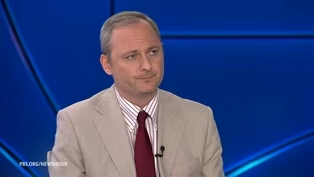
GEOFF BENNETT: We turn now to Dennis Sienik, the charge d'affaires of Ukraine to the U.S.
I spoke with him a short time ago and asked about the evidence Ukraine has that Washington is deliberately withholding intelligence with advance warning of the Russian missiles that hit Kyiv.
DENYS SIENIK, Ukrainian Deputy Ambassador to the United States: Well, nobody is talking about any deliberate actions.
What we are talking about is the mere fact that something has happened.
So, last week, we had situations when Ukraine did not receive early warning, and we informed about it our partners and wanted to establish the facts.
And then, unfortunately, it happened again.
And we just hope that the technology will work and all the data will be provided later on, so that in the future we will be able to be notified about the future attacks.
GEOFF BENNETT: And, specifically, as it relates to SpaceX's Starshield system that plays a critical role in Ukraine's military operations, including those interceptor drones and the longer-range strikes, President Zelensky said again today that access to that communication system has been restricted.
Again, what evidence do you have that that has been deliberate?
And do you believe that decision, if so, came from President Trump or Elon Musk, or both?
DENYS SIENIK: Well, our specialists can track literally live the speed of the connection that Starlink is working on and the Starshield technology.
And we can see that the speed that we used to have, which was unlimited speed, is no longer in place.
And we can see that, when we are launching our drones to intercept Russian drones, and when they reach the speed of more than 100 miles, then the system says there is a failure and the maximum speed has been exceeded.
GEOFF BENNETT: Does Ukraine believe the U.S.
is acting as an honest broker in these peace negotiations, or do you increasingly see Washington as a source of pressure, rather than protection?
DENYS SIENIK: Well, the fact that we speak on a daily basis with American team means that there is a clear desire to end the war, at least to start with the cease-fire.
That's our priority.
GEOFF BENNETT: When the president takes steps that effectively ease pressure on Russia and ramps up pressure on Ukraine, what message does that send to President Putin?
DENYS SIENIK: Our position has never changed since day one.
There must be additional pressure on Russia so that Russia stops this war.
So, any message that Putin will receive that sanctions may be lifted or restrictions may be lifted or there will be less pressure on Russia, that will incentivize his attacks and actually move him to escalate in order to achieve even greater objectives that he has on his mind.
We can see that the sanctions are working.
Russian economy is staggering.
The inflation rate, the consumption rate, the wealth fund in Russia has been depleted.
The only thing is that every time Russia is adjusting itself to the existing sanctions.
And that is why we are so actively advocating for putting more and more new sanctions, more pressure on Russia, so that it does not have the capability to adapt.
GEOFF BENNETT: There are reports that President Putin wants to discuss Ukraine's future with President Trump and China's leader without President Zelenskyy at the table.
Is Ukraine concerned that decisions about its future are being made or could be made without its consent?
DENYS SIENIK: Well, nothing about Ukraine without Ukraine.
And this has not changed.
I cannot imagine how it is possible to discuss, like, anything which is related to the war without my president being present at the table.
GEOFF BENNETT: What would you say to those Americans who believe the U.S.
has done enough to support Ukraine, and it's time for Ukraine to make some difficult compromises to end this war?
DENYS SIENIK: We are talking about our territory that we have been defending since 2014.
You fought fiercefully for your independence.
We are fighting fiercefully for our independence.
And we understand that, if you look into history, Russia will not stop.
And I really want to draw your attention to the situation in Oleshky in Kherson region.
About 2,000 people are trapped in that occupied town without access to food, to medicine.
Russian soldiers are taking food away from Ukrainians, do not allow any access to Ukrainian side, to our partners, to Red Cross to enter the that town and to provide medicine.
That's what Ukrainians are thinking about.
My message to the American people is just gratitude.
We are grateful for all the assistance that the United States has provided, that the U.S.
Congress has provided to Ukraine.
I am thrilled to see the Ukrainian flags flying in the streets.
As long as there is a conflict and aggression, he will do his best to stay in power.
In the contrary, he will have to focus on his domestic affairs.
And they are not doing great at all.
And that is why I have no doubt that Putin will continue doing what he is doing.
But I hope that we will be able to sit down at the negotiations table and finish this war.
GEOFF BENNETT: Charge D'affaires Denys Sienik, thank you for your time this evening.
We appreciate it.
DENYS SIENIK: Thank you.
GEOFF BENNETT: We start the day's other headlines in France.
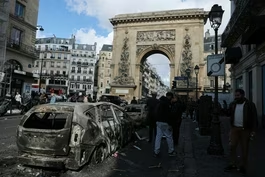
Curfews are in effect in parts of Paris and other cities, as authorities there try to restore order after widespread rioting this past weekend.
Government officials have acknowledged what they call failures in their handling of the unrest and say an investigation is under way to track down those responsible.
Special correspondent Ross Cullen reports now from Paris.
ROSS CULLEN: Violence flaring on the streets of cities across France, looting, arson, rioting, vandalism.
Over the weekend, the country suffered the worst unrest in years.
Shops were looted, tear gas and water cannon fired, blazes started in multiple cities.
More than 2,000 people were arrested as parts of some cities went out of control.
The French president, Emmanuel Macron, addressed the nation on Sunday.
EMMANUEL MACRON, French President (through translator): Yesterday, despite their professionalism, our law enforcement officers were subjected to extraordinary violence on several occasions in many cities.
ROSS CULLEN: This is the aftermath of that violence, debris still smoldering and the smell of burnt metal in the air, vehicles gutted after being set alight on the street, broken glass all over the sidewalks.
Well, this restaurant you can see behind me was one of at least three thousand businesses across the nation which were either damaged or ransacked during the violence over the weekend.
The unrest took hold after the mass nationwide protests on October the 17th.
More than 600,000 people took part in peaceful rallies across the country, a convergence of different protest movements demonstrating against high gas prices, rising inflation, and underinvestment in public services.
But the unrest that took hold after the demonstrations was unprecedented.
The French prime minister said he would use all necessary measures to restore order.
SEBASTIEN LECORNU, French Prime Minister (through translator): I know that a state of emergency is not a political tool.
It's a complex matter, including its implementation.
So, if it becomes necessary, of course we could do it.
Currently, curfews and their implementation seems more appropriate to the current situation.
ROSS CULLEN: Paris is one of the most visited cities in the world.
And, on Monday, tourists were caught up as a new protest blocked access to the Louvre Museum.
CHRIS VELENIK, Tourist From Pennsylvania: We hope that the governments can do better with the education.
I think that's important.
I think that's important everywhere, in our country too, in the United States.
So, I mean, there are legitimate complaints here.
And we have to take them seriously.
And if it inconveniences people, it's a shame.
But that's what has to happen, I guess.
ROSS CULLEN: The political ramifications are already widening just six months out from a presidential election.
The government blames the far left, which accused the police of brutality.
The far right says Macron's statement was a terrible confession of impotence.
And the Yellow Vest anti-government movement that is calling for lower fuel prices says it plans an act ii to its protests next weekend, so France may have to brace for further trouble ahead.
For the "PBS News Hour," I'm Ross Cullen in Paris.
GEOFF BENNETT: Also, today a federal judge clashed with Justice Department lawyers in the latest legal standoff over the fate of a Washington, D.C., golf course.
The judge is demanding details on who's responsible for the recent cutting down of hundreds of trees at the East Potomac Golf Links.
The government has argued that they were removed as part of routine maintenance.
But President Trump told reporters today that he's aiming to, as he put it, build a better golf course after posting on social media that the site would be closed for a 15-month renovation.
During today's hearing, the judge said -- quote -- "There is no universe in which all of this coincidentally happened all at the same time."
The U.S.
Supreme Court says it will review a Reconstruction era ban on home distilleries.
The justices will decide whether Congress had the authority to ban the practice back in the 1860s in an effort to prevent distillers from avoiding taxes.
The High Court will also revisit the issue of race and school admissions in a case involving Asian American parents and selective middle schools in Maryland.
It comes three years after the justices restricted affirmative action in higher education.
And the court rejected a bid by alleged 9/11 Mastermind Khalid Sheikh Mohammed to revive a plea deal the government later withdrew.
He and two accomplices are expected to stand for a military trial in the year 2028.
Israeli authorities say they have arrested at least 10 people in connection with recent settler attacks in the occupied West Bank, including on European diplomats and Washington Post photojournalist Heidi Levine.
Police released video today showing at least one suspect being arrested in a predawn operation.
Authorities have not identified the suspects, but Israel's army radio reports that all are Israeli citizens.
Meantime, Israeli settlers continued to move through Palestinian-owned olive groves today as local residents accuse Israeli forces of standing by, rather than intervening to protect them during the annual harvest.
MOHAMMED ABU RABEE, Resident of Deir Abu Mash'al, West Bank (through translator): I do not believe the army.
These people are one nation in two sides of one coin.
They are the same.
The settlers attack us when the Israeli army is here.
GEOFF BENNETT: U.S.
and European officials have condemned the violence.
Meantime, President Donald Trump has endorsed Israeli Prime Minister Benjamin Netanyahu's reelection bid, calling him a great warrior.
Mr.
Trump's support comes just over a week ahead of Israel's first elections since the October 7 Hamas-led attacks.
In Yemen, authorities say Houthi forces fired ballistic missiles at a military camp today, killing at least 53 soldiers and injuring 200 more.
Video published on social media shows the aftermath of the attack.
It was one of the deadliest strikes since a resurgence in fighting between the Iran-backed group and government forces this summer.
It comes a day after Houthi health officials say an airstrike by Saudi-led forces killed at least nine people in rebel-held territory in Yemen's north.
The Saudi government has not commented on that incident.
On Wall Street today, stocks ended mixed to start the week.
The Dow Jones industrial average slipped around 35 points.
The Nasdaq rallied more than 1 percent following last week's losses.
The S&P 500 also ended higher on the day.
And journalist Noah Adams, who hosted NPR's "All Things Considered" for nearly two decades, has died.
NOAH ADAMS, NPR News: This is special coverage from NPR News.
GEOFF BENNETT: To millions of radio listeners, Noah Adams was a steady, reassuring voice, guiding Americans through historic moments, from the fall of the Berlin Wall to the September 11 attacks.
But Adams also had a gift for telling quieter, more personal stories, capturing the lives and experiences of everyday Americans.
He wrote five books exploring subjects from the Wright Brothers to his own experience learning how to play the piano in his 50s.
His wife says Adams died at their home in Ohio on Friday.
Noah Adams was 84 years old.
Still to come on the "News Hour": our Politics Monday team looks at the most competitive races two weeks before Election Day; how a more sustainable aviation future may be electric; and the complexities of Black American life are placed front and center in a new multimedia exhibition.
In recent presidential elections, Ohio has become reliably Republican.
But, this year, the state is once again a major battleground.
The Cook Political Report rates both the governor's race and the U.S.
Senate contest as toss-ups.
Several congressional races are also competitive.
And with just two weeks until Election Day, Liz Landers reports on how national issues, especially concerns about affordability, are shaping voters' decisions in Ohio.
LIZ LANDERS: Youngstown, Ohio, was built on steel.
Today, abandoned factories still line stretches of the Mahoning River, a reminder of jobs that left decades ago and never fully came back.
RON GAY, Communications Workers of America: I was born right before the steel mill started to close, which was the late '70s.
And it's been rough to see the neighborhoods go down, to see the income of people go down, to see the overall quality of the city go down.
LIZ LANDERS: And the losses keep coming.
The summer, Youngstown bakery Schwebel shut down after 120 years.
In nearby B Boardman, AT&T is closing a call center that once employed hundreds of union workers.
A decade ago, Donald Trump won over working-class voters in Ohio by promising to bring jobs like these back.
This year, with Republicans in charge in Washington and in Columbus, they're the ones being asked to answer for it.
Chris Anderson, leads the Mahoning County Democratic Party.
CHRIS ANDERSON, Chair, Mahoning County Democratic Party: They promised that, on day one, they were going to tackle inflation and affordability, they were going to make everyone's lives better.
And I think you would be hard-pressed to find a single person who thinks that their life is better today than it was in 2024.
LIZ LANDERS: That argument now runs through two toss-up races.
One could decide control of the U.S.
Senate.
The other could give Ohio its first Democratic governor in 15 years.
FMR.
SEN.
SHERROD BROWN (D-OH): Ohioans don't have anyone in the Senate fighting for you until November.
LIZ LANDERS: In a region still waiting for its comeback, Sherrod Brown is attempting one of his own.
He won three Senate races here before losing two years ago.
His pitch?
Republicans made life more expensive.
FMR.
SEN.
SHERROD BROWN: Jon Husted stands with corporations, not with us, not with Ohioans, not with you.
And we all pay for it.
SEN.
JON HUSTED (R-OH): My team and I are here to serve you.
LIZ LANDERS: Republican Jon Husted, appointed to the seat last year, has his own story of the decline.
He says his father was laid off when the Ohio factory where he worked closed.
SEN.
JON HUSTED: And after 25 years of clocking in every day, he got laid off.
Husted says the answer is the tax cuts he voted for and that Brown had three decades to fix things.
NARRATOR: Thirty-two years in D.C.
is enough for Senator Brown.
LIZ LANDERS: But the war with Iran and the gas prices that came with it have tested even Trump's allies.
Last month, Husted broke with the president, saying the war needs to end so prices can come down.
At Trump's recent rally here, some supporters said they're willing to wait.
GERALD CARPENTER, Republican Voter: Gas prices affect me a bunch.
I own a pizza shop.
So, I have got delivery boys.
Everything that we -- cheese, flour, boxes, you name it, it can go up.
But I have been doing it for 31 years.
So it's not like there haven't been ripples in the past.
And I believe Trump's a man of his word that, if we get these gas prices under control, we get Iran under control, and I think gas prices will come down.
LIZ LANDERS: It's a similar fight in the governor's race.
VIVEK RAMASWAMY (R), Ohio Gubernatorial Candidate: Why is it that life feels so unaffordable?
LIZ LANDERS: Republican Vivek Ramaswamy, an entrepreneur and former presidential candidate, promises to roll back property taxes and eventually scrap the state income tax.
VIVEK RAMASWAMY: So this question on property taxes, this is probably the number one issue in the state that a governor can fix relatively immediately.
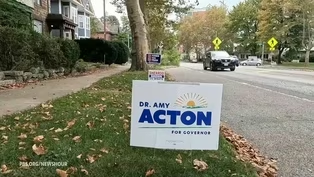
AMY ACTON (D), Ohio Gubernatorial Candidate: As governor, I will take on the corruption that's raising our costs, cut taxes for the middle class.
LIZ LANDERS: Democrat Amy Acton, who led the state Health Department early in the COVID pandemic, is proposing tax credits for working families.
She says Ramaswamy's tax cuts would come at the expense of schools and public safety.
AMY ACTON: My opponent says people are struggling because they're not working hard enough, because they're lazy and mediocre, which is not the Ohioans I know and that I have grown up with.
LIZ LANDERS: Early voting is already under way.
With control of the Senate up for grabs, many voters see a choice that reaches well beyond Ohio.
RHONDA LUETJE, Columbus, Ohio, Resident: I feel like, Trump's first term, he had some people surrounding him that acted as kind of bumpers for him that kept him in the lane, but this time he is completely unchecked, and the House and the Senate are also not checking him and, to some degree, the Supreme Court.
BOB THOMPSON, Mansfield, Ohio, Resident: I think that if we can keep everything red, after the midterms, he will do what he needs to do for the second half of his term.
LIZ LANDERS: Back in Youngstown, the stakes feel closer to home.
Just ask the region's AFL-CIO Labor Council.
LARRY FAUVRE, President, Mahoning and Trumbull AFL-CIO Labor Council: I have lived here all my life.
I have watched the good times.
I have watched the bad times.
And my family grew up here, and some of my family have moved away because there was no jobs here that they could do.
So hopefully we can bring it back.
LIZ LANDERS: Voters here have heard that promise before.
On Election Day, they will decide who to believe this time.
For the "PBS News Hour," I'm Liz Landers.
GEOFF BENNETT: A new poll puts President Trump's approval rating at a record low.
Meantime, the president is escalating his feud with Ukraine's president.
Our Politics Monday team is here to discuss that and more.
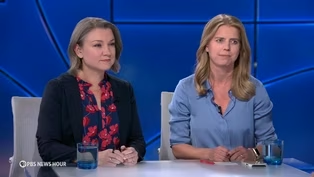
We have got Tamara Keith of NPR and Carrie Dann of The Cook Political Report With Amy Walter.
Amy Walter is away this evening.
It's great to see you both.
TAMARA KEITH, National Public Radio: Good to be here.
GEOFF BENNETT: So let's start with this latest new national poll.
You have got The Wall -- excuse me -- The Washington Post/ABC News/Ipsos poll.
It's putting President Trump's approval rating at just 33 percent, the lowest of either term.
And Democrats have an eight-point advantage heading into November.
So, Tam, how much of a liability is that for Republicans on the ballot?
I know you have some new reporting.
TAMARA KEITH: Yes, so back in September, President Trump held a dinner in the Rose Garden with about 30 Republicans in competitive races.
And, at that dinner, he promised he was going to go to all of their districts.
He was going to go to 35 competitive districts and help those members by just showing up.
Well, my analysis of his travel since that time is that he's gone to a fewer than a third of those districts, and instead he's gone to a lot of very red states and very red districts.
Part of that is because he's a liability in swing races, and part of that is that he loves the warm embrace of a rally in a place where they actually love him.
He claims he's going to say thank you.
But part of it is just that the map has shifted so that areas that we weren't even really talking about a few months ago are now considered competitive races.
GEOFF BENNETT: And, Carrie, where do you watching most closely to gauge where this election is headed and if all of this polling is actually true or accurate?
CARRIE DANN, Managing Editor, The Cook Political Report With Amy Walter: One of the numbers I found the most fascinating in that Washington Post poll was among Republicans.
And the way The Post broke it down was MAGA-affiliated Republicans and then Republicans who say, I affiliate as a Republican, but I'm not really into the MAGA movement.
Among MAGA Republicans, Donald Trump's approval rating is 94 percent.
Like, basically, all of those people are huge fans of the president.
But among that other group of Republicans who are not into the MAGA movement, he's barely breaking even.
Almost half of those voters disapprove of him.
And, to your point, I think one of the trickiest things that Republicans are trying to do is to tell those people, disaffected Republicans, hey, you got to hold your nose and show up in November and vote for a candidate, even if you're not crazy about the president, without deactivating that 94 percent approval rating among MAGA people, which is I think why he's going to these very red areas to juice every single one of those voters that he possibly can, while also quietly singling to other Republicans in the state, hey, you might not love the president right now, but you need to show up for your team.
GEOFF BENNETT: And, Tam, Democrats appear to have momentum, even in states -- as Liz just reported, states like Ohio, that have shifted toward Republicans in recent elections.
How do you interpret that?
TAMARA KEITH: Yes, Ohio is a fascinating state.
It is, according to AdImpact data, the most expensive state in that Senate race among all of the Senate races starting September 1 through Election Day.
Just truckloads of money are being dumped on that state.
What is fascinating about it is you really have, in some ways, two incumbents and then also two non-incumbents at the same time, because Jon Husted didn't win the seat.
He was appointed.
And a lot of people still think Sherrod Brown is a senator from Ohio.
GEOFF BENNETT: Well, let's shift our focus in the time that remains to Ukraine, because President Trump is escalating his confrontation with Ukrainian President Volodymyr Zelenskyy.
There's this dispute over access to important satellite communications that are used for the military there.
The president has blamed Ukraine for rising gas prices in this country.
What's driving the president's increasingly hostile posture toward Ukraine and its leader?
CARRIE DANN: Well, I think you justified that he's trying to draw a line between Ukraine and high gas prices.
I think it may be a little bit late to do that credibly with voters.
I think voters have drawn a very bright line between the Iran conflict and the high gas prices.
He may be trying to deflect that by talking about this other conflict.
But I looked back.
You mentioned AdImpact.
I looked at the ad spending around the issue of Ukraine and Russia this cycle, $2 million.
For Iran and gas prices, we're at like $80 million.
So, clearly, the politics of this are not that voters really care about this issue.
I think what he is trying to do is tie it to gas prices and tie the high gas prices to Joe Biden, instead of the decisions that his administration has made.
GEOFF BENNETT: How do you see it, based on your reporting?
TAMARA KEITH: Well, voters very clearly tie it to the Iran war.
Like, they draw that direct line.
The president certainly -- I have covered him for years.
He has often been looking for reasons to escalate or to fight with Zelenskyy.
This isn't really new.
This is certainly a new front in this, but he's often been feuding with Zelenskyy.
And so this is a moment where he is just throwing a lot of spaghetti against a lot of walls.
In this case, doing a deal or announcing that Russia will sell diesel to the United States, no one is expecting this to actually bring down diesel prices, but it speaks to the fact that the president is trying to show that he's working on this thing that is actually a very big problem for a lot of people.
GEOFF BENNETT: We have got one more topic, and we have got a minute left.
I'm going to see if I can fit this in, but here we go.
So President Trump, he is turning his attention to this public golf course in our own backyard here in Washington, D.C.
His administration wants to overhaul this historic East Potomac course.
It sparked a legal fight, as we reported earlier in the program.
Is the real story here less about a golf course and more about who gets to decide what happens to a public land?
CARRIE DANN: I think it's cumulatively.
I don't -- I'm not sure voters outside of D.C.
necessarily know very much about this issue, but I do think it speaks to the idea that he, in many of these cases, whether it's the Kennedy Center ballroom or the East Wing of the White House or this golf course, has blazed through benchmarks or guardrails against the things that he's trying to do.
That's, I think, a metaphor for a lot of things people feel about the president.
I don't know if it's a huge issue that resonates, but cumulatively he's also choosing to spend his time on this.
TAMARA KEITH: Yes, I mean, I think that we have seen in polls for months, and literally a text from one of the swing voters I check in with all the time earlier today, saying, why is the president focused on a golf course?
Why is he focused on beautification projects, when people are literally choosing between paying their heating bill and their grocery bill?
GEOFF BENNETT: Two terrific journalists and broadcast professionals.
We did it.
GEOFF BENNETT: Tamara Keith, Carrie Dann, thanks again.
TAMARA KEITH: You're welcome.
CARRIE DANN: Thanks.
GEOFF BENNETT: Electric aviation, or e-aviation, is still in its infancy infancy, but a growing number of companies are developing plans to bring electric aircraft into wider use.
And unlike its approach to other forms of electric transportation, the Trump administration has so far embraced the industry's expansion.
Our aviation correspondent, Miles O'Brien, became the first journalist to pilot one of these aircraft and reports on the promise and the challenges of this emerging technology.
MILES O'BRIEN: It wasn't very graceful, but that's me stepping into the future of aviation, a more sustainable future.
KYLE CLARK, Founder and CEO, BETA Technologies: As we get rolling on the runway, stay on the center line.
MILES O'BRIEN: The pilot in command is Kyle Clark, founder and CEO of BETA Technologies, a start-up focused on developing electric aircraft.
KYLE CLARK: Give it to me.
I will go off the center line, come back.
Just feel it out, because, when you land you're going to want to have that muscle memory.
MILES O'BRIEN: We taxied toward the runway, held short, and then it was suddenly silent.
It's just weird how quiet it is.
KYLE CLARK: I know.
MILES O'BRIEN: When the motor is all electric, it only turns when you need it.
KYLE CLARK: Three, two, one gentle back.
There we go.
And just feel that... MILES O'BRIEN: Yes, yes.
KYLE CLARK: Perfect.
And fly like you have got a glass of wine in your hand there, kind of.
MILES O'BRIEN: As we flew over Vermont's Green Mountains, Kyle gave me an update on the company he founded nine years ago here in his hometown, Burlington.
They are designing and building planes, batteries, and motors, marching through an FAA certification process that isn't plugged in to this kind of transformation.
What takes up most of your time?
KYLE CLARK: Regulatory.
It's the interpretation of the rules that were written for turbine aircraft applied to electric aircraft.
MILES O'BRIEN: Right.
KYLE CLARK: It's not an easy task to write a rule that's applicable.
MILES O'BRIEN: While the Trump administration has pulled back federal support for electric cars, it appears to be charged up about electric aviation.
In May of 2026, Transportation Secretary Sean Duffy flew with Kyle Clark in the plane we were in.
He also got some time in the electric vertical takeoff and landing, or eVTOL, version, and then gushed about it on social media.
SEAN DUFFY, U.S.
Transportation Secretary: People and products are going to move more efficiently, more cost-effectively.
KYLE CLARK: We burned $3.
SEAN DUFFY: Three fricking dollars on that flight.
SEAN DUFFY: This is not "The Jetsons."
This is actual real life.
MILES O'BRIEN: There is some real-life testing under way.
In June of 2025, the White House launched a program to accelerate the deployment of eVTOL operations in the United States.
The FAA has carved out some airspace for eight projects spanning 26 states.
Beta is among at least eight companies that will test-fly still uncertified electric and hybrid aircraft in demonstration missions, ranging from cargo delivery to passenger service, a three-year pilot program in more ways than one.
CHRIS ROCHELEAU, Former Deputy FAA Administrator: What we want to be able to do is make sure they're able to actively operate in the national airspace system.
That's something that we hadn't done before.
MILES O'BRIEN: Chris Rocheleau was the FAA deputy administrator when we spoke with him.
When do you think there will be electric vertical takeoff and landing air taxis flying in the United States with paying passengers?
CHRIS ROCHELEAU: I think we are right around the corner from certifying an aircraft.
We certainly have made it clear and the secretary of transportation and the administrator of the FAA has made it clear we will be operating commercially by L.A.
'28, by the Olympics.
MILES O'BRIEN: San Jose-based Archer Aviation is the official air taxi provider for the 2028 Olympic and Paralympic Games.
The company plans to carry as many as four paying passengers at a time on 10-to-20-minute flights across greater Los Angeles.
It will be an important P.R.
milestone.
But the Jetsonian vision of skies filled with air taxis has yet to arrive.
KYLE CLARK: I think we should go over to the battery line.
MILES O'BRIEN: Kyle Clark gave me a factory tour with a special focus on the bottleneck to practical, affordable electric flight, the batteries.
The plane we flew has 13,000 lithium-ion cells bundled into 55 modules, five times the energy of a Tesla Model 3.
But Clark says they exceed automotive and even FAA safety standards.
KYLE CLARK: We use advanced materials like carbon and titanium, aluminum.
Of course, it costs a little more to do it like this, but we also have twice the number of battery management systems in here and a whole lot more quality control coming in.
MILES O'BRIEN: BETA engineers are running batteries through accelerated life cycles to see how they perform over time.
They deliberately drop them, overheat them, and otherwise push them to failure, working toward a design that ensures even the worst-case scenario does not become catastrophic.
COO Sean Donovan earned his battery chops at Tesla.
SEAN DONOVAN, COO, BETA Technologies: E.V.s on the ground have pushed battery technology really far that have really enabled electric aviation.
MILES O'BRIEN: But batteries designed for electric vertical takeoff and landing aircraft must meet a challenge nothing in your garage will ever face.
They need to deliver very high power at the beginning and the end of their discharge time.
VENKAT VISWANATHAN, University of Michigan: That has -- it turned out to be the Achilles' heel for this industry.
MILES O'BRIEN: Venkat Viswanathan is a professor of aerospace engineering at the University of Michigan.
VENKAT VISWANATHAN: Batteries now have to deliver both energy and power.
This historically is very difficult for a battery.
MILES O'BRIEN: And the rules add to the difficulty.
The FAA requires an aircraft to have enough range to reach the destination, divert to an alternate, and fly another 45 minutes.
So, at the bottom of the ledger, what range can today's batteries truly deliver?
VENKAT VISWANATHAN: About five passengers, about 150 nautical miles.
MILES O'BRIEN: Is that a business?
VENKAT VISWANATHAN: I think there are certain use cases where that is certainly a business.
I think that it is still a challenge to be able to make this use case as an urban air taxi use case, right, which is what is imagined as the grand opportunity for these eVTOLs.
MILES O'BRIEN: Kyle Clark says BETA has built its business plan around both the current limitations and the expected progress of battery technology.
That's why the company is initially focusing on the fixed-wing aircraft we flew, first for cargo missions and later for passengers, while aggressively installing charging stations at airports nationwide.
Investors initially embraced the strategy.
BETA's November 2025 IPO raised about a billion dollars and valued the company at 7.4 billion.
But its shares have since fallen roughly 40 percent as the difficult road to certification continues.
So what's the big vision then?
KYLE CLARK: Built a bigger airplane and a bigger airplane or bigger plane, get up to 70, 150 passengers of an electric airplane.
And it's a two-decade vision.
But the path of batteries, the path of electric motors, material science says it's possible.
We're going to do it.
MILES O'BRIEN: The fixed-wing version of the ALIA has one electric motor.
Coupled with the fly-by-wire control, it was extremely responsive to my inputs.
The eVTOL ALIA has four additional motors to handle vertical flight.
No need to tilt propellers.
It's all part of an effort to reduce complexity and weight.
It's simple to fly.
But what goes up must come down.
KYLE CLARK: Nose down just a little bit.
OK, I have got the controls with you.
MILES O'BRIEN: OK.
KYLE CLARK: OK, we're going to -- oh, I got the controls.
(CROSSTALK) KYLE CLARK: Yes.
MILES O'BRIEN: Not my finest performance.
Apparently, my muscle memory is fading.
And I dropped the wine glass.
As we taxied to the charging station and plugged in, I found myself wishing I could try again.
For the "PBS News Hour," I'm Miles O'Brien in Burlington, Vermont.
GEOFF BENNETT: As cultural institutions across the country face growing pressure to avoid issues of race, a major new exhibition is confronting them head on.
The work of artist Arthur Jafa spans two floors of New York's New Museum and his largest exhibition to date.
Senior arts correspondent Jeffrey Brown met with Jafa for our arts and culture series, Canvas.
JEFFREY BROWN: Everywhere you look in Arthur Jafa new exhibition, one image is placed next to another, whether still or moving, each affecting the other, each changed by its proximity to the other.
ARTHUR JAFA, Artist and Filmmaker: This is the Big Bang, the beginning of the universe.
That image has never existed next to that image.
One picture here, another picture there, you put them next to each other, boom, we got something else.
JEFFREY BROWN: At New York's New Museum, the boom of Jafa's exhibition, titled I Am Tony, a reference to jazz drummer Tony Williams, extends over two floors.
Photographs and sculptures, wall plaques, and installations of cutout figures, music and soundscapes everywhere.
JEFFREY BROWN: Most of all, his films, including "Love Is the Message, The Message is Death" from 2016, a seven-minute montage or visual poem made from more than 100 video and archival clips, portraying the pain and joy, the hatred and celebration of Black life in America.
ARTHUR JAFA: I'm less interested increasingly in making work about Black people and more interested in making work like Black people.
JEFFREY BROWN: What does that mean?
ARTHUR JAFA: It means I'm not trying to declare anything about Black people.
I'm just trying to make things that in some way parallel or reflect the complexity of Black being or what a Black person, how a Black person might be understood.
JEFFREY BROWN: Jafa was born and raised in Mississippi.
He started out in the film world, notably a cinematographer on "Daughters of the Dust," the 1991 movie directed by his former wife, Julie Dash.
He would work with Spike Lee and Stanley Kubrick.
His turn to the art world came later.
He's always been a collector and creator of images.
Here, he's constructed a kind of maze of them that visitors can walk through.
ARTHUR JAFA: It's a different way to structure them, like you're moving through the relationship of images, as opposed to standing outside of them.
JEFFREY BROWN: Another display here, a series of photographic notebooks.
ARTHUR JAFA: Yes, I have just been fascinated with that.
All of my life, just I have been gatherer, a hoarder, maybe even of images and stuff.
I consume images, so I'm also interested in cooking, just to take the analogy.
JEFFREY BROWN: Cooking them?
ARTHUR JAFA: Yes, I mean, you know what I'm saying?
You -- if there's something you're interested in, you don't necessarily just want to consume it.
You want to produce it as well.
JEFFREY BROWN: His art films can be quick-cut still images, as in "SloPEX," playing in the room where we talked, or extended scenes, as in "The White Album," another meditation on race and racial attitudes.
"Akingdoncomethas" is an hour-45-minute portrait of the Black church with sermons and singing, while "Aghdra" is a computer-generated ocean, lava-like, accompanied by a soundtrack of slowed-down soul music.
ARTHUR JAFA: A lot of it is just leaning into an aspect of moving images that I think is musical.
JEFFREY BROWN: Music, culture, history, the full variety of lived Black experience and all its complexities, as in one of Jafa's newest works, "M.J.," for Michael Jackson, the mesmerizing performer, the troubled individual.
There's the moment in "Love Is the Message, The Message is Death" where a woman says, what would America be if it loved Black people as much as it loves Black culture?
So you are looking at the both the beauty and the violence.
ARTHUR JAFA: Yes.
Sometimes, I say we like the canary in the mine shaft, a Western civilization, but the mine shaft is an incredible place to be.
Black culture exists in a perpetual state of emergency.
And I mean that in both senses of it, like crisis and the pressure of crisis, but also constantly emerging, constantly coming up with new things.
And that coming up with new things, this sort of inventiveness, the improvisation, all that, it is -- and it's strictly bound up with the pressure of Black life.
You can't separate the two.
JEFFREY BROWN: And you're capturing that in these films.
ARTHUR JAFA: I'm capturing it.
I'm trying to -- like I said, I'm trying to make a thing that's like it, that is modeled on in some kind of way, so is a rich enough proxy of the actual thing, you know?
JEFFREY BROWN: You have said many times you don't think of yourself as a protest artist or... ARTHUR JAFA: I'm definitely not.
JEFFREY BROWN: Yes.
So it's not a political artist.
This isn't -- it's not... ARTHUR JAFA: It's not, not political either.
If you make a rendering of a Black anything, Black child, Black grandmother, it's going to be inherently political just because this is an anti-Black environment, but it doesn't mean that's necessarily what your motivations are.
It's like we exist, we continue to exist, we have a very complex relationship with our continued existence, and we recognize that other people have a complex relationship with our continued existence.
So they say you make art about what you know, and this is what we know, so I'm trying to make art about what I know.
JEFFREY BROWN: Arthur Jafa's exhibition I Am Tony continues through January 3.
For the "PBS News Hour," I'm Jeffrey Brown at the New Museum in New York.
GEOFF BENNETT: Social media has become the main way we share our lives with family, friends, and strangers alike.
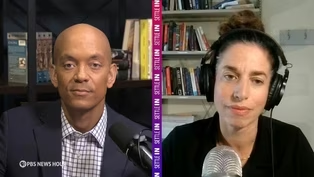
In this week's episode of "Settle In," I spoke with Kathryn Jezer-Morton, author of the new book "The Story of Your Life" about how the incentives of social media platforms have narrowed the kinds of stories we tell and shapes how we see ourselves.
You write about what you call the redemption narrative, the pressure to turn whatever difficulty one is going through into this story of personal growth or triumph.
Why are we so drawn to that?
KATHRYN JEZER-MORTON, Author: You know, I think that's something that is really at the core of American identity.
I mean, I think that the project of the United States was sort of built on this idea of starting something in a new place and overcoming the odds in order to make it work.
And I think that's the story of capitalism.
It's the story of economic progress as we know it today.
So, to me, this is just an extension of that.
But it's just not the only story.
And I do think it makes sense to tell a story about redemption when you're talking about a business, when you're talking about an enterprise.
I think it makes less sense to lean on that narrative when you're talking about a family or an individual, just because a family's life is always going to have ups and downs.
GEOFF BENNETT: There's something almost radical these days about saying, yes, this experience was difficult, and it didn't necessarily make me a better person.
GEOFF BENNETT: It was just something I had to go through.
KATHRYN JEZER-MORTON: Yes, right.
That's right.
That's -- to kind of just let it land on that kind of unresolved note is really dissonant, I think, to the contemporary ear.
People want to hear a resolution.
They want to hear the takeaways, what I learned from.
And this is really, I think, a product of this narrative orientation that we have towards redemption.
Make it better.
Learn something from your troubles.
And I just don't believe that that's always the path that we take.
And the people that I spoke to in this book really reinforced that idea for me that it's not always just better and better and better.
GEOFF BENNETT: Well, say more about the people with whom you spoke for the book and how you determined who you would speak with and what stories you would include.
KATHRYN JEZER-MORTON: Yes, I mean, it really just started leaving my bubble, trying to find strangers.
I joined like Meetup.com groups, just any place where I could go where I would be able to talk to strangers without making people uncomfortable.
I went on Facebook and community groups, and I asked if I could talk to people.
I really just kind of tried everything.
And I just spoke to a lot of different kinds of people, mostly millennials, I would say.
And I heard a lot of stories.
Basically, if someone told me a story that really stuck in my head, I would be like, I'm going to build a chapter around this, and then I would find other stories, and I would just kind of put them together.
But I kind of let the data lead the way, and I was just looking for people to surprise me.
And it was not hard to find people to surprise me, I have to say.
It was a lot easier than I thought it was going to be.
GEOFF BENNETT: One of the real paradoxes you identify in your book is that social media promises individuality and self-expression, but actually produces an enormous amount of conformity.
What did you find when you were sort of researching and stitching together that part of your book?
KATHRYN JEZER-MORTON: Yes, I call it like a small-C conservatism.
People want to replicate ways of being that they have already seen, which is a fundamentally conservative orientation.
Like, I want it to be the traditional way.
And I think a lot of that is just because people -- not everyone is like a natural-born storyteller with a huge creative well of ideas, and they just figure, hey, that looked cool, I'm going to do it that way.
So, I mean, that's just a basic human orientation.
But I also just think that we -- this is now our version of success.
When we see someone taking a cool-looking vacation, we're like, that's what success is.
I want to do that.
If I'm able to do that, I will have succeeded.
And so, yes, it does sort of funnel us into these ways of telling our story that are really, really similar to each other.
GEOFF BENNETT: And you can watch all episodes of "Settle In" on our YouTube page or wherever you get your podcasts.
Some sad news now for all of us here at the "PBS News Hour."
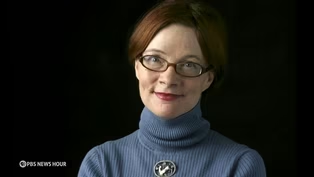
Film critic Ann Hornaday has died.
As chief film critic for The Washington Post, she was a respected and passionate voice in the world of cinema.
She was also a longtime regular on this program, sharing her love of film with our viewers.
Senior arts correspondent Jeffrey Brown is back now with a remembrance.
ANN HORNADAY, Film Critic, The Washington Post: I mean, this has been such a great year for first-time filmmakers.
JEFFREY BROWN: Sometimes, it was the excitement of a creative new voice.
ANN HORNADAY: And one of them is this woman named Celine Song.
JEFFREY BROWN: Sometimes the thrill of watching how a director makes decisions.
ANN HORNADAY: It's just a superb exercise in restraint on almost every level, written and directed by Tom McCarthy, who's just a fantastic filmmaker, and just his choices throughout this film are at spot on in terms of never really putting too much spin on the ball.
JEFFREY BROWN: Often, it was the sheer joy of movies.
ANN HORNADAY: Listen, I will tell you something.
My number one movie of the year was "Top Gun: Maverick."
And I was utterly disarmed almost immediately.
Those elbows that had been sharply out collapsed.
And it was just so much fun to see it, and the audience was having such a good time.
JEFFREY BROWN: Ann Hornaday was one of the nation's leading film critics, a finalist for the Pulitzer Prize for Criticism in 2008.
She also regularly shared her views with us on the "News Hour."
Marty Baron, then-executive editor at The Post, characterized her work this way: MARTY BARON, Former Executive Editor, The Washington Post: She writes with great intellect.
She always writes with great heart.
JEFFREY BROWN: And she loved sharing her passion with young people.
She met Benjamin Price when he was just six and encouraged his love of movies.
Today, he studies film in college and is interning with a studio.
ANN HORNADAY: And so what I have done with the book, I hope, is to guide readers through my process in evaluating a movie as a professional critic.
JEFFREY BROWN: The way you think about it as a critic.
ANN HORNADAY: Exactly.
JEFFREY BROWN: Hornaday's 2017 book, "Talking Pictures," offered stories and tips for the rest of us on how to watch and talk about movies.
ANN HORNADAY: Well, I have actually learned to watch movies sort of on the job, and in many cases that means through my interviews with filmmakers like writers and directors and actors and different craftspeople, and they have really taught me a great deal about this medium and how to appreciate it.
ACTOR: Woodward, Bernstein, you're both on the story now.
JEFFREY BROWN: She was at work on a book about one of her favorite films, "All the President's Men."
But after leaving The Post last year, she was diagnosed with glioblastoma.
She died today.
Ann Hornaday was 66 years old.
For the "PBS News Hour," I'm Jeffrey Brown.
GEOFF BENNETT: And our thoughts go out to Ann's family and friends.
And that is the "News Hour" for tonight.
I'm Geoff Bennett.
For all of us here at the "PBS News Hour," thanks for spending part of your evening with us.
 New
Arthur Jafa explores complexities of Black American life
Video has Closed Captions
Arthur Jafa explores complexities of Black American life in new exhibition (6m 27s)
 New
E-aviation takes off as companies seek new era of flight
Video has Closed Captions
Electric aviation takes off as companies seek new era of flight (8m 33s)
 New
French authorities impose curfews after weekend rioting
Video has Closed Captions
French authorities impose curfews after weekend rioting (3m 31s)
 New
Kathryn Jezer-Morton joins Geoff Bennett on On 'Settle In'
Video has Closed Captions
On 'Settle In,' Kathryn Jezer-Morton and Geoff Bennett discuss social media's impact (4m 38s)
 New
News Wrap: Judge clashes with DOJ over D.C. golf course
Video has Closed Captions
News Wrap: Federal judge clashes with DOJ over D.C. golf course (4m 31s)
 New
Ohio becomes midterm battleground after years of GOP wins
Video has Closed Captions
Ohio becomes midterm battleground after years of Republican wins (5m 19s)
 New
Remembering film critic and News Hour regular Ann Hornaday
Video has Closed Captions
Remembering Ann Hornaday, film critic and News Hour regular (2m 33s)
 New
Tamara Keith and Carrie Dann on Trump's record-low approval
Video has Closed Captions
Tamara Keith and Carrie Dann on Trump's approval rating hitting a record low (6m 46s)
 New
Trump escalates Zelenskyy feud as Russia continues attacks
Video has Closed Captions
Trump escalates clash with Zelenskyy as Russia continues deadly attacks on Ukraine (3m 22s)
 New
U.S. must pressure Putin to end war, Ukrainian official says
Video has Closed Captions
U.S. must put pressure on Russia so Putin ends the war, Ukrainian official says (6m 37s)
Providing Support for PBS.org
Learn Moreabout PBS online sponsorship New Episode
- News and Public Affairs

Today's top journalists discuss Washington's current political events and public affairs.

- News and Public Affairs

FRONTLINE is investigative journalism that questions, explains and changes our world.
 New Episode
 New Episode
 New Episode
 New Episode



 New Episode
 New Episode


 New Episode
Support for PBS provided by:
Major corporate funding for the PBS News Hour is provided by BDO, BNSF, Consumer Cellular, American Cruise Lines, and Raymond James. Funding for the PBS NewsHour Weekend is provided by...