Utah Insight
Transgender Rights and Resources
Season 5 Episode 6 | 26m 25sVideo has Closed Captions
With access to gender-affirming care being limited, how are Utahns affected?
Transgender issues in sports and health care has been a growing topic. How will continued anti-trans legislation affect Utah communities and the rights we hold? Learn from our panel of experts as we discuss this complicated matter.
Problems playing video? | Closed Captioning Feedback
Problems playing video? | Closed Captioning Feedback
Utah Insight is a local public television program presented by PBS Utah
Utah Insight
Transgender Rights and Resources
Season 5 Episode 6 | 26m 25sVideo has Closed Captions
Transgender issues in sports and health care has been a growing topic. How will continued anti-trans legislation affect Utah communities and the rights we hold? Learn from our panel of experts as we discuss this complicated matter.
Problems playing video? | Closed Captioning Feedback
How to Watch Utah Insight
Utah Insight is available to stream on pbs.org and the free PBS App, available on iPhone, Apple TV, Android TV, Android smartphones, Amazon Fire TV, Amazon Fire Tablet, Roku, Samsung Smart TV, and Vizio.
All Episodes Now Streaming
Hosted by Jason Perry, each week’s guests feature Utah’s top journalists, lawmakers and policy experts.Providing Support for PBS.org
Learn Moreabout PBS online sponsorship(light music) - [Announcer] Funding for "Utah Insight" is made possible by viewers like you.
Thank you.
- [Raeann] Coming up on "Utah Insight."
- I think it's important just to see representation of yourself.
- [Raeann] Breaking barriers, Utah's transgender community finds hope and support through a growing network of resources.
- We need our allies to be fierce and loud so that we know that we're not alone in this.
- From mental health care to advocacy groups, we explore the strides being made to provide inclusive services in the beehive state.
(upbeat music) Welcome to "Utah Insight."
I'm Raeann Christensen.
For the first time ever, the Human Rights Campaign has declared a national state of emergency for LGBTQ+ Americans due to a rise in anti-LGBTQ+ legislation.
The Human Rights Campaign reports 75 bills across the US have been signed into law this year, more than doubling last year's record.
Many of those laws have been directed at transgender people here in Utah, both this year and in years past.
They include bans on transgender healthcare, anti-transgender bathroom bills, restricting transgender student athletes, and banning birth certificate modifications.
In Utah right now an estimated 2,100 Utahans between the ages of 13 and 17, and about 14,000 Utah adults are transgender.
And joining us for this important conversation in the studio, Dr. Collin Kuhn, a Clinical Child and Adolescent Psychologist, Nick Arteaga, Transgender Rights Strategist with ACLU of Utah, and Olivia Jaramillo, Public Outreach Director for Equality Utah.
Thanks so much for being here.
We have a lot to cover today.
I do wanna start off with gender-affirming care, and Utah is one of 22 states right now that have bans on gender-affirming care for youth.
SB 16 was passed by the Utah legislature and signed by Governor Cox in 2023.
There are some exceptions allowing care to continue for minors who were already receiving treatment.
Gender-affirming care can include hormones, puberty blockers, surgeries, counseling, and mental health, just to name a few.
So I wanna start, there's a lot of confusion right now about what is and what isn't allowed, who can receive the treatment.
Dr. Kuhn, can you give us just a rundown to kind of clear it up so people will understand?
- Sure, absolutely.
There is a lot of confusion.
So when SB 16 passed on January 28th, 2023, when Governor Cox signed that into law, that effectively made it so any kid who did not have a diagnosis of gender dysphoria at that point, would no longer have access to any kind of transgender healthcare, not including the mental health.
Mental health is separate.
So talking about hormone, blockers, surgeries, things like that.
And where we had, as you had mentioned, some of the kids being grandfathered in, if they did have a diagnosis of gender dysphoria, they were grandfathered in.
But part of what SB 16 did was create what Utah's calling a transgender treatment certification.
So any therapist who wants to have this certification has to complete 40 hours of CEUs in accordance with their licensing laws, licensure laws that are specific to transgender healthcare and minors.
If they attended a conference that's for transgender healthcare of adults, it doesn't count.
So once those kids who are grandfathered in reach the point where they're at maybe getting blockers or hormones, they then the next step now have to be evaluated by a therapist who holds this transgender treatment certification.
They have to have at least three sessions and then they can go on to get their blockers or hormones if that therapist agrees.
- Okay, that's some good information to know.
Thanks for clearing that up.
Olivia, how do you think the ban on gender-affirming care in Utah affects the mental, the physical health of transgender individuals, particularly our youth?
- Yeah, thank you.
That's a really good question, and it's a question that we really worked through with legislators, and we wanted to ensure when that bill passed, we wanted to ensure that there was still a pathway for care, more specifically, like Dr. Kuhn referred to, to mental health.
It is imperative that that treatment still continues because regardless of whether hormone therapies or puberty blockers are allowed, the diagnosis is still there.
And that is something that still must actively be treated, especially from a mental health aspect, it's something that permeates through all of society that affects our youth, that affects transgender adults.
We're specifically talking about that issue.
So it affects everybody and it affects them everywhere that they go.
- Okay, and Nick, in the absence of gender-affirming care for youth, I know there's mental health.
What support systems can be put in place to help these children?
- Oh my gosh, that's a really good question.
I mean, I'm not a trans youth, but as a trans adult, I mean, I'm still facing barriers that are a consequence of these bills being passed, which is really wild.
So the implications and the negative impacts are far and wide even outside of the trans youth.
But the people that care for them, the people that are serving them, the people that are in community with them, the resources that are available, I guess like human connection, empathy, I mean, they're children, they're people.
They need to know that they're supported and that they're loved and that they're cared for.
And unfortunately, the rhetoric and the language that we see in these bills really indicate something different.
And so, yes, it is negatively impacting their health, all aspects of it.
And so I think just showing up in ways that we can, letting them know that they're loved, cared for, and supported, of course, within our capacity as well, but I think those fundamental things are kind of being erased when we see these news articles or we see these updates, or we see these bills passing.
I think it unfortunately takes a really heavy toll.
So being able to undermine that or even supersede that with love, care, and affection, I think is super important.
I wish I had more tangible resources jumping to mind, but I think that's always the most important and something that I hope that we're all capable of that will make a really, really big difference.
- And speaking of that harmful rhetoric, Dr. Kuhn, as lawmakers discuss these bills, it often does seem like there is some harmful talk that happens.
What steps can be taken to ensure that the public discussions about transgender issues are evidence-based, respectful, not something that's going to harm the youth?
- That's a tough one.
So, I think trying to have conversations where we're using research from peer-reviewed journals, right?
Looking at research, for example, Dr. Kristina Olson and the Human Diversity Lab, she's out of Princeton, she's got her research.
Most of it is on the website that you can find that.
And I think if we seek to understand rather than to be understood, that's gonna create that respect that we need to have the dialogue.
Because at the end of the day, I think we're all on the same page.
We want the same thing.
We want to protect our most vulnerable youth, period.
I think we can all agree on that.
We have different ideas of how to do that, but I think the more that I can understand somebody's position that might be different than mine, the closer we're going to come to some agreement.
And I think that's what can really help make sure that those conversations are productive.
- That's really good advice.
Do you have something?
- Well, and we were actually talking about this.
We feel we're hopeful that with Utah, it is a unique state and we're in a very unique position to do it.
There has been, regardless of these bills being passed, there has been a lot of effort to find common ground on how to move forward, how to ensure that even transgender youth still have access to mental healthcare.
Even we saw it this year with the bathroom bill.
We saw that there was an effort made to ensure that we still cared for the transgender youth, for transgender adults as human beings.
And that there is a genuine effect there, and that we are in a unique position as Utah for 10 years now, we've been building towards a legal equality in the state that has been like no other in any other conservative state.
So we have to remain hopeful that we can move forward.
- Okay.
In 2023, a poll conducted by The Trevor Project revealed a clear connection between anti-trans legislation and the mental health challenges faced by transgender and non-binary youth.
86% of respondents say debates around anti-trans bills have negatively impacted their mental health.
45% of trans youth reported experiencing cyber bullying and nearly one in three reported not feeling safe to go to the doctor or hospital when they are feeling sick or injured.
And back to the bathroom bill, I know there's a lot of confusion around that as well.
The bathroom bill restricts transgender individuals from using bathrooms and locker rooms that align with their gender identity and publicly-owned and controlled buildings such as public schools, the Utah Capitol, and city and county buildings.
Nick, this bill went through several different revisions before it finally passed.
So can you kind of run us through where it stands now?
What's going on?
I know there's a lot of confusion.
- Yeah, there are a lot of changes that it made, but just again, to some of the points we made earlier, the impact of the initial draft of the bill is still being felt within the community.
But essentially, my understanding of the bill, because I'm not a lawyer, is that if somebody were to feel panic or unsafe because they think you're using the bathroom that doesn't match your birth certificate, essentially, security should come down and check out the situation.
But it is really strange.
It's forcing people to surveil each other and to, generally, when I go into the restroom, it's just to do things that I need to do, not really to report on who's in there and what I think is going on and where I think they should be.
Unfortunately, this bill is kind of enforcing people to do that.
And I think that, yeah, I've never carried around documents with me.
I don't have my birth certificate with me on hand.
I have to use the restroom more often than I think about it.
And so the implications of this bill as it stands is that yeah, people are afraid to go out into public spaces.
They're not being social, they're not getting the support that they need.
Their basic human needs are not being met as a result.
The statistics that you just shared were really alarming, people not getting care when they're medically required to or injured is very scary.
So even if people don't work in government-owned buildings, there's still an impact where people are just afraid to leave their houses in general.
But if anybody wants to add onto that.
- Yeah, oh, go ahead.
- Well, and it's very true, and one of the big things that came out of this bill is we still see a lot of misconceptions of what the bill actually impacts and what it doesn't impact.
This bill primarily impacts K-12, some higher education, but specifically it does restrict restroom usage.
But in any other facilities, for example, in government-owned buildings, it restricts using changing rooms or lockers, but it does not restrict transgender people from using a restroom.
And in the private sector, one of the things about this bill is that there are no restrictions.
Transgender people can use whatever restroom they align with, that they choose to use.
And we still see that there is some misconception to that.
So we're very thankful that we get opportunities where we're able to talk about it.
- And one thing that I would add to that, I let all of the kiddos that I work with make sure that they're aware of is that with HB 257, part of that reporting if the somebody's feeling unsafe in the bathroom because they feel like somebody's there that shouldn't be, is that that child who feels unsafe doesn't have the right to approach the child that they believe shouldn't be there.
Their avenue is to go to the principal and the adults then can try to figure out what next steps need to be taken.
In terms of like restrooms when the kids are out public spaces, you know, one of the categories on Yelp is you can choose your filter of restaurants and things like that that have gender neutral bathrooms.
So you can find another place that you wanna support that is gonna be affirming to you.
- [Raeann] That's really good advice.
- And even in working with legislators, the sponsors of this bill, we were able to work and find a common ground to ensure that there is an understanding that we're not sticking to criminally punish anybody, that we're seeking to protect a certain group.
And at the same time, hopefully in the future, we can work towards really understanding these issues more specifically pertaining to trans community.
- Okay.
The Biden administration recently expanded Title IX protections to require schools to allow transgender students to use bathrooms and locker rooms that align with their gendered identity.
However, Utah legislators voted last week to reject those expanded protections.
PBS Utah's Cailley Chella was at that special session and has more.
- [Cailley] Utah legislators voted to ignore new federal protections for transgender students last Wednesday.
The new protections come from an expansion of Title IX to include gender identity.
- They've unilaterally taken action that has put their directives in conflict with existing state law.
- [Cailley] Representative Neil Walter says, those state laws are HB 11 and HB 257, the 2022 Transgender Sports Bill and the 2024 Transgender Bathroom Bill.
Supporters say these bills protect women.
- Women for years fought for a seat at the table, and again, fought to have sports and protections under the law to be treated equally as females.
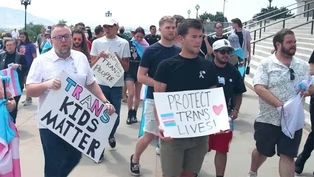
- [Cailley] Meanwhile, outside, activists protested the vote.
- It's quite ironic to them, see that they are now insisting after all these years of removing such funding for feminist-led initiatives, that they are now somehow protecting cis women.
I think the people of the state are not fooled, we know that's just rhetoric.
- [Cailley] Title IX has offered protection from sex-based discrimination since 1972.
The expansion of it that the Utah legislature voted to ignore would require public schools to allow transgender students to use facilities that align with their gender identity.
- When trans lives are under attack, what do we do?
- [Crowd] Stand up, fight back!
- [Ermiya] Being able to have that kind of protection is very vital for trans kids who experience higher rates of sexual violence, higher rates of harassment.
So for the governor to ultimately decide to remove that layer of protection sends a huge message that he does not care about the trans kids of the state.
- Earlier this year, lawmakers passed the Utah Constitutional Sovereignty Act, which means that the legislature can basically ignore any federal rules that they think are unconstitutional unless a court orders them to comply.
- Aren't these kids just as worthy of health, safety, and wellbeing?
These are the kids that we are trying to fight against right now that we are doing battle with the federal government on?
- [Cailley] This marks the first time that Utah lawmakers have used the new law to bypass federal regulations.
The final vote to ignore the new federal protections passed mostly on party lines with only one Republican lawmaker joining all Democrats in opposition.
For PBS Utah, I'm Cailley Chella reporting.
- Okay, Dr. Kuhn, you had talked to me a little bit about these birth certificate amendments that are not being allowed in Utah, the Transgender Sports Ban Bill, you're seeing a lot of these children coming to your office and are affected by this.
And now we've got the state joining a lawsuit against Title IX protections.
Can you give us some advice on what these children might be able to do?
- Oh my gosh.
It's just so difficult, right?
There's so many aspects there.
You know, at least when SB 93 passed, at 15 and a half, kids can start the process to get their name and gender marker changed so that by the time they get their license, they'll be able to have the name that's appropriate for them.
And so for some of these kids, we can also get their name changed prior to 15 and a half.
We can't get the gender marker changed, but I'll encourage them because they're in classrooms and they're sitting there trying to take standardized tests and their legal name is on the screen.
Other people can see that and that outs them.
And that is really then just increasing the risk of the harassment and the bullying.
- And I know this targets people that are already high risk for suicidality.
Olivia, can you talk a little bit about that?
It's just important for parents maybe to get them into mental health support, get them into support groups.
What advice can you give?
- Oh, absolutely.
We advise that you seek the mental health protections that we are able to access in the state.
And one of the surprising things that was found in a study recently that we presented as well last week during the Health and Human Services Interim Committee at the legislature, right before they put this to a vote, we talked about the effect that has caused that that has come from some of these bills and the way that they make the transgender community feel specifically, one of our biggest finding that we found there is that it's not just the transgender person, the youth going through this, it's also their family that suffers from this.
One of the big things that this study found is that the family's mental health also tended to get worse.
So this isn't just affecting the transgender child or that transgender person, it's affecting the entire family unit.
So that is something that I really hope we're able to continue letting them know that they must seek mental health support, create a good support system around themselves, and see themselves that we're actively, there's organizations like Equality Utah, the ACLU, they're continuously going up to fight for their rights, for their protections.
- Okay, we do have some positive news, every year on March 31st, the streets of Salt Lake City are adorned with the vibrant hues of the transgender pride flag.
It's the International Transgender Day of Visibility, a day dedicated to celebrating transgender and non-binary individuals.
- I think it's important just to see representation of yourself.
Growing up in southeast Idaho as a Black queer person was already hard.
And then adding trans to it was a little bit harder of a acceptance.
And so we're here to show that people are here living their lives, living their lives, and also that you see people that are a part of your community.
- Transgender Day of Visibility started back in 2009 to honor transgender people and raise awareness of the discrimination they face while celebrating their contributions to society.
In 2021, President Joe Biden formally proclaimed the day as International Transgender Day of Visibility urging Americans to support full equality for all transgender people.
And we do know that speaking of allies in March, the Salt Lake City Council also voted to declare March 31st as an International Transgender Day of Visibility.
Nick, I know you were there.
So what does this day mean to you and to possibly all the other youth and adults that identify as transgender?
- Yeah, I think it's a really important day.
I love that we have a specific day every single year that we can look forward to.
But what I've intentionally tried to do is at ACLU of Utah purchase a 10 by 15 foot transgender flag so we could hang it at the city county building.
So we have a great relationship with the mayor's office who's allowed us to literally bring visibility to the city and leave it flying for a few days, so folks can come and take a look, maybe take pictures or just hopefully just be reminded, you know, that they are cared for.
Even if we don't know each other personally, that there are people like these fine folks who are fighting for their protections in different avenues and capacities in which we can.
And it's because our youth matter, because trans people matter because human rights should belong to everybody and everybody should have access to them.
And so, yeah, I think it's very important and it's a pleasure to be able to host that event and to work so closely with our government officials to make that happen.
And so it's just a sense of pride and joy for me in the work that I do.
And yeah, I hope other people are seeing it and enjoying it as well.
- Yeah, and I was just gonna add on there too, with TDOV, it really allows us to show resiliency and the research is really clear around resiliency.
And the more that we can build that community belonging and identity pride, and be the role model, see role models, representation, that does wonders to increase and boost mental health for kids.
So it's a really great opportunity for those of us who are privileged to be able to be out and public about that, to be there and represent.
- And we heard Sammee say that it was important to see representation of yourself, Olivia, why is that important for our transgender youth to see people that are like them?
- It matters, and I'll take an example, in our family units, we see our parents go on to certain professions, certain careers, and we tend to try to imitate what they're doing or something similar, maybe something lateral, maybe sometimes we don't.
But it's the same with being a visible person in this community that when you see somebody that is an adult, a professional and thriving, it gives you the hope that there is a life to live and that there are people that will be supportive, that will be understanding most of all.
That is the biggest effect for me.
- Okay, we had a conversation on the phone and you said you wanted to talk about how we normalize the transgender community.
Can you kind of give us your thoughts on, that's really, it seems like it might be a hard thing to do, but how do we get there?
- I do remember that phone call.
And it's so important to talk to trans people about more than trans issues.
It starts to create the effect that we all know trans people, that we start seeing different facets of who we are.
You start seeing that we have different professions, we have children, we have families, some of us have served in the military.
You get to learn of the whole person concept, not just whatever you know of that person.
It's so important that we start talking to trans people about more than trans issues.
- Okay.
And we have about 30 seconds, I wanna get, 30 seconds for each of you for final thoughts.
And I just wanna know if you guys could give some advice to maybe some of the transgender youth that are watching, give them some sort of hope, identify with them, Dr. Kuhn.
- Yes, for sure.
So I think, like Olivia was saying, that representation, trans being trans, it's just part of who we are.
It's just part of who I am.
There are all of these other things.
And so letting the kids see that with the representation that you can be trans and still be referred to as a doctor, right?
You can do anything that you want.
Nothing changes.
It's just part of who we are.
- Just human.
- Yeah.
- Okay, Nick.
- Yeah, I didn't choose to be trans, but I love it.
And yeah, I'm proud of that.
But it did take a really long time to get here, so I think it's great for folks to see people being genuine and honest about who they are and not allowing their transness to feel like a barrier even though it can be sometimes, but to also feel elated and feel joy in some of the things that we can't control, that some people want to villainize.
And so just keep on going.
There are more of us out there, and yeah, statistically this is, I feel like I'm very privileged and lucky to be here.
And so I just want folks to know that I recognize that and also want to do what I can to propel our youth to get to where we are.
- Okay, Olivia?
- Well, thank you so much for having us and thank you for bringing this conversation.
It's so important that we talk about it and I wanna direct my comments towards everybody, towards the people that are not transgender.
You may think you don't know a trans person, but you probably do.
And more than likely, you have a really good connection with them.
I encourage people to really get to know us on a deeper level than just who we are as trans people.
I think that is really the way to move forward and the way to move forward is together.
- Okay, I love that.
Thank you, that was good.
So we are out of time now and I wanna just thank you all for being here.
I know we could probably go on for quite some time and it's a complex issue for sure.
So next time on "Utah Insight," politics on college campuses.
What do you think should be considered free speech about Utah politics on campuses?
We do wanna hear from you.
You can use those methods that you see on your screen.
We have social media, email, you can give us a call.
And we wanna thank you so much for watching "Utah Insight" and we will see you back here next week.
(light upbeat music)
Utah Legislature Rejects Title IX Expansion
Video has Closed Captions
Clip: S5 Ep6 | 2m 14s | Learn how Utah lawmakers are planning to bypass a federal expansion of Title IX. (2m 14s)
Providing Support for PBS.org
Learn Moreabout PBS online sponsorship
- News and Public Affairs

Top journalists deliver compelling original analysis of the hour's headlines.

- News and Public Affairs

FRONTLINE is investigative journalism that questions, explains and changes our world.












Support for PBS provided by:
Utah Insight is a local public television program presented by PBS Utah