
Voter Privacy in Utah
Season 10 Episode 30 | 26m 51sVideo has Closed Captions
Learn why a change in Utah law could make some voter registration information public.
A change in Utah law means the voter registration information of hundreds of thousands of Utahns could soon be made public. Our expert panel examines the change, and what this means for some voters. Plus, the campaigns for Utah's 4 congressional seats are heating up. Journalists McKenzie Romero, Brigham Tomco, and Sean Higgins join host Jason Perry on this episode of The Hinckley Report.
Problems playing video? | Closed Captioning Feedback
Problems playing video? | Closed Captioning Feedback
The Hinckley Report is a local public television program presented by PBS Utah
Funding for The Hinckley Report is made possible in part by Cleone Peterson Eccles Endowment Fund, AARP Utah, and Merit Medical.
Voter Privacy in Utah
Season 10 Episode 30 | 26m 51sVideo has Closed Captions
A change in Utah law means the voter registration information of hundreds of thousands of Utahns could soon be made public. Our expert panel examines the change, and what this means for some voters. Plus, the campaigns for Utah's 4 congressional seats are heating up. Journalists McKenzie Romero, Brigham Tomco, and Sean Higgins join host Jason Perry on this episode of The Hinckley Report.
Problems playing video? | Closed Captioning Feedback
How to Watch The Hinckley Report
The Hinckley Report is available to stream on pbs.org and the free PBS App, available on iPhone, Apple TV, Android TV, Android smartphones, Amazon Fire TV, Amazon Fire Tablet, Roku, Samsung Smart TV, and Vizio.
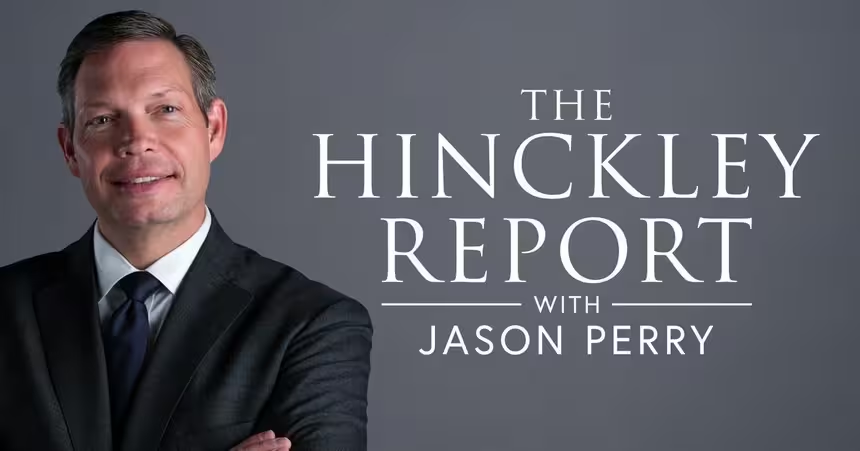
The Hinckley Report
Hosted by Jason Perry, each week’s guests feature Utah’s top journalists, lawmakers and policy experts.Providing Support for PBS.org
Learn Moreabout PBS online sponsorshipmale announcer: Funding for "The Hinckley Report" is made possible in part by the Cleone Peterson Eccles Endowment Fund, and by donations to "PBS Utah" from viewers like you.
Thank you.
♪♪♪ ♪♪♪ Jason Perry: Hello, and welcome to "The Hinckley Report."
I'm Jason Perry, Director of the Hinckley Institute of Politics.
Covering the week, we have McKenzie Romero, editor of the "Utah News Dispatch;" Brigham Tomco, reporter with the "Deseret News;" and Sean Higgins, reporter with "KUER News."
Thank you so much for being with us.
Very interesting week in politics, as we set the stage for the upcoming elections.
McKenzie, I wanna start with you for just a moment about what's happening in Utah: a legal fight over voter data that may impact, well, over 300,000 people here in the state of Utah.
Let's get to this for just a moment because we are in the spotlight on this issue.
McKenzie Romero: So we know that, in their legislative session, lawmakers changed the law regarding voter privacy, and took away an option that voters had to opt in to have some of their voter registration information be private.
With that opening back up, the lieutenant governor has notified those roughly 300,000 people that their voter registration status, their privacy could be changing.
And so if they want to try to keep that, if they apply for an exemption that's allowed under this law, they have a deadline coming up.
Jason Perry: It starts in 2018, Brigham, with a law that was passed in the state of Utah that said you can withhold your information about--it's not how you voted, but certain information you could have withheld from the public, and particularly from people who do things like polling or even candidates, for example.
Talk about that for a moment, because this is a little bit of a backtrack from that which came from a bill this year.
Brigham Tomco: Yeah, so this made Utah an outlier in the country.
During that time period, Utah was the only place in the country where you could opt in to have your voter information withheld or private without giving any reason.
There are some other states around the country that require you to list reasons for why you might be an at-risk voter, and then you can have this information withheld.
But around the country, it is the norm for campaigns and government entities to be able to access the information, at least about your name, address, voter registration, party affiliation, and now Utah is back to that pre-2018 status quo.
And this also opens up that data to people who want to pay to access it, and so it is an increase in transparency.
Some people have worried about the threat of potentially being doxed or having their identity posted online or something like this.
And there is still an option, if someone is at risk of domestic violence, or if they're a celebrity or a public official, they can apply for this at-risk voter classification and still have their voter information be private.
Jason Perry: This is with the clerk.
You can file your request, and they can accept it or deny it.
And I guess you can do that time and time again.
Let's connect this to the bill that just passed, Sean, this session.
It was Senate Bill 153, Senator John Johnson, that talked about bringing this back, making sure that the information become available.
What kind of information are we talking about, and sort of the policy rationale that you are hearing about why this bill was put in place?
Sean Higgins: So this is, it's pretty basic voter information.
It's name, address, what party you, if you are registered with a party, and your status as a voter, and the elections you voted in in the past.
I think there's around 1.5 million registered voters in Utah, about 300,000 opted to have this information private, not a small number.
And this information is used by polling firms for sure, but I'm thinking we're coming up on midterm election season.
Door-knocking is a huge way for campaigns to activate voters, and I have to think if I was running a campaign, I'm kind of licking my lips at at having 300,000 new names I could potentially be knocking on activating voters.
And in some of these districts, particularly congressional districts heading into the primaries, and a lot of these more contested state legislative districts, a handful of votes here and there could really make a difference if you're activating these voters that were previously withheld their information.
So I think there is a privacy argument to be made there, but on the other hand, this is a way for potentially more people who may have lapsed and not voted in the last couple of elections to be reminded that their voice matters, and to be encouraged to support one candidate over another.
And we'll see how that turns out.
Jason Perry: I want to--oh, go ahead, McKenzie.
McKenzie Romero: The idea of having your information out there is concerning to some voters, and we're starting to hear that as word about this change in the law is spreading.
We've heard from people about how they want to apply for exemptions, whether or not they will qualify.
They're concerned about what to do if they're denied.
The answer is that there is no appeal process laid out, but they can keep trying.
They can apply again to their clerk.
And also, we've even heard some voters who have discussed maybe trying to game the system by unregistering, then quickly registering to vote, unregistering again.
The reality is, that likely wouldn't accomplish the goal that they're seeking.
They would end up a list for having voted.
And we've even heard, in some extreme cases, a few voters who have said, "You know, maybe I'm just done.
It's better to have my information private in this crazy world that we have with scammers and doxers and any other number of scary things on the Internet."
And so they've thought, "Maybe I'm just not gonna vote for a while."
Jason Perry: I want to get to this letter for just a moment that we referenced from the lieutenant governor, because she's required to send something out.
But I want to read a little quote from her in this letter, and then let's talk about sort of the political ramifications of this, and what people are perceiving the impacts will be.
Here's what she said in the letter.
"We don't want anyone to worry when they see a letter from our office in their mailbox.
The individuals receiving notices have previously opted-in to voter registration privacy protections and we want to make sure they understand how this new law may affect them.
On May 25, 2026, the records of most of the voters who are currently classified as 'private' or 'withheld' will become public and viewable on the voter registration list, which is available upon request for a fee."
Brigham, talk about this for just a moment, because this kind of stoked a little bit of this conversation McKenzie was just talking about.
Brigham Tomco: Well, this ties into a broader national conversation that states around the country are having, including Utah Lieutenant Governor Deirdre Henderson, where the Trump administration is asking for greater access to voter data, including the sensitive pieces of personal identification, like Social Security number and birth date and things like this, as an effort to verify or go through the voter registration rolls around the country.
And so I get the sense that Lieutenant Governor Henderson is trying to message to voters how this is separate from that national or federal issue, and that this doesn't tap into some of that more sensitive identifying information.
Sean Higgins: And I have to think just where this conversation in Utah will go in the future, the legislature.
I feel like a lot of the work the legislature does during the session is iterating on things they've done in the past.
Three hundred thousand people is not a small amount of people.
That's a lot of constituents here in the state of Utah who may not, may really not be okay with their information being out there again.
And if enough of them lobby enough of their state representatives, we could see changes either in a special session or in a coming session as well.
So, I don't think this is over yet.
I think this is kind of the first step in maybe where this process goes in the context of that national conversation.
But I would put my money on something of this changing.
Jason Perry: Yeah, well, I want to talk about this federal nature for a second, McKenzie, because the lieutenant governor's office, the state of Utah, is in a lawsuit right now from the Department of Justice.
It's from their departments, the Civil Rights Division, suing to access more information.
Where does this head?
McKenzie Romero: Well, so Utah is not alone on that list.
It's a long list of states that are facing lawsuits from the federal government right now, as the Trump administration has sought this sensitive voter information, which they say is important for voter security, for elections to be secure, and to keep track of who is voting, whether or not they can vote.
Critics of that would argue that collecting everyone's voter information, all that sensitive data in one place, is actually a real threat to election security because then a bad actor only has to be, only has to go after that one trove of information.
There's also a lot of talk about what the Trump administration's motivations really are in seeking that information.
In their lawsuit in Rhode Island just last week, it was, it came out in a hearing that that sensitive voter information is not being used just for voter security where it's already being used, but is being shared with the Department of Homeland Security for immigration enforcement efforts.
Jason Perry: Brigham, before we leave this one, just a quick question as you start talking about these federal issues.
When you're talking to elected officials in your reporting, how much of this is about the voter data privacy?
How much of this is a states's rights issue?
How much of this is sort of a federal play to say, "They're not secure, we have to make sure that only US citizens are voting?"
Brigham Tomco: So it comes down to these constitutional questions, where you have folks like Utah Senator Mike Lee saying that it's the purview of the federal government to verify or to ensure that states only have citizens or those who should be registered to vote on their voter rolls.
And so the argument from the Trump administration is that under the National Voting Rights Act of 1990, states have to meet these standards of transparency in their voter register lists.
And they are appealing to the-- sorry, the Civil Rights Act of 1960, saying that this allows the attorney general, in this case, I guess the acting attorney general, to look at those voter registration rolls of the states.
But Lieutenant Governor Henderson is saying that this violates a kind of fundamental constitutional provision that says that the management and administration of elections falls to state officials, not federal officials.
McKenzie Romero: And the lieutenant governor has offered the federal government the publicly available voter information, which we've just been talking about, the information that is out there and that's used by campaigns and elected officials all the time.
They've said that they're happy to make that available to the federal government, but where Lieutenant Governor Henderson is trying to draw the line is that sensitive and private voter information.
Jason Perry: Okay, I want to switch gears for just a moment.
Sean, let's talk about just kind of the final phases of this initiative to repeal Proposition 4, which would eliminate this, or at least have a chance to vote on whether or not they eliminate the independent redistricting commission.
You can remove your signatures, and that happened in two districts, but we have three more that are very close.
There's still people are taking their names off, and those are, it's Northwest Salt Lake, South Jordan, and Southern Davis County.
Interesting, this is the district held by Luz Escamilla, a Democrat, and then two Republicans, Lincoln Fillmore and Todd Weiler.
Talk about that dynamic just a little bit.
Sean Higgins: Yeah, I think this really speaks to the messaging around this issue.
It's really has taken on a definition of its own.
I think if you asked people ten years ago what gerrymandering was, I think there was probably a consensus on what people thought gerrymandering was, and in the context of this broader fight over districts here in Utah, Prop 4 in particular, I think both sides of this issue have crafted their own narrative on what gerrymandering really is.
I think for people on the Republican side of the aisle, gerrymandering is creating a safe Democratic district in a state where Republicans have a clear majority in all statewide offices.
And if you talk to people on the Democratic side of the aisle, gerrymandering is creating four safe congressional districts in a state where between 30% and 35% of the state does not vote for Republicans year in and year out.
So I think when we look at this saga of the signature gathering process, we initially saw that they had met the threshold in all of these areas.
And it looked to my eye pretty safe that we could see Prop 4 on the ballot in November, and then the effort to take names off.
And I think that that has gained traction, and particularly in some of these Republican Senate districts, more moderate Republican Senate districts, speaks to that this is a little bit of a hard one for people to wrap their heads around.
It's not a clear yes or no like we saw with the collective bargaining bill: do you support the right for public unions to exist, or do you not?
This one is a little bit more gray and depends on your personal definition of what gerrymandering actually is.
Brigham Tomco: Well, it's also sparked some soul-searching in the Republican Party.
We've seen over 10,000 names removed from this Prop 4 petition to get it on the ballot, and that's kind of an unprecedented number.
That's now removed the ability for voters to weigh in this fall, but also it's kind of put the spotlight on the Republican Party organization in the state, the ability to mobilize voters on this issue, and even with $4 million in kind of national money coming in to boost it and these really high profile, national GOP organizations like Turning Point Action coming in to support this, including an endorsement from President Donald Trump.
And so, among some Republican strategists, this has, I think, seeded some doubt or worry about whether this is the year to have an amendment on the ballot this fall that legislative leadership is pushing for that would clarify that the legislature can amend or repeal or replace any ballot initiative, like they had understood their powers to be, you know, prior to 2024, so.
Jason Perry: 'Cause that's something our legislature could still do by special session, right, McKenzie, if they wanted to still have some question about that out there?
So I'm kind of curious where they go, and what you're hearing as you interview these elected officials about not just that, but initiatives generally.
McKenzie Romero: Yeah, so we know that there was interest in this during the legislative session, that it was talked about by legislative leadership, Republican legislative leadership throughout, and in the interest in putting this question back on the ballot to assert their boundary drawing authorities, but they didn't get it through.
They didn't pass it.
They were obviously very busy.
And what we heard from Stuart Adams was that they wanted to get the language right.
Obviously, that was a challenge the last time that they tried this, was that they tried to put the question on the ballot, and a court ruled that it was unclear, that it needed to be more down the middle when it came to presenting that question to voters.
And so we expect to see, I think, a special session where they can attack this in a more focused way, instead of trying to juggle it with everything else they're doing during the regular general session.
Jason Perry: Okay, of course, all this has ramifications on our congressional districts and who's running and what's going to happen there.
Can we transition to those races?
Because they're just so interesting.
And Brigham, you did some great reporting this week on money that's going into these districts.
I was going to go through these districts.
I want to talk about money, I wanna talk about signatures.
I want to talk about endorsements on a few of these congressional districts, and let's start with the first, you know, congressional district.
Democrats are really working hard to raise a lot of money in this one, so talk about that one for just a moment, because it's an interesting race to watch.
Brigham Tomco: Yeah, so overall, this is a weird election year.
You have these incumbents or former incumbents who are having to run amid new constituents trying to reestablish their name ID, and part of that is the money game, right?
Trying to get enough money to put their message out there, and also just let these new voters in these new districts know who they are.
And so in the first congressional district, we are seeing what looks more and more like a head-to-head matchup, although it's not, you know, definitive in any way yet, but between former US congressman Ben McAdams, who is leading the fundraising race with over nearly $600,000 new dollars just in the first three months of 2026, and then overall he has $800,000 on hand.
But then we see the candidate framing themselves as kind of like the progressive anti-establishment-type challenger, Nate Blouin, current state lawmaker, state senator who raised $300,000 in the first quarter, which kind of, I think, raised some eyebrows that he could be competitive in terms of advertising, and might establish himself as the alternative to McAdams in that crowded first congressional district Democratic primary.
Jason Perry: Sean, just about some of these endorsements in these races too, it's interesting to kind of see how this plays out.
Former Mayor and Congressman McAdams, he's being endorsed by people like Mayor Mendenhall; much of the Salt Lake City Council; Karrie Galloway, who's the former CEO of Planned Parenthood.
And Mayor Blouin, a long list of progressive politicians, including Bernie Sanders.
Talk about how those are playing out, because I want to know if this is going to be a battle of moderate versus progressive in this district.
Sean Higgins: I think broadly, yes, but one thing that we've talked about in our newsroom particularly is looking at the voter makeup of this new district.
Yes, it's a, I think, I believe D plus 14 when you look at a presidential race, but when you look at voter registration, it's roughly 1/3 Republican, 1/3 unaffiliated, 1/3 Democratic.
So, how progressive is this district I think is yet to be seen.
I do think, talking with some people who are in the Democratic machine in Utah, this is something they haven't seen in a really long time.
There's a lot of national interest here with how close the House of Representatives is, and there's a lot of money to be spent on getting a candidate that is aligned a certain way into the US Congress from both the more traditional, quote, unquote, "moderate" wing of the Democratic Party, and then the Bernie Sanders-AOC progressive wing of the party as well, with Nate Blouin raising a half million dollars.
And he says he's denying any corporate PAC money, but--and I think it just says, it speaks to the dynamics of politics in Utah.
Ben McAdams is pretty ubiquitous in Democratic politics over the last few decades.
He's the last Democrat to hold federal office here in Utah, and that's not a thing to just balk at, and I think it shows in his endorsements from other well, well-known establishment Democrats here in Utah.
Jason Perry: Okay, I want to hit the second congressional district for just a moment, McKenzie, because this is interesting also.
Blake Moore raised over $500,000 in the first quarter.
Karianne Lisonbee, around $150,000.
This is turning out to be a very interesting race with a lot of lines being drawn for various reasons.
Talk about some of those, what you're hearing.
McKenzie Romero: Yeah, so it's interesting that, as we were waiting to see who's gonna be running in which district among our incumbent representatives in Congress, Blake Moore was the first to step up and to say that, okay, he's running in this district, which largely represents the area that he represented before.
So he's well known there.
People there know his name.
He's been working for them in Congress for several years, and so he carries that experience.
So maybe it'll be harder to shake that up because the voter makeup isn't as mixed up as we're seeing in some of these other districts, but Representative Lisonbee will have to try to break through to get the attention of those voters who are already very familiar with Blake Moore.
Brigham Tomco: And I think something to add here is the national versus local connections that these candidates are touting or advertising.
Blake Moore is one of the few Utahns, potentially the only one to ever be in House Republican leadership in Washington DC.
And so he has the national backing and the numbers to prove it.
His money on hand is $2.4 million.
And compared to Representative Lisonbee, who's raised $150,000 over the past three weeks since she's been in this campaign, not only is there that money disadvantage, but Blake Moore has the endorsement of people like House Speaker Mike Johnson, and President Trump endorsed him in his previous district before Lisonbee entered the race, which is, you know, maybe an important thing to note there.
Meanwhile, Representative, well, Karianne Lisonbee, who was a member of the state house, she is counting on the endorsement of the entire House majority team here in the state of Utah and a few dozen lawmakers, and so she's really leaning in hard to her ties to state lawmakers.
And you know, maybe that doesn't translate to the same kind of name ID, but I think it's an important distinction that people might make between that kind of federal GOP backing and the local backing.
Sean Higgins: And I think speaking to that dynamic of incumbency, I think certainly it's an advantage to not just be an incumbent, but like Brigham said, to be an incumbent with a position in leadership.
If I'm thinking if I'm an Ogden resident, I kind of want my federal representative to have connections in Washington to get my district things that I want, whether it's more funding for Hill Air Force Base or what have you in the northern part of the state.
But I think as well, these more prominent Republicans in leadership learned a really important lesson back in 2010 when Eric Cantor, the former, I think he was majority whip in the House at that time, was unseated during the rise of the Tea Party.
And I think there are no--no one's resting on their laurels anymore as a power of an incumbent.
I think that speaks to the amount of money Blake Moore has raised in particular, but also just wanting to maintain that status in Utah as a member of senior Republican leadership in the House.
Jason Perry: One last thing on this redistricting question, too, that gets brought up in the second congressional district, but also in the fourth where Representative Kennedy is, is with our lines being redrawn again and again, at least where we have right now, it's not uncommon anymore, apparently, to not live in the district that you represent.
Talk about that dynamic really quickly, McKenzie.
McKenzie Romero: Yeah, I think we're used to it in Utah, that of people living within their district, but it's not uncommon around the country for people to live outside the district that they're representing.
And for those critics or opponents who are saying, "Well, they don't even live here.
How can they represent it?"
The fact is, they maybe did live there when they were first elected, so it wasn't their choice to leave the district.
The district kind of left them behind.
And also, it speaks to the choices that they are going to be able to make having known the district in the past, even if maybe they're a block or two out.
Jason Perry: Before we leave this one, let's chat for just a moment about what's happening with our congressional delegation, and the impacts this might be having on our state legislature.
A couple of races the two of you might be watching.
Any local legislative races, Brigham or Sean?
Sean Higgins: I mean, certainly, looking up north in Ogden, Rosemary Lesser was defeated two years ago by Jill Koford in a really, really tight race that swung, I think, back and forth by a handful of votes multiple times before that election was certified.
That was a big loss for Democrats in the House.
Lesser was in leadership at that time, I believe, so she is very much eyeing a return to the state house, and again, someone with name ID up there.
So Representative Koford is running for state senate now.
That's certainly one I'm looking at.
I know there are some races in Salt Lake County.
Jordan Teuscher is being, has a really big challenger, Head of the Fraternal Order of Police here.
He's the sponsor of the public union collective bargaining bill, so I think that's the one that I have my eyes on the most, but there are certainly others.
Jason Perry: Okay, go ahead, Brigham.
Brigham Tomco: Yeah, one I'm keeping my eye on is in Riverton, where you have a well-known Senate Republican, Dan McCay, who's been one of the most vocal advocates of things like our tax cuts in the state, the restriction on abortion, really well known among the GOP base around the state.
And then you have an up-and-coming lawmaker, Representative Doug Fiefia, who after one term in the House is now challenging this incumbent Republican in the Senate.
And so that's in Riverton, and I think it's one to keep an eye out for, as both of those lawmakers seem to have ambitions for, you know, potentially higher office.
McKenzie Romero: And in all of these races, whether it's from redistricting or these voter registration issues or what's happening in national politics, there's just, there's a lot of interest.
There's a lot of excitement.
There's a lot of passion, maybe sometimes not excitement.
But we may see a lot of participation in what's normally kind of an off year, a midterm year, not a presidential year.
Our last issue in our last 90 seconds, Sean.
Let's start with this.
What is the progress of this $1 billion that the Trump administration wants to put out for saving the Great Salt Lake?
Sean Higgins: I will say it's quite a magic trick for Utah to pull off turning a tweet into a billion dollars in this proposed budget.
I think the important word there is this is a proposed congressional budget.
Congress is--still has to approve this money.
I will say this is a significant amount more than even President Biden was able to get toward the Great Salt Lake.
He was only allocating about $50 million toward the lake, so $1 billion is exponentially more than that.
But the big hiccup is this has to get through a very, very divided Washington DC, a very divided House, a very divided Senate to become reality.
We seem to go through these budget fights every few months now.
There's continuing resolution after continuing resolution, so I think it's great in theory, but in practice, we'll see how this turns out.
McKenzie Romero: And conservationists would say that in all of this going on, we can't necessarily bank on all of these big flashy plans.
At the end of the day, what we really need to be doing is small choices each day, individuals and individual organizations, governments, businesses on what we're doing to conserve water, to use a little less so that, collectively, we can all get more water to the lake.
Jason Perry: Last 15 seconds, Brigham, you get it.
Brigham Tomco: Yeah, well, I think what this $1 billion also reveals is the relationship between Utah Governor Spencer Cox that he has curated with the president over the past year and a half.
In February, they sat down for an hour and a half, and his request was $1 billion for the Great Salt Lake, and it looks like that relationship is paying off.
Jason Perry: It seems like we'll watch that closely.
Thank you so much for your insights, and thank you for watching "The Hinckley Report."
This show is also available as a podcast.
Thank you for being with us.
We'll see you next week.
announcer: Funding for "The Hinckley Report" is made possible in part by the Cleone Peterson Eccles Endowment Fund, and by donations to "PBS Utah" from viewers like you.
Thank you.
♪♪♪

- News and Public Affairs

Top journalists deliver compelling original analysis of the hour's headlines.

- News and Public Affairs

FRONTLINE is investigative journalism that questions, explains and changes our world.












Support for PBS provided by:
The Hinckley Report is a local public television program presented by PBS Utah
Funding for The Hinckley Report is made possible in part by Cleone Peterson Eccles Endowment Fund, AARP Utah, and Merit Medical.