
May 18, 2026 - Full Show
5/18/2026 | 26m 48sVideo has Closed Captions
Watch the May 18, 2026, full episode of "Chicago Tonight."
Gas prices are still on the rise as travelers prepare to hit the road for Memorial Day weekend. And what to know about President Donald Trump’s visit to Beijing.
Problems playing video? | Closed Captioning Feedback
Problems playing video? | Closed Captioning Feedback
Chicago Tonight is a local public television program presented by WTTW
WTTW video streaming support provided by members and sponsors.
May 18, 2026 - Full Show
5/18/2026 | 26m 48sVideo has Closed Captions
Gas prices are still on the rise as travelers prepare to hit the road for Memorial Day weekend. And what to know about President Donald Trump’s visit to Beijing.
Problems playing video? | Closed Captioning Feedback
How to Watch Chicago Tonight
Chicago Tonight is available to stream on pbs.org and the free PBS App, available on iPhone, Apple TV, Android TV, Android smartphones, Amazon Fire TV, Amazon Fire Tablet, Roku, Samsung Smart TV, LG TV, and Vizio.

WTTW News Explains
In this Emmy Award-winning series, WTTW News tackles your questions — big and small — about life in the Chicago area. Our video animations guide you through local government, city history, public utilities and everything in between.Providing Support for PBS.org
Learn Moreabout PBS online sponsorship>> Hello and thanks for joining us on Chicago tonight on Brandis Friedman.
Here's what we're looking at.
Gas and food prices are still going up.
What's causing that?
And what does it say about the rest of the economy?
Takeaways from President Trump's visit to China.
>> In 1986, there were only about a dozen piping plover pairs left in the Great Lakes.
>> And piping plover eggs are spotted at Montrose Beach and in Waukegan.
We explain what their presence means for conservation efforts.
First off tonight, Alderperson Jesse Fuentes is suing the federal government over an incident with 2 federal agents.
>> The case stems from last fall during the Department of Homeland Security's Operation Midway Blitz when immigration agents handcuffed and detained her.
The 26 word Alderperson says she was advocating for a hospitalized constituent who was in ICE custody at the time and claims agents physically shoved and threatened.
Her went as was released outside the hospital.
Where more of the story on our website.
Chicago's 45th Ward Alderman Jim Gardner says his lawsuit against the city is about transparency and accountability.
He's accusing the city its board of ethics.
And now former inspector general of allegedly conspiring to charge him with an ethics violation and drive him out of office.
>> This is about the hearing officer being asked by the city if you could make his decision private all while leading up to the case, they made this public this is about transparency and accountability to be frank, what price can you put on that?
What price can you put on your reputation?
Gardner says the city and inspector general suppressed evidence and used false testimony in an investigation.
>> That found Gardner used his position as alderman to retaliate against a neighbor who been critical of them.
That board of Ethics ruling was later overturned the far northwest side, Alderman is asking a jury to award him at least a million dollar in dollars in damages.
The Chicago law Department declined to comment on the lawsuit saying it has not yet been served and doesn't comment on pending litigation.
Northwestern University's next president will make university history has its first Asian American president.
The school's board of trustees today announced that Mone Chang will become the university's 18th leader.
Chang has been at the helm of Purdue University since 2023 where he's credited with expanding researching activity to more than a billion dollars creating industry partnerships and advancing major initiatives in tech health and business.
He starts his new gig on July.
1st.
What's driving rising gas and food prices?
That's right.
After this.
>> Chicago tonight is made possible in part why the Alexandra and John Nichols family.
The Pope Brothers Foundation.
And the support of these donors.
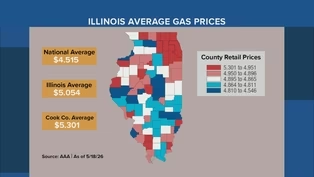
>> Travelers are preparing to hit the road for the upcoming Memorial Day weekend and their wallets may take a hit, too.
Gas prices in Chicago are up $0.70 from a month ago and nearly a dollar and $0.70 compared to last year.
Meanwhile, inflation is up and disruptions to fertilizer shipments are leading to uncertainty in the agriculture business.
Joining us, our can foster professor of agricultural economics at Purdue University and Sam Henri executive director of the Energy Policy Institute at the University of Chicago.
Thanks to both for joining us.
Maury.
How has the war in Iran affected oil and gas prices?
>> Well, this is the biggest disruption in the industrial market.
So it's pretty significant.
The global oil market is about 100 million barrel a day will market.
You have about 20 million barrels a day or so going through the Strait of Hormuz so there's really nothing that compares to the market is down something on the order of 1.2 billion barrels over the over the course of the crisis.
And so this has led to a massive increase in oil prices already from about $60 a barrel before the crisis that out today around $110 a barrel.
So it's been it's been a pretty significant impact.
>> On that, Sam, can you explain how oil more markets settle on a global price?
>> Supply demand.
It's a global market the sum total of all of the supplies to go into the market on any day and demand the cost of drilling the next well to meet demand.
And so it's really one of the most fluid, one of the most liquid markets in the world.
No pun intended you I think question that a lot of Americans have, I can imagine I and probably many Chicagoans is, you know, given that the U.S.
is such a massive producer and a massive export are, why are prices?
So I hear and it really just speaks to the global nature of the of the oil market.
Essentially a disruption like this that happens anywhere in the world affects prices everywhere, United States, although it is a massive producer to massive export or is also an importer.
Well, and these are just fundamentally global markets.
And so the price that could in the world market is the price that short of or adjusted for location for shipping costs is the price that we pay here in the U.S.
>> Can foster how is the Strait of Hormuz closure affecting farmers?
>> Well, I think a it's broadly separate depending on where you are in the United States.
If you're Midwestern farm, most Midwestern farmers secured their fertilizer prior to the conflict and in some cases, even applied at my school.
And so these fertilizer prices aren't the prices that they're paying.
If you go to the south, it's a little different.
The culture, there's some of Southern farmers would not have purchased fertilizer for this year's crop.
>> And course, are facing higher prices for fertilizer.
At the same time, the Rouge right at the beginning of planting season.
So most of the plans were in place and it's been very little disruption to farmers plans for the 26 Think, you know, the thing to watch is the duration of this conflict.
And if it goes on into the fall and starts to affect the 27 crop planting season, then think we're going to see some changes >> How crops are grown, where the room?
And which crops are focused on by farmers as they make adjustments in trying to avoid.
>> High for prices than it sounds like you're saying the oil price shocks that we're seeing right now might not be directly impacting food prices.
>> You know, I mean, they are or they will be, but not through that channel.
So they're more likely to affect food prices through the energy portion of the retail food dollar, which is mostly around transportation processing.
And the and the cold chain keeping things cold or frozen, not directly through farm prices who are farm fertilizer prices.
>> Sam, with the street closure of the Strait of Hormuz, of course, if that closure continues on for another month or 2, what then might we see happening to oil prices?
>> Well, I think you're going to see prices continue to go up.
You're really starting to see in this the the kind of the buffers, the brakes on the on the market really start to erode.
You know, one reason that prices have gone up as much as many people suspected or expecting that they would at the beginning of the crisis, is that the oil market was in a state of surplus.
There was lots of inventory and see their workers, a sanctioned Iranian barrels.
It's essential Russian barrels and that bought the world several, you know, several days of supply.
There's lots of commercial inventories in the U.S.
and other parts of the world that bought the world extra days of supply that those inventories are starting to come down.
And I think it's a real question of how quickly we get to a resolution of the crisis.
You know, the most important thing to bring the prices down is going to be opening up the Strait of Hormuz again, you know, even wants to straight opens.
I think something that's important to understand is that it is going to take some time for the oil markets are really, really cool.
Great for barrels to start flowing back through the Strait of Hormuz.
Again, I think, you know, estimates range from 3 to 6 months.
I'm hearing more and more that it will take up to 6 months for the low market to stabilize and normalize.
And so, you know, you're starting to see the forecast come out from from places like Goldman Sachs and other market forecasting a experts who are saying prices, even if the prices result tomorrow, you're looking at prices, you know, close $200 a barrel through air.
>> Can you know if and when the street does reopen, how would you expect fertilizer prices to respond?
>> You know, fertilizers, markets are very much like they will market.
It's a global market is very fluid and there will be some delays matters of weeks as new inputs surface to the United States into Western.
You're where I think it turned into fertilizer, but we would expect a destabilizing, you know, relatively few weeks or months back to normal.
So you know that the timing of resolution, he's super important here because if you resolved in time for for farmers to begin making the 27 crop decisions based on lower fertilizer prices or the prospect.
Florida for the laser prices between now and next spring that takes a lot of really fun that channel in terms of retail food, price, inflation.
>> Sam, you mentioned, you know, prices not, you know, shooting quite as high as some people expected.
They might have when the conflict started.
That said a little over $5 a gallon today, which I think that is enough for for some folks.
I think it's hard to imagine prices going much higher.
>> It is the point where we're starting to see some demand destruction.
It's true prices are up about 55% from before the crisis.
It's costing the typical American household around an extra $100 a month and gasoline spending.
So that's less money that's available for groceries are going baseball game or whatever it might be.
But it is certainly the case the prices can go higher if the crisis is not results soon, if this is dragging out into, you know, into June it's hard to imagine a drag on beyond June into July.
You know, there's not going to be enough football for last.
really are drawing down the inventories at a historic pace.
There's never been a drawdown in inventories like this, which is what you would expect to match this kind of historic prices.
So when we get to the point where there aren't those you know, inventory is available as a buffer and you really get into a shortage situation in the world market prices will have to go higher to bring the market into into equilibrium.
And so you're missing 20 million barrels a day ish.
Well, it will have to, you know, the demand will have to go down to make demand and supply come come into equilibrium.
And that is going to require much higher prices.
So the most important thing that could happen in terms of the oil market.
I mean, he's obviously foreign policy.
This is a national security, a crisis.
There's many other considerations.
But from an oil market perspective, the most important thing that can happen is getting the straight back open in getting barrels flowing through the strait again.
>> Can we've got about 30 seconds.
But what other policy decisions short of reopening the Strait of Hormuz might meaningfully meaningfully impact the cost that farmers are paying.
>> Well, I think more than the cost side, we see relaxation in terms of renewable fuels policy that are going help prices in the future in particular, soybeans because soybean willows primary in put into making biodiesel.
And there's been quite a bit of opportunity to expand that market.
Now based on decisions that were made in Washington.
put it give a little higher revenues to offset the increased costs.
>> Okay.
That's where we'll have to leave it.
Sam Morin can Foster.
Thank you both for joining us.
Appreciate it.
Thank Up next, details about President Trump's visit to Beijing.
In exchange of niceties and kicking the can down the road.
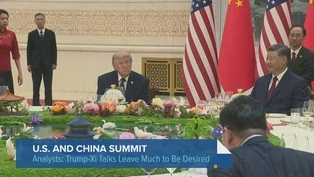
That's how analysts are describing last week's Beijing summit between President Donald Trump and Chinese President Xi Jinping.
While the 2 leaders reach some agreement on trade deals, questions still loom large over Taiwanese independence and which country will emerge as the dominant world power for decades to come.
Joining us to break down the summit is Raymond quote, vice-president of research for geo strategy in diplomacy at the Chicago Council on Global Affairs Rain.
And thank you for joining us.
Thank you for having me.
break down the goals that each country had for this summit.
Please China want.
One of us want.
Sure.
So on both sides are looking for some kind of economic engagement.
>> The Chinese are facing a long term economic malaise and really they're trying to grow their way out of using exports.
Of course, in order to do that, you access the U.S.
the tariffs that we post on him.
I think the highest last year was 145% somewhere around there meant that they really can access the market on the U.S.
aside.
We're obviously dealing with a host of economic issues right here, including oil prices because of the Iran And so find ways to get cheaper goods.
You know, there's that there's hopefully opportunity for a meeting of the minds where we can de-escalate from Air Force are going on and get back to doing business as usual.
Which country would you say accomplished more of its goals?
Probably China.
Unfortunately.
I the Chinese start with United States.
Usually we coordinate these gauges here, interagency process where the State Department takes lead and then we'll get Commerce Department, Treasury Dot all on board saying these are our priorities and you X Y and Z order.
That really didn't happen.
in advance the summit, we didn't have the mid-level bureaucrats going out there and kind hacking with the easy low hanging fruit.
So and said it was kind of a, you know, kind a free for all.
Everyone went over there all once.
Everyone's trying to advocate for their key positions, whereas on the Chinese side, they did all that homework.
They had a clear sense of parties, knew what they want to ask for and really also set the agenda by saying, I was going to be a top priority.
>> All right.
Let's talk about Taiwan because, of course, that is a big we knew.
That was a big point of discussion.
Remind us of the geopolitical significance that Taiwan holds for the U.S.
sure.
So time was part of what we call the first island chain.
This close from Japan, Japan, Taiwan, Philippines, all the way down.
It's really kind of the barrier that keeps China contained within its own region.
Taiwan is a critical linchpin to general MacArthur called it a unsinkable aircraft carrier and submarine tender.
And so it's a critical strategic strategic note.
Also, there's economics about 90% of the most advanced semiconductors in the world are made in town itself.
And so if you were to see if the Chinese were, for example, to capture Taiwan, they would have not only a strong, just such a strategic stronghold, but also possession of a really important critical commodity in global supply chains.
Where did the 2 countries lands on Taiwanese independence?
how did that like?
Have that conversation go.
Yeah.
So I mean.
The summit itself didn't seem to address that.
There wasn't like there was a readout or a public statement.
But Trump's interview with I think rep there on FOX News after this.
That's really where a lot of this came out and then fortunate at least in my view, Trump's parrot in quite a lot of the Chinese government's the talking points saying that, look, it's really the town knees are causing problems and they're in the strait, even though the Chinese have launched multiple military operation, soft blockades, you name And you know, I think perhaps the worst thing in my mind that Trump reiterated his belief that China time it's stolen, the U.S.
chip industry just not true at all.
But that this was almost kind of retribution for saying like we want to you should give it back to us and maybe will consider defending.
You are supporting you.
>> What does that tell you?
Is that does that signal sort of a shift in U.S.
policy around Taiwan?
If the president is saying this?
Well, both Trump and secretary of state Rubio, specially Rubio mentioned a couple times that U.S.
policy and how it has changed.
Maybe I mean, you technically that might be true.
But we really have to see what happens when with the with what Trump decides to do with the move, arms sales package.
>> With this 6 assurances, one, some of these insurance, we get to China as well as Taiwan.
We said that we would not pretty clear negotiate with the Chinese over arms sales to Taiwan.
It seems like that may have actually occurred during this meeting or that at the very least the Chinese have given that the Trump administration a talking point to say maybe we should hold sales.
>> Leading up to the summit.
Experts expected the 2 leaders to discuss a ion and access to advanced AI technologies, but readout from both countries.
Countries did not highlight AI as a central topic.
missed an opportunity here.
>> I don't know.
I mean, I think there was an announcement that the U.S.
allowed 10 Chinese companies to purchase Nvidia's.
Second most advanced chip.
Now no Chinese AI models tend to work on the fission Cs Post rock computing power.
But even so getting access.
So its ships will be a huge boon for those particularly Chinese companies.
The fact that Jensen I think I've really flew from California or somewhere met up with Air Force One, Alaska.
You it strikes me that this an opportune moment for him.
But 2, it also means that wasn't really coordinate in advance.
going back to that question about the interagency process and the kind of advance work if you're going to have a CEO of a company show up last-minute trip, that means you haven't prepared the conversation with their counterparts in China.
>> The 2 countries have also been a little bit tight-lipped about any conversation around Iran.
What do we know about what came out of those conversations about LeBron?
So as far as I can tell, there was Chinese verbal support saying, yes, we want to have Strait of Hormuz reopen.
We want to have peace in the Middle East, but at the same time, you generally speaking, I think the Chinese view this as well.
you broke it.
You bought it.
You have to fix this in fact, you know, when I think about other countries in the region, for example, of the Thai foreign minister was, I believe DC a couple weeks back.
He said, look, the U.S.
has offered us any support with the economic fallout of this.
By contrast, the Chinese and the Russians have come to us and said if you need support, we are willing to help and just kind of.
Shifts of public opinion and government opinion in the region towards China and away from United States.
Reports of also noted that Trump has been a few says in his praise of President Xi while the Chinese leader did not seem to return that level of admiration and we know that it is something that President Trump appreciates.
>> some have argued that that, you know, that that contrasts reflects a power imbalance, suggesting that Trump was seeking.
She's approval.
Anything to that.
It was written into I you know, I don't like to do the armchair psychology eyes.
I'm personally not a trained in psychology.
>> But I think there was a notable kind of point there.
Yeah, I think to some extent.
rough droughts are Trump seems have backed a little bit off the cuff, right where Xi Jinping was much more disciplined about saying, you know, a B and C priorities that could just be a reflection of that were and the lack the relative lack of preparation, the U.S.
side meant that Trump was kind of kind filling the void with more happy talk.
For example, whereas, you know, she's and he's like, nope, we've got a B and C issues will talk about.
Let's go down the list.
And here is we're gonna kind of give you our positions and we for your and sticking to the business, which is also I mean, a reflection of the 2 men's differences of style, right?
We know the president likes to talk off the cuff >> and say what he thinks that's rather than sticking to the agenda sometimes or the teleprompter.
Exactly.
Okay.
So despite the summit yielding some, you know, few concrete outcomes.
Both countries have treat the meeting itself as a success.
Officials on both sides arguing that the talks helped reinforce stability in the relationship.
Just yesterday, the White House in Beijing announced that President Xi will make a reciprocal visit to Washington in September as summit Mark a step towards, you know, a more stable U.S.
China relationship.
What is all the signal?
Well, I mean, think it's not only the meeting of September think there are also some meet twice more this year.
So there's multiple opportunities for both President Trump and Xi Jinping to meet with each other.
>> I am hesitant to say this will last week along comes ability.
One issue is kind of a credibility deficit we have here in midst the U.S.
aside when Trump, for example, talks about our trade deals with Canada, Mexico being the worst he's ever seen.
Those are negotiate under his first term.
And so if you're going to stab your own kind of trade going to the back, how much can the Chinese trust will actually come into this long-term relationship?
I'm sure you'll be keeping an eye on.
We'll have you back to discuss it again next time.
Raymond Poe, thank you so much.
Thank you for having me.
>> Up next, the story behind Plover Mania.
Wbtw News explains right after this.
If you've been in Chicago for the past 7 summers, you know, that bird lovers and many others have gone plover crazy.
>> That's because these rare, tiny shorebirds have against all odds been nesting at Montrose Beach.
Well, Plover mania 2026 edition is ready to take flight.
Maybe not take flight yet because it is at least in its embryonic stages, literally plover eggs have been laid at Montrose Beach and in Waukegan.
So what's all the fuss about?
Patty wet Lee explains.
>> Chicago's lakefront is famously open in free.
So why crime section of Montrose Beach Road off every summer because it's for the birds.
Literally the piping plovers.
There's tiny shorebirds about the size of a smartphone.
>> Action of the week there used to 1000 them spread across the entire great thing with the people took away a lot of the beaches where they live building houses, hotels, marinas and resorts.
by 1986, there were only about a dozen piping plover pairs left in the Great Lakes.
All of nesting in Michigan.
The future looked so bleak for our feathered friends.
They were officially added to the endangered species list.
4 to 2019, 2 of these rare creatures, a male and a female turned up on Montrose Chicago's birders rejoice there had been investing here in Cook County since Harry Truman was president.
>> lodging.
A pair flavors have landed on one of the most crowded beaches in Chicago and decided to start a family.
slightly unwise choice of part.
But amazing.
An army of volunteers quickly formed to protect the flavors they on teen rose from beachgoers and other threats.
>> Long story short.
The couple and eventually their chicks spent the summer charming the pants off.
Chicago before flying south for the winter.
What do you know?
Like all summer blockbusters?
This and Rose returned in Montrose been asked again 20 incredibly, landed in Chicago within hours of each other.
Despite spending winter on opposite sides of the Gulf whatever.
>> The dynamic duo competed the trilogy in 2021.
Raising a checked that Montrose.
>> Less in 2022.
The soccer took a tragic turn.
Rose never made it back to Chicago and Monday died of an infection, though.
Some would say it was really of a broken heart.
Still the legacy of these love birds lives not just in their son.
The money was also found immediate Montrose.
>> But in the goodwill, these 2 crazy kids created for their species.
Monti in putting the love in plover.
>> And for more on the piping plover nests, you can check out our Web site at Wt Tw dot com slash news.
One note before we go, you are invited to join us for a W T Tw News town hall about police community relations in Chicago.
It's Tuesday.
May 26 at 06:00PM at Cal U Haul in Pilsen.
You can reserve your free tickets at W W Dot com slash events.
Tickets are limited.
So sign up today.
And that is our show for this Monday night.
Join us tomorrow night at 5, 30 10 now for all of us here at Chicago Brandis Friedman, thank you for watching.
Stay healthy and safe and have a good night.
>> Closed caption was made possible by Clifford and Clifford Law a Chicago personal injury and wrongful
 New
NewFood, Gas Prices Still on the Rise Ahead of Memorial Day Weekend
Video has Closed Captions
What's behind rising prices and what does it say about the economy? (8m 53s)
 New
NewTakeaways From Trump's Trip to China
Video has Closed Captions
The president recently returned to the U.S. following a three-day visit to China. (8m 28s)
Providing Support for PBS.org
Learn Moreabout PBS online sponsorship
- News and Public Affairs

Top journalists deliver compelling original analysis of the hour's headlines.

- News and Public Affairs

Today's top journalists discuss Washington's current political events and public affairs.












Support for PBS provided by:
Chicago Tonight is a local public television program presented by WTTW
WTTW video streaming support provided by members and sponsors.