
A conversation with Kate Levin Markel of the McGregor Fund
Clip: Season 54 Episode 27 | 14m 43sVideo has Closed Captions
We spoke with the outgoing president about the organization’s past, present and future.
Host Stephen Henderson sits down with McGregor Fund President Kate Levin Markel to talk about her decision to step down from her position at the end of the year to make way for new leadership to guide the foundation into the future. Levin Markel discusses the past and present state of philanthropy in Detroit, along with the future trends she is seeing in other cities.
Problems playing video? | Closed Captioning Feedback
Problems playing video? | Closed Captioning Feedback
American Black Journal is a local public television program presented by Detroit PBS
A conversation with Kate Levin Markel of the McGregor Fund
Clip: Season 54 Episode 27 | 14m 43sVideo has Closed Captions
Host Stephen Henderson sits down with McGregor Fund President Kate Levin Markel to talk about her decision to step down from her position at the end of the year to make way for new leadership to guide the foundation into the future. Levin Markel discusses the past and present state of philanthropy in Detroit, along with the future trends she is seeing in other cities.
Problems playing video? | Closed Captioning Feedback
Where to Watch American Black Journal
American Black Journal is available to stream on pbs.org and the PBS app.
Providing Support for PBS.org
Learn Moreabout PBS online sponsorship- Welcome to "American Black Journal."
I'm your host, Stephen Henderson.
The longtime president of the McGregor Fund has announced she will step down at the end of this year.
Kate Levin Markel has begun her transition from the organization after more than two decades of service.
In her announcement, she said the time is right to create space for new leadership for the fund's next chapter.
I am pleased to have Kate Levin Markel as my guest today to talk about her decision and the future of philanthropy here in our city.
Welcome back to "American Black Journal."
- Thank you, Stephen.
It's so great to be back.
- Yes, it's always great to see you.
I was teasing you a little before we started about, you know, why you think it's okay to leave now, and who told you that that was permissible?
But I do actually want to just express an immense amount of respect for the decision that you're making, and the reason, as I was saying in the open, that you stated, that it's time to create space for new leadership and the future.
And I think far too few people, far too few leaders, think of their responsibility that way.
That's really the most important responsibility of a leader, I think, is to know when it's time to say, "Hey, let's find somebody else."
So I want to congratulate you on that.
- Thank you.
- But I do want to have you talk just a little more about what that means, create space for new leadership and take the foundation into the future.
What do you imagine when you say that?
- Thank you for having me on- - Mm-hm.
- To discuss this topic, which is something I've thought a lot about.
- Yeah.
- And in fact, when I was promoted into this role, I've been at McGregor Fund a very long time, I've been in this role now 11 years, I made a promise to myself that I would stay about 10 years, going in.
Because I really believe being the leader of a foundation is a very unique role.
It's very unique.
There's a lot of privilege that comes with it.
There's a lot of trust.
- Yes.
- Community trust, and there's not much accountability, honestly.
And nobody really tells you it's time to leave.
- Yes.
Right.
- Nobody tells you it's time to leave.
- No one probably feels comfortable saying, "It's time to leave," right?
- That's right.
And it's very hard to objectively measure how good a job I'm doing.
I don't have customers.
- Right.
- I don't need to raise money.
- Right.
(laughs) - I don't have owners.
- Yeah.
Yeah.
- I report to a board, and all the money we use for our operation is already invested in the bank, so to speak.
So there's really very little accountability and feedback.
But it's also very much, in my view, a job that doesn't belong to the person who holds it.
It's an honor.
And in that sense, it's almost like a public trust.
- Yeah.
- So I really believe there are just so many reasons why people might be tempted to stay too long.
I've seen that happen.
I didn't want to be one of those people.
Because I know that you have to limit your own tenure in this role, and there's always opportunity for bringing in new leadership.
- Yeah.
Yeah.
- So it's a unique situation.
- It is.
It is.
And that kind of leads us to where we are in the city now with philanthropy and lots of other things.
You know, I spend time in other cities, sometimes looking at how philanthropy behaves in those communities.
And I've kind of reached the conclusion that this is a special place in that regard, that philanthropy here plays a different role than it does in lots of other cities, and it plays a bigger role, in some ways out of necessity, but also in some ways out of I think a sense of obligation to the community and the need.
So as you sort of transition away from the center of that, I'd love to know what you think about where we are with philanthropic support for and focus on Detroit and Detroiters.
- I have two very complementary but different thoughts about this.
- Mm-hm.
- The first one is that without question, the history of philanthropy in Detroit is uniquely strong.
- Yes.
- And the desire among organized professional philanthropy to work together was very significant as it emerged decades ago.
And this city has faced a lot of challenges for very deep-seated reasons, and I do think there was a kind of consciousness among my predecessors in leading different philanthropies to come together and really put resources on the table to solve very entrenched structural problems, when possible.
- Yes.
- The greatest example, of course, being the bankruptcy.
- Sure.
- So I think we deserve some of that reputation.
I also feel like there is a future for philanthropy which is being modeled more thoroughly in other places where frankly, the wealth is newer.
- [Stephen] Huh.
- And so there are new foundations that are modeling different priorities.
They are being started by donors who have different life experiences and they're more experimental, in some cases.
I also believe that we've a little bit rested on our laurels here in Detroit, and we could be doing more to stay current with what I think the field is learning about how to be most effective.
- Yeah.
- And by that, I mean really centering the community you're there to serve in your larger strategic thinking and in your decision-making and as teachers.
- Yeah.
Wow.
- And that's a culture shift that we're very excited about at the McGregor Fund.
We see it as not only joyful but essential to doing our work well, and that's something our team has worked really hard on, changing our practice in the way we are accountable to community through our partners during my time in the leadership role.
- Yeah.
Yeah.
Last time you were here, we talked about what was going on in the country at the time and the really brutal effects of the changes in Washington on social safety nets and all kinds of quality of life and other kinds of factors in Detroit.
And you were very concerned about the government's role and philanthropy's role in meeting those challenges.
I wonder what you think.
That was about a year ago.
Things are somewhat different, I suppose, but in some ways, not.
I wonder what you think of that now and what you think of the challenge to philanthropy that that represents.
- There's a lot in your question.
As always, Stephen, you ask such thoughtful questions.
Well, first of all, a year ago, at the very beginning of the current federal administration, our partners in the social safety net, nonprofit organizations who support Detroiters- - Yes.
- In myriad ways, were being significantly disrupted in their work where they were receiving federal funds to do what the government had asked them to do- - Yes.
- And contracted with them to do, and then in comes the new administration that decides, "We don't like this work anymore and we're just gonna stop paying for it."
- Right.
- So we were in, we meaning our country, not philanthropy, we were in chaos in that moment.
In some ways, the chaos has been a bit normalized, I'm sorry to say.
- Yeah.
- The funding disruptions to our nonprofit partners continue.
The tactics are multiple.
Some of it is, "We don't like this and we don't want to pay for it."
Some of it is, "We're gonna change the rules in the middle of the game."
Some of it is, "Going forward, we are not going to support this work, even though it's evolved over many years in a very bipartisan consent base way."
- Sure.
- So that still is going on with our partners in their effort to support community in ways that they've been asked to do.
Now we layer on some new challenges.
Coming up toward the end of this year and certainly at the beginning of 2027, individuals are gonna be very directly affected by changes in some of our entitlement programs- - Yes.
- Some of our benefits, which were passed by the Congress- - Yeah.
- A year ago.
Those have not hit yet.
- Right.
- So there's a new wave of pain coming for people with regard to being able to access healthcare and support for food assistance if they're food insecure- - Yeah.
- Due to their economic circumstances.
So we have a, kind of, unfortunately, a new wave of pain coming.
- Right.
- I remain hopeful that we are, as a country, learning what happens, there are consequences to these decisions and elections, and that this will be corrected.
But in the meantime, a lot of damage done to critical safety net infrastructure and it's not gonna stop.
- Yeah.
- So nonprofits are working under extraordinary strain.
There's a lot of very fresh research that documents that strain.
I'm very concerned about the longevity of the workforce of people called to do this work, not for money, not for job security, but because they're passionate about it, and they can't even rely on a paycheck now.
- Right, right.
- It's very discouraging.
It's a terrible job market for young people coming out of college or early in career who want to move into these fields and who can't even find work, let alone what appears to be a secure job path.
- Like sustainable work, yeah.
- That's right.
So the costs of this are going to- - They ripple over time, yeah.
- They ripple out.
Right.
Now I don't think it's all doom and gloom, but we have to, I believe we have to be honest about the harm being done and there are also specific types of harm being done, to particular communities.
In my view, the administration has and continues to weaponize its power to punish people and communities it does not like.
- It doesn't like.
Yeah.
- And that continues.
So we could have a long conversation about different examples of different communities who are being targeted.
Their own safety is involved.
Their legal rights are at risk.
- Yeah.
- And that also requires a kind of escalated response that our nonprofit sector isn't necessarily scaled up to provide, but folks want to do it.
So where does this leave philanthropy, as I said before, and still continue to believe very strongly, we have to just be willing to spend more money and pay for things we don't normally pay for.
- That you wouldn't normally do.
And of course, you're doing that at McGregor.
I mean, you were very swift in saying, "We're we're just gonna do more."
- We were.
- We're running out of time, but quickly, it's an unfair question, but I'm gonna ask it anyway: What's next for you?
- I don't have an answer to that.
(Stephen laughs) I learned- - It's okay not to have an answer.
I just... - I learned from my elders that if you're beginning to think of the next thing, you already have a foot out the door.
- Oh, okay.
- And I don't have a foot out the door.
I am 103%, 120% committed to the work we're doing.
- Yeah.
- Our partners, our team.
And I'll take a little time off and figure out what's next for me.
But it's about the work.
- Yeah.
Yeah.
- And it's work I love.
- I know it will be something important and exciting, so, that's a good enough answer for me for now.
(laughs) - Well, I'll just say this.
I have been so blessed, so blessed to do the work I've been able to do.
- Yeah.
- It has given my life such meaning and this is all through the relationships I have been honored to have with so many Detroiters.
And I'm not ready to walk away from that.
- Yeah.
- And give that up.
- Yeah.
I didn't, I wouldn't think you would.
But it's great to have you here.
And we'll have you here again before you leave.
- Thank you, Stephen.
It's so great to be here.
- Yes.
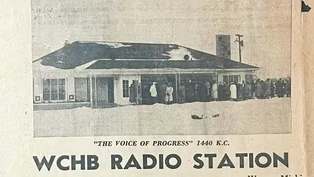
A look into the history of the family who created WCHB radio
Video has Closed Captions
Clip: S54 Ep27 | 8m 8s | Family members talk about the history and legacy of Detroit radio station WCHB. (8m 8s)
Providing Support for PBS.org
Learn Moreabout PBS online sponsorship New Episode
- News and Public Affairs

Top journalists deliver compelling original analysis of the hour's headlines.

- News and Public Affairs

FRONTLINE is investigative journalism that questions, explains and changes our world.
 New Episode
 New Episode
 New Episode
 New Episode
 New Episode

 New Episode
 New Episode
Support for PBS provided by:
American Black Journal is a local public television program presented by Detroit PBS