
A look into the history of the family who created WCHB radio
Clip: Season 54 Episode 27 | 8m 8sVideo has Closed Captions
Family members talk about the history and legacy of Detroit radio station WCHB.
In a special Destination Detroit report, One Detroit producer Bill Kubota explores the history of WCHB and WJZZ radio with members of the family who founded the stations. Annette Bass and her brother-in-law Eric Bass talk about how his grandfather, father and uncle built the Inkster-based WCHB-AM radio from the ground up. It was a first for an African American owned and operated radio station.
Problems playing video? | Closed Captioning Feedback
Problems playing video? | Closed Captioning Feedback
American Black Journal is a local public television program presented by Detroit PBS
A look into the history of the family who created WCHB radio
Clip: Season 54 Episode 27 | 8m 8sVideo has Closed Captions
In a special Destination Detroit report, One Detroit producer Bill Kubota explores the history of WCHB and WJZZ radio with members of the family who founded the stations. Annette Bass and her brother-in-law Eric Bass talk about how his grandfather, father and uncle built the Inkster-based WCHB-AM radio from the ground up. It was a first for an African American owned and operated radio station.
Problems playing video? | Closed Captioning Feedback
Where to Watch American Black Journal
American Black Journal is available to stream on pbs.org and the PBS app.
Providing Support for PBS.org
Learn Moreabout PBS online sponsorship- The Detroit PBS "Destination Detroit" series explores the rich histories of the people who have helped shape Southeast Michigan.
Residents were invited to share stories about how their families came to Michigan and the lives that they built here.
Today, we bring you a conversation from the series with members of the family behind WCHB, the nation's first African-American owned and operated radio station built from the ground up.
(upbeat R&B music) - [Bill] Motown founder Berry Gordy.
His family came to Detroit from Georgia in the 1920s around the same time Dr.
Haley Bell arrived.
- Grandpa Bell came to Detroit in 1923.
He's from Brunswick, Georgia.
He was born in 1895, and Mary Bell, his wife, she was born in Lebanon, Tennessee, which is outside of Nashville, in 1900.
- [Bill] Another Great Migration story.
Annette Bass came to Michigan Central last year to tell us about Bell Broadcasting for our "Destination Detroit" project.
- Grandma Bell said they put three cities in a hat, and one was Texas, I think the third one was West Virginia, and Detroit was second.
So they drew Detroit twice, so they decided to come to Detroit.
- [Bill] Three decades later, Dr.
Bell, a successful dentist, had saved up to build a radio station, partnering with sons-in-law Wendell Cox and Robert Bass.
WCHB 1440 AM's first broadcast, November 7th, 1956.
- What many researchers and historians argue, if there had not been WCHB that launches in 1956, there would not be a Motown Records.
- Coming to you live from WCHB, it's most definitely the Joltin' J-O-E, gettin' down to the nitty in this Detroit city.
- And I can remember Berry Gordy coming over to my house when we lived down Lafayette Park back in the '60s, with two or three, four 45s in his hand, asking my father, Dr.
Bass, "Can you please see if you can get these on the air next week for me?"
- [Bill] If they were airworthy, Eric Bass said WCHB would play them first, before the other Detroit stations would get a chance.
- Dr.
Bell was a dentist.
He set up his dental office in Hamtramck.
Dr.
Cox, my uncle, set up his office down the street, near Holbrook.
My grandfather's office was near Caniff.
And when my father got out of dental school, he set up shop in my grandfather's office also on Joseph Campau.
So all three of them operated there.
Three Black dentists servicing the 90% population of Polish people back in the '50s and '60s.
- [Bill] Doctors Bell, Bass, and Cox owned the first Black-owned radio station in the USA, built from the ground up.
- Then my grandfather, he wanted to be getting into broadcasting, because Detroit's Black population was booming in those days.
It was growing exponentially.
The Great Migration brought a lot of Black people from the South to Detroit, and there was no television, no radio targeting them specifically.
He applied for a FCC license for a building permit to build a station in Detroit to target the Black audience.
He was denied multiple times back in the '50s.
- [Bill] The Federal Communications Commission wouldn't let them in Detroit, but they got the okay in Inkster, west of the city.
Annette Bass's husband, Bobby Bass, along with brother, Eric Bass, became Bell Broadcasting executives.
With few family members left, Annette's trying to preserve the Bell Broadcast legacy.
- I mean, all those are archive boxes down there.
Those are all family members.
I mean, these are files, those are employee files over there.
When my husband passed in 2013, he left me with all this material.
Most of it he inherited from his grandmothers.
- [Bill] WCHB, Detroit Soul Radio.
- [Radio Announcer] WCHB, The Soul of the City.
♪ 1440, WCHB ♪ - [Bill] And it covered the news for the Black audience.
- During '63?
- Yeah, mm-hm.
- Martin Luther King did his first version of "I Have a Dream."
- [Annette] It was two weeks after Medgar Evers was assassinated.
- And they had a march in Detroit, 'cause I remember I got tired of walking.
My dad put me on his shoulders (chuckles) and we walked from like the Boulevard all the way to Jefferson.
That was a long way.
And then after the march, everybody went to Cobo Hall, and that's when he first did his first version of "I Have a Dream."
- [Bill] WCHB, there to put it on the air.
- And so his rural plantation background gradually gave way to urban industrial life.
- Well, this is pretty unique, man.
My grandfather couldn't have pulled this off any other place, in my opinion.
Detroit was a once-in-a-lifetime deal, you know, that's why coming to Detroit, we probably wouldn't have enjoyed this success anywhere else.
- [Bill] WCHB radio talent then, in binders now, 60 years later.
Who are they?
Annette Bass wants to put names to the faces.
- [Annette] I said if anybody recognizes- - [Eric] Knows these people.
- [Annette] Yeah, please write their name down because I have- - [Man] You know who these people are?
- Some of them.
Now check this dude out.
This cat named Robbie D, he was a white jock, obviously, that worked for WCHB back in the '60s.
- [Bill] "Time" magazine featured Mr.
Hip Lip, Robbie D, in 1967.
- [Robbie D Recording] Temptin' Temptations on the WCHB.
Rockin' Robbie D shows what's happening for you.
This is WCHB, Inkster, Michigan, loudly and proudly serving all the greater Detroitland, 1440 minutes a day!
- One of his things was, "Shut your trap, sit on my lap, and inhale my rap, baby."
That was a little- - See, you can't say that now.
- [Eric] Now he was working for a Black-owned and operated radio station in the mid-'60s, man.
This cat was ahead of the times.
- [Bill] Bell Broadcasting put FM station WCHD on the air in 1960.
Not many FM listeners then.
WCHD played jazz, and Annette's late husband, Bobby, helped run the operation, gathering a faithful audience.
- That's why you have to have people who are really locked into that.
That was Bobby's strength.
Bobby really understood jazz music.
- [Bill] There was another jazz station in Connecticut programmed by pianist Dave Brubeck of "Take Five" fame, called WJZZ.
But in the early '70s, it gave up its call letters and Bell Broadcasting took them.
WCHD renamed WJZZ with the station's marketing man, Eric Bass, helping roll out their iconic logo.
- I saw it, I said "Bobby, that's it.
That's the radio station.
That's who we want to be.
That's what we want people to see WJZZ and think about Detroit."
And it was so prolific that when it hit, we said, "We're going to put this on hats, we're going to put it on shirts, we're going to put it on billboards."
- [Radio Announcer] American FM.
WJZZ Detroit.
Jazz, 106.
- [Bill] By the 1980s, jazz radio evolved into smooth jazz with WJZZ on top, recognized nationally for its programming and tie-ins with the likes of concerts at Shane Park and the Montreux-Detroit Jazz Festivals.
- [Annette] That's from '81.
- There was always a smooth jazz show at down at the Fox, a smooth jazz show down at Orchestra Hall, a smooth jazz function here, a smooth jazz function, until the format became, until it didn't generate enough money.
Then they (slaps hands) immediate, overnight, gone.
- [Bill] Radio in transition, Bell Broadcasting forced to adapt.
- So small independently owned families like mine, you had to do one of two things.
You either had to get bigger to compete or they're gonna squeeze you out.
And we hung out, we hung for a long time and competed.
- [Bill] Bell Broadcasting sold its stations in 1998, but the history's still here, with Annette Bass sorting it out.
- This family was very unique.
They were like radio royalty.
That's what I consider them, radio royalty.
 New
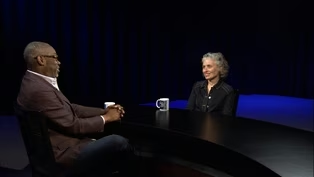
NewA conversation with Kate Levin Markel of the McGregor Fund
Video has Closed Captions
Clip: S54 Ep27 | 14m 43s | We spoke with the outgoing president about the organization’s past, present and future. (14m 43s)
Providing Support for PBS.org
Learn Moreabout PBS online sponsorship New Episode
- News and Public Affairs

Top journalists deliver compelling original analysis of the hour's headlines.

- News and Public Affairs

FRONTLINE is investigative journalism that questions, explains and changes our world.
 New Episode
 New Episode
 New Episode
 New Episode
 New Episode

 New Episode
 New Episode
Support for PBS provided by:
American Black Journal is a local public television program presented by Detroit PBS