
McGregor Fund and philanthropy in Detroit, WCHB radio
Season 54 Episode 27 | 26m 46sVideo has Closed Captions
McGregor Fund president discusses her decision to step down and a look at the history of WCHB radio.
We’ll talk with the president of the McGregor Fund about her decision to make way for new leadership, and we’ll discuss the current state of philanthropy. Plus, as part of our “Destination Detroit” series, we’ll hear about a family that made African American broadcasting history.
Problems playing video? | Closed Captioning Feedback
Problems playing video? | Closed Captioning Feedback
American Black Journal is a local public television program presented by Detroit PBS
McGregor Fund and philanthropy in Detroit, WCHB radio
Season 54 Episode 27 | 26m 46sVideo has Closed Captions
We’ll talk with the president of the McGregor Fund about her decision to make way for new leadership, and we’ll discuss the current state of philanthropy. Plus, as part of our “Destination Detroit” series, we’ll hear about a family that made African American broadcasting history.
Problems playing video? | Closed Captioning Feedback
Where to Watch American Black Journal
American Black Journal is available to stream on pbs.org and the PBS app.
Providing Support for PBS.org
Learn Moreabout PBS online sponsorship- Coming up on "American Black Journal," we're gonna talk with the president of the McGregor Fund about her decision to make way for new leadership, and we'll discuss the current state of philanthropy.
Plus, as part of our "Destination Detroit" series, we'll hear about a family that made African-American broadcasting history.
Stay right there.
"American Black Journal" starts now.
- [Announcer 1] Across our Masco family of companies, our goal is to deliver better living possibilities and make positive changes in the neighborhoods where we live, work, and do business.
Masco, a Michigan company since 1929.
Support also provided by the Cynthia & Edsel Ford Fund for Journalism at Detroit PBS.
- [Announcer 2] The DTE Foundation is a proud sponsor of Detroit PBS.
Through our giving, we are committed to meeting the needs of the communities we serve statewide, to help ensure a bright and thriving future for all.
Learn more at DTEFoundation.com.
- [Announcer 1] Also brought to you by: Nissan Foundation, and viewers like you.
Thank you.
(upbeat music) (upbeat music continues) - Welcome to "American Black Journal."
I'm your host, Stephen Henderson.
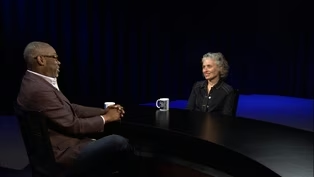
The longtime president of the McGregor Fund has announced she will step down at the end of this year.
Kate Levin Markel has begun her transition from the organization after more than two decades of service.
In her announcement, she said the time is right to create space for new leadership for the fund's next chapter.
I am pleased to have Kate Levin Markel as my guest today to talk about her decision and the future of philanthropy here in our city.
Welcome back to "American Black Journal."
- Thank you, Stephen.
It's so great to be back.
- Yes, it's always great to see you.
I was teasing you a little before we started about, you know, why you think it's okay to leave now, and who told you that that was permissible?
But I do actually want to just express an immense amount of respect for the decision that you're making, and the reason, as I was saying in the open, that you stated, that it's time to create space for new leadership and the future.
And I think far too few people, far too few leaders, think of their responsibility that way.
That's really the most important responsibility of a leader, I think, is to know when it's time to say, "Hey, let's find somebody else."
So I want to congratulate you on that.
- Thank you.
- But I do want to have you talk just a little more about what that means, create space for new leadership and take the foundation into the future.
What do you imagine when you say that?
- Thank you for having me on- - Mm-hm.
- To discuss this topic, which is something I've thought a lot about.
- Yeah.
- And in fact, when I was promoted into this role, I've been at McGregor Fund a very long time, I've been in this role now 11 years, I made a promise to myself that I would stay about 10 years, going in.
Because I really believe being the leader of a foundation is a very unique role.
It's very unique.
There's a lot of privilege that comes with it.
There's a lot of trust.
- Yes.
- Community trust, and there's not much accountability, honestly.
And nobody really tells you it's time to leave.
- Yes.
Right.
- Nobody tells you it's time to leave.
- No one probably feels comfortable saying, "It's time to leave," right?
- That's right.
And it's very hard to objectively measure how good a job I'm doing.
I don't have customers.
- Right.
- I don't need to raise money.
- Right.
(laughs) - I don't have owners.
- Yeah.
Yeah.
- I report to a board, and all the money we use for our operation is already invested in the bank, so to speak.
So there's really very little accountability and feedback.
But it's also very much, in my view, a job that doesn't belong to the person who holds it.
It's an honor.
And in that sense, it's almost like a public trust.
- Yeah.
- So I really believe there are just so many reasons why people might be tempted to stay too long.
I've seen that happen.
I didn't want to be one of those people.
Because I know that you have to limit your own tenure in this role, and there's always opportunity for bringing in new leadership.
- Yeah.
Yeah.
- So it's a unique situation.
- It is.
It is.
And that kind of leads us to where we are in the city now with philanthropy and lots of other things.
You know, I spend time in other cities, sometimes looking at how philanthropy behaves in those communities.
And I've kind of reached the conclusion that this is a special place in that regard, that philanthropy here plays a different role than it does in lots of other cities, and it plays a bigger role, in some ways out of necessity, but also in some ways out of I think a sense of obligation to the community and the need.
So as you sort of transition away from the center of that, I'd love to know what you think about where we are with philanthropic support for and focus on Detroit and Detroiters.
- I have two very complementary but different thoughts about this.
- Mm-hm.
- The first one is that without question, the history of philanthropy in Detroit is uniquely strong.
- Yes.
- And the desire among organized professional philanthropy to work together was very significant as it emerged decades ago.
And this city has faced a lot of challenges for very deep-seated reasons, and I do think there was a kind of consciousness among my predecessors in leading different philanthropies to come together and really put resources on the table to solve very entrenched structural problems, when possible.
- Yes.
- The greatest example, of course, being the bankruptcy.
- Sure.
- So I think we deserve some of that reputation.
I also feel like there is a future for philanthropy which is being modeled more thoroughly in other places where frankly, the wealth is newer.
- [Stephen] Huh.
- And so there are new foundations that are modeling different priorities.
They are being started by donors who have different life experiences and they're more experimental, in some cases.
I also believe that we've a little bit rested on our laurels here in Detroit, and we could be doing more to stay current with what I think the field is learning about how to be most effective.
- Yeah.
- And by that, I mean really centering the community you're there to serve in your larger strategic thinking and in your decision-making and as teachers.
- Yeah.
Wow.
- And that's a culture shift that we're very excited about at the McGregor Fund.
We see it as not only joyful but essential to doing our work well, and that's something our team has worked really hard on, changing our practice in the way we are accountable to community through our partners during my time in the leadership role.
- Yeah.
Yeah.
Last time you were here, we talked about what was going on in the country at the time and the really brutal effects of the changes in Washington on social safety nets and all kinds of quality of life and other kinds of factors in Detroit.
And you were very concerned about the government's role and philanthropy's role in meeting those challenges.
I wonder what you think.
That was about a year ago.
Things are somewhat different, I suppose, but in some ways, not.
I wonder what you think of that now and what you think of the challenge to philanthropy that that represents.
- There's a lot in your question.
As always, Stephen, you ask such thoughtful questions.
Well, first of all, a year ago, at the very beginning of the current federal administration, our partners in the social safety net, nonprofit organizations who support Detroiters- - Yes.
- In myriad ways, were being significantly disrupted in their work where they were receiving federal funds to do what the government had asked them to do- - Yes.
- And contracted with them to do, and then in comes the new administration that decides, "We don't like this work anymore and we're just gonna stop paying for it."
- Right.
- So we were in, we meaning our country, not philanthropy, we were in chaos in that moment.
In some ways, the chaos has been a bit normalized, I'm sorry to say.
- Yeah.
- The funding disruptions to our nonprofit partners continue.
The tactics are multiple.
Some of it is, "We don't like this and we don't want to pay for it."
Some of it is, "We're gonna change the rules in the middle of the game."
Some of it is, "Going forward, we are not going to support this work, even though it's evolved over many years in a very bipartisan consent base way."
- Sure.
- So that still is going on with our partners in their effort to support community in ways that they've been asked to do.
Now we layer on some new challenges.
Coming up toward the end of this year and certainly at the beginning of 2027, individuals are gonna be very directly affected by changes in some of our entitlement programs- - Yes.
- Some of our benefits, which were passed by the Congress- - Yeah.
- A year ago.
Those have not hit yet.
- Right.
- So there's a new wave of pain coming for people with regard to being able to access healthcare and support for food assistance if they're food insecure- - Yeah.
- Due to their economic circumstances.
So we have a, kind of, unfortunately, a new wave of pain coming.
- Right.
- I remain hopeful that we are, as a country, learning what happens, there are consequences to these decisions and elections, and that this will be corrected.
But in the meantime, a lot of damage done to critical safety net infrastructure and it's not gonna stop.
- Yeah.
- So nonprofits are working under extraordinary strain.
There's a lot of very fresh research that documents that strain.
I'm very concerned about the longevity of the workforce of people called to do this work, not for money, not for job security, but because they're passionate about it, and they can't even rely on a paycheck now.
- Right, right.
- It's very discouraging.
It's a terrible job market for young people coming out of college or early in career who want to move into these fields and who can't even find work, let alone what appears to be a secure job path.
- Like sustainable work, yeah.
- That's right.
So the costs of this are going to- - They ripple over time, yeah.
- They ripple out.
Right.
Now I don't think it's all doom and gloom, but we have to, I believe we have to be honest about the harm being done and there are also specific types of harm being done, to particular communities.
In my view, the administration has and continues to weaponize its power to punish people and communities it does not like.
- It doesn't like.
Yeah.
- And that continues.
So we could have a long conversation about different examples of different communities who are being targeted.
Their own safety is involved.
Their legal rights are at risk.
- Yeah.
- And that also requires a kind of escalated response that our nonprofit sector isn't necessarily scaled up to provide, but folks want to do it.
So where does this leave philanthropy, as I said before, and still continue to believe very strongly, we have to just be willing to spend more money and pay for things we don't normally pay for.
- That you wouldn't normally do.
And of course, you're doing that at McGregor.
I mean, you were very swift in saying, "We're we're just gonna do more."
- We were.
- We're running out of time, but quickly, it's an unfair question, but I'm gonna ask it anyway: What's next for you?
- I don't have an answer to that.
(Stephen laughs) I learned- - It's okay not to have an answer.
I just... - I learned from my elders that if you're beginning to think of the next thing, you already have a foot out the door.
- Oh, okay.
- And I don't have a foot out the door.
I am 103%, 120% committed to the work we're doing.
- Yeah.
- Our partners, our team.
And I'll take a little time off and figure out what's next for me.
But it's about the work.
- Yeah.
Yeah.
- And it's work I love.
- I know it will be something important and exciting, so, that's a good enough answer for me for now.
(laughs) - Well, I'll just say this.
I have been so blessed, so blessed to do the work I've been able to do.
- Yeah.
- It has given my life such meaning and this is all through the relationships I have been honored to have with so many Detroiters.
And I'm not ready to walk away from that.
- Yeah.
- And give that up.
- Yeah.
I didn't, I wouldn't think you would.
But it's great to have you here.
And we'll have you here again before you leave.
- Thank you, Stephen.
It's so great to be here.
- Yes.
Coming up next, family members talk about the history and legacy of Detroit Radio Station WCHB.
But first, here's a clip from a 1998 "American Black Journal" conversation with philosopher, author, and political activist Cornel West about the future of Black America.
- Who will help Black America love itself again so that it can trust itself again so that it can do business with itself again so that it can be healthy again?
- Well, I think historically, it has been the Black artists, the great Black preachers, the great Black singers, the great Black painters and so forth.
If you look at Stevie Wonder, Aretha Franklin, or Ray Charles or John Coltrane, they're talking about love supreme, loving ourselves so we can love others.
But love is something very difficult, very daring.
It's wrestling with the darkness.
It's taking a risk, as it were, and it's linked to that courage.
But keeping in mind that that love linked to the hope and the faith is in no way the same as American optimism, because we are a blues people.
And the blues is not about optimism.
It's not about sentimentality.
It's about struggle, how we keep keeping on.
We know we've been down so long, down don't bother us, but we know we still can move toward the up and up, as Curtis Mayfield and other great truth-tellers have put it forward.
And that's part of our tradition.
That's tradition we trying to keep alive in this tent.
- The Detroit PBS "Destination Detroit" series explores the rich histories of the people who have helped shape Southeast Michigan.
Residents were invited to share stories about how their families came to Michigan and the lives that they built here.
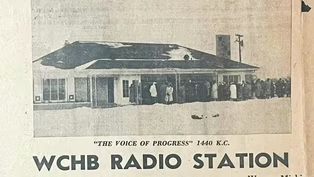
Today, we bring you a conversation from the series with members of the family behind WCHB, the nation's first African-American owned and operated radio station built from the ground up.
(upbeat R&B music) - [Bill] Motown founder Berry Gordy.
His family came to Detroit from Georgia in the 1920s around the same time Dr.
Haley Bell arrived.
- Grandpa Bell came to Detroit in 1923.
He's from Brunswick, Georgia.
He was born in 1895, and Mary Bell, his wife, she was born in Lebanon, Tennessee, which is outside of Nashville, in 1900.
- [Bill] Another Great Migration story.
Annette Bass came to Michigan Central last year to tell us about Bell Broadcasting for our "Destination Detroit" project.
- Grandma Bell said they put three cities in a hat, and one was Texas, I think the third one was West Virginia, and Detroit was second.
So they drew Detroit twice, so they decided to come to Detroit.
- [Bill] Three decades later, Dr.
Bell, a successful dentist, had saved up to build a radio station, partnering with sons-in-law Wendell Cox and Robert Bass.
WCHB 1440 AM's first broadcast, November 7th, 1956.
- What many researchers and historians argue, if there had not been WCHB that launches in 1956, there would not be a Motown Records.
- Coming to you live from WCHB, it's most definitely the Joltin' J-O-E, gettin' down to the nitty in this Detroit city.
- And I can remember Berry Gordy coming over to my house when we lived down Lafayette Park back in the '60s, with two or three, four 45s in his hand, asking my father, Dr.
Bass, "Can you please see if you can get these on the air next week for me?"
- [Bill] If they were airworthy, Eric Bass said WCHB would play them first, before the other Detroit stations would get a chance.
- Dr.
Bell was a dentist.
He set up his dental office in Hamtramck.
Dr.
Cox, my uncle, set up his office down the street, near Holbrook.
My grandfather's office was near Caniff.
And when my father got out of dental school, he set up shop in my grandfather's office also on Joseph Campau.
So all three of them operated there.
Three Black dentists servicing the 90% population of Polish people back in the '50s and '60s.
- [Bill] Doctors Bell, Bass, and Cox owned the first Black-owned radio station in the USA, built from the ground up.
- Then my grandfather, he wanted to be getting into broadcasting, because Detroit's Black population was booming in those days.
It was growing exponentially.
The Great Migration brought a lot of Black people from the South to Detroit, and there was no television, no radio targeting them specifically.
He applied for a FCC license for a building permit to build a station in Detroit to target the Black audience.
He was denied multiple times back in the '50s.
- [Bill] The Federal Communications Commission wouldn't let them in Detroit, but they got the okay in Inkster, west of the city.
Annette Bass's husband, Bobby Bass, along with brother, Eric Bass, became Bell Broadcasting executives.
With few family members left, Annette's trying to preserve the Bell Broadcast legacy.
- I mean, all those are archive boxes down there.
Those are all family members.
I mean, these are files, those are employee files over there.
When my husband passed in 2013, he left me with all this material.
Most of it he inherited from his grandmothers.
- [Bill] WCHB, Detroit Soul Radio.
- [Radio Announcer] WCHB, The Soul of the City.
♪ 1440, WCHB ♪ - [Bill] And it covered the news for the Black audience.
- During '63?
- Yeah, mm-hm.
- Martin Luther King did his first version of "I Have a Dream."
- [Annette] It was two weeks after Medgar Evers was assassinated.
- And they had a march in Detroit, 'cause I remember I got tired of walking.
My dad put me on his shoulders (chuckles) and we walked from like the Boulevard all the way to Jefferson.
That was a long way.
And then after the march, everybody went to Cobo Hall, and that's when he first did his first version of "I Have a Dream."
- [Bill] WCHB, there to put it on the air.
- And so his rural plantation background gradually gave way to urban industrial life.
- Well, this is pretty unique, man.
My grandfather couldn't have pulled this off any other place, in my opinion.
Detroit was a once-in-a-lifetime deal, you know, that's why coming to Detroit, we probably wouldn't have enjoyed this success anywhere else.
- [Bill] WCHB radio talent then, in binders now, 60 years later.
Who are they?
Annette Bass wants to put names to the faces.
- [Annette] I said if anybody recognizes- - [Eric] Knows these people.
- [Annette] Yeah, please write their name down because I have- - [Man] You know who these people are?
- Some of them.
Now check this dude out.
This cat named Robbie D, he was a white jock, obviously, that worked for WCHB back in the '60s.
- [Bill] "Time" magazine featured Mr.
Hip Lip, Robbie D, in 1967.
- [Robbie D Recording] Temptin' Temptations on the WCHB.
Rockin' Robbie D shows what's happening for you.
This is WCHB, Inkster, Michigan, loudly and proudly serving all the greater Detroitland, 1440 minutes a day!
- One of his things was, "Shut your trap, sit on my lap, and inhale my rap, baby."
That was a little- - See, you can't say that now.
- [Eric] Now he was working for a Black-owned and operated radio station in the mid-'60s, man.
This cat was ahead of the times.
- [Bill] Bell Broadcasting put FM station WCHD on the air in 1960.
Not many FM listeners then.
WCHD played jazz, and Annette's late husband, Bobby, helped run the operation, gathering a faithful audience.
- That's why you have to have people who are really locked into that.
That was Bobby's strength.
Bobby really understood jazz music.
- [Bill] There was another jazz station in Connecticut programmed by pianist Dave Brubeck of "Take Five" fame, called WJZZ.
But in the early '70s, it gave up its call letters and Bell Broadcasting took them.
WCHD renamed WJZZ with the station's marketing man, Eric Bass, helping roll out their iconic logo.
- I saw it, I said "Bobby, that's it.
That's the radio station.
That's who we want to be.
That's what we want people to see WJZZ and think about Detroit."
And it was so prolific that when it hit, we said, "We're going to put this on hats, we're going to put it on shirts, we're going to put it on billboards."
- [Radio Announcer] American FM.
WJZZ Detroit.
Jazz, 106.
- [Bill] By the 1980s, jazz radio evolved into smooth jazz with WJZZ on top, recognized nationally for its programming and tie-ins with the likes of concerts at Shane Park and the Montreux-Detroit Jazz Festivals.
- [Annette] That's from '81.
- There was always a smooth jazz show at down at the Fox, a smooth jazz show down at Orchestra Hall, a smooth jazz function here, a smooth jazz function, until the format became, until it didn't generate enough money.
Then they (slaps hands) immediate, overnight, gone.
- [Bill] Radio in transition, Bell Broadcasting forced to adapt.
- So small independently owned families like mine, you had to do one of two things.
You either had to get bigger to compete or they're gonna squeeze you out.
And we hung out, we hung for a long time and competed.
- [Bill] Bell Broadcasting sold its stations in 1998, but the history's still here, with Annette Bass sorting it out.
- This family was very unique.
They were like radio royalty.
That's what I consider them, radio royalty.
- And you can see more "Destination Detroit" stories at detroitpbs.org.
That's gonna do it for us this week.
You can find out more about our guests at americanblackjournal.org, plus connect with us anytime on social media.
Take care and we'll see you next time.
(upbeat music) - [Announcer 1] Across our Masco family of companies, our goal is to deliver better living possibilities and make positive changes in the neighborhoods where we live, work, and do business.
Masco, a Michigan company since 1929.
Support also provided by the Cynthia & Edsel Ford Fund for Journalism at Detroit PBS.
- [Announcer 2] The DTE Foundation is a proud sponsor of Detroit PBS.
Through our giving, we are committed to meeting the needs of the communities we serve statewide to help ensure a bright and thriving future for all.
Learn more at DTEFoundation.com.
- [Announcer 2] Also brought to you by: Nissan Foundation, and viewers like you.
Thank you.
(light piano music)
 New
NewA conversation with Kate Levin Markel of the McGregor Fund
Video has Closed Captions
Clip: S54 Ep27 | 14m 43s | We spoke with the outgoing president about the organization’s past, present and future. (14m 43s)
 New
NewA look into the history of the family who created WCHB radio
Video has Closed Captions
Clip: S54 Ep27 | 8m 8s | Family members talk about the history and legacy of Detroit radio station WCHB. (8m 8s)
Providing Support for PBS.org
Learn Moreabout PBS online sponsorship New Episode
- News and Public Affairs

Top journalists deliver compelling original analysis of the hour's headlines.

- News and Public Affairs

FRONTLINE is investigative journalism that questions, explains and changes our world.
 New Episode
 New Episode
 New Episode
 New Episode
 New Episode
 New Episode
 New Episode
 New Episode
Support for PBS provided by:
American Black Journal is a local public television program presented by Detroit PBS